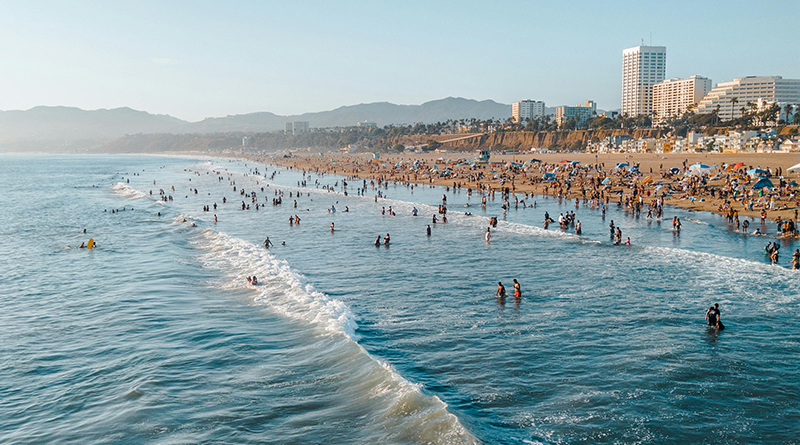
SANTA MONICA — Visitors near the Santa Monica Pier were met with an unusual sight mid-September as the ocean waters appeared tinted pink. The change, however, was not a cause for alarm but rather part of a scientific study aimed at understanding local water circulation and the stability of the pier’s breakwater.
Scientists with the UCLA Coastal Flood Lab and the Bay Foundation released about ten gallons of a harmless chemical dye called rhodamine into the ocean to help track currents. According to an article released by ABC7 Eyewitness News on September 15, Tom Ford, CEO of the Bay Foundation, emphasized that the dye poses no risk. “The dye is absolutely nontoxic. It’s safe for human exposure, as well as wildlife,” he explained.
Researchers noted that the dye helps them visualize how currents move, something that can be difficult to measure with the naked eye. “It’s very hard to see some of those currents. You put the dye in it, we can see that visually,” Ford said in the same report.
Not all beachgoers were impressed by the temporary color change. Santa Monica resident Mona Rifian told ABC7 Eyewitness News that she had hoped for something more dramatic. “I thought it could be maybe a little psychedelic for all of the locals,” she said. “So I was hoping we could see the North Shore turn pink, but I’ll give it a few more minutes, then walk back.”
As the dye drifted northward along the beach, Ford explained that the real insights were being gathered underwater. “We have a lot of instrumentation in the ocean out here that is measuring that dye far more specifically, or better than our naked eye would be able to discern,” he said.
The purpose of the study goes beyond spectacle. According to ABC7 Eyewitness News, the data will help scientists assess water quality and determine whether the pier’s breakwater needs to be adjusted or reinforced. Santa Monica Mayor Lana Negrete underscored the stakes, noting the pier’s vulnerability. “The pier is the heartbeat of this city. Yes, it is at risk of one big wave attacking it and maybe making it not as sturdy,” she said.
Ford added that the pier’s importance extends beyond locals. “Millions of visitors come down here, perhaps for their first time ever seeing the ocean. We want to make sure that that experience persists into the future for decades to come,” he said.
For now, the pink tint has already begun to fade, but the research it represents could help safeguard one of Southern California’s most iconic coastal landmarks.