


Once the boat is already out of the water, taking a broader look at its systems can prevent another haul-out, uncover developing problems and help owners decide where their maintenance dollars matter most.
Getting a boat out of the water takes planning, time and money. Once it is sitting in the yard, however, the reason it came out in the first place should not necessarily be the only thing getting attention.
A scheduled bottom job can expose a damaged transducer. A worn through-hull can raise questions about the valve, hose and fittings attached to it. An aging engine may prompt a larger conversation about whether another repair makes sense or whether the boat is finally ready for a repower.
For Scott Wooden, owner of Specialty Marine in Oxnard, a haul-out is an opportunity to look at the boat as a collection of connected systems rather than a list of isolated repairs.
Before the boat goes back into the water, Wooden recommends inspecting bottom paint, through-hull fittings, trim tabs, power trim and tilt systems, bow thrusters, anodes and transducers, as well as looking for gelcoat or fiberglass damage. Fuel and vent fittings and fuel tanks also deserve attention.
Some of those items may have nothing to do with the original reason for the haul-out, but that is precisely the point. With the hull accessible, problems that are difficult to see or address in the water can be identified before the boat is relaunched.
What deserves attention will also depend on the propulsion system.
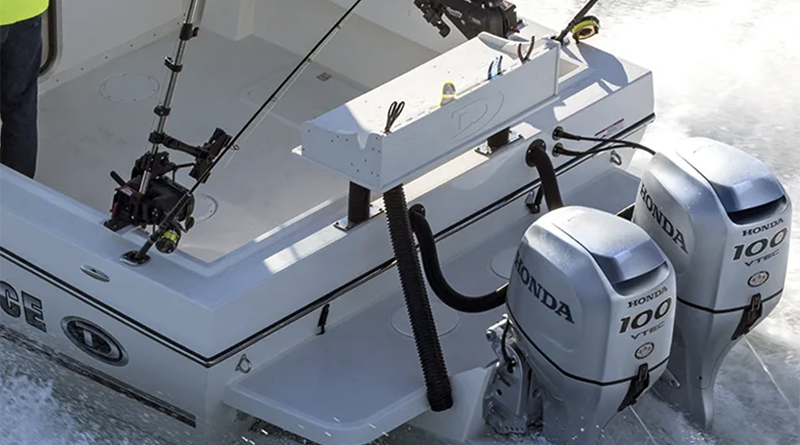
For outboard-powered boats, Wooden recommends looking at the lower units, including gear oil, propellers and propeller shafts, along with anodes, power trim and tilt systems, ground straps and fuel-related components.
On boats with sterndrives, the list includes the drive and gear oil, propellers, propeller shafts, bellows, trim rams, trim tabs, transducers, anodes and ground straps.
Those inspections can reveal problems owners may not realize are developing. Wooden said common discoveries include loose trim tabs, damaged transducers, corrosion affecting power trim and tilt pumps or trim rams, broken through-hull fittings and damaged propellers and related components.
Finding one problem should sometimes lead to a closer look at the rest of the system connected to it.
“We look at systems, and things related to systems are best addressed together,” Wooden said.
A failed through-hull transducer, for example, creates an opportunity to consider whether the replacement should be paired with newer sonar or chartplotter technology. Similarly, a damaged or corroded through-hull should not simply be replaced without assessing the valve, pump, hose or fittings associated with it.
The same approach can help owners distinguish between work that needs to happen immediately and projects that can wait. Safety and seaworthiness come first. From there, related work can be bundled when doing so avoids duplicating labor or another haul-out.
Repowering is a larger decision.
Before recommending that an owner invest in a new engine, Wooden said he starts with several basic questions: Does the owner like the hull configuration? Is the boat the right size? What is its overall condition? Most importantly, does the owner plan to keep it?
Unless a restoration, sentimental value or another consideration is involved, Wooden said an owner should generally expect to keep the boat for several years to justify the investment in a repower.
If the owner likes the boat and intends to continue using it, reliability and safety become major considerations.
“It can be dangerous offshore, so if the boat is not safe and reliable mechanically, they should seriously consider repowering, regardless if it is an outboard or an I/O,” Wooden said.
Repowering does not always mean replacing an old engine with a newer version of the same configuration. Some owners may consider converting a sterndrive boat to outboard power, with efficiency and quieter operation among the factors to evaluate. Regulations can matter as well. Wooden noted that restrictions on two-stroke engines in some bodies of water can make a change in propulsion necessary depending on where a boat is operated.
Age alone, however, is not necessarily a reason to remove an engine that continues to do its job.
“If the existing engine is safe, reliable, non-polluting and performs consistently, then they should continue to use and maintain it regardless of the age,” Wooden said.
When those qualities are no longer present, the calculation changes, particularly when reliability could affect the safety of the people aboard.
Beyond propulsion, a haul-out can also be the right time for upgrades that would otherwise require difficult or expensive in-water work. Through-hulls, transducers, trim systems, propellers and other below-the-waterline equipment are obvious candidates because access is substantially easier while the hull is dry.
That does not mean every available upgrade belongs on the work order.
For owners working within a limited budget, Wooden recommends separating safety needs from improvements that would simply be nice to have. Cosmetic and entertainment upgrades may be more noticeable, but less visible components can be far more important to the boat.
“The vessel must be solidly seaworthy, and it is not very sexy to have unseen items such as through-hulls repaired when you never see them,” Wooden said. “A new sound system is a lot more fun, but does not keep the boat afloat.”
That priority list should ideally be established before the boat arrives.
Wooden recommends removing as much unnecessary gear from the boat as possible. Clearing work areas gives technicians room to access equipment and reduces the possibility of personal belongings being lost or damaged while the vessel is in the yard.
Owners should also be clear about what they expect the yard to accomplish.
Boatyards schedule labor and other resources based partly on the anticipated scope of a project. Adding several unplanned jobs after the boat arrives can affect that schedule, particularly when the additional work requires different technicians, parts or equipment.
That does not mean an owner should ignore a legitimate problem discovered during the haul-out. Unexpected repairs are part of boat ownership. The distinction is between responding to something the yard finds and arriving with an incomplete plan, then continually adding projects that could have been discussed beforehand.
A little preparation can make the difference between taking advantage of a haul-out and allowing one project to grow unnecessarily.
The boat does not need to leave the yard with every possible upgrade. It does need to leave seaworthy.
Once the hull is exposed and the boat is already accessible, the practical approach is to inspect what normally cannot be seen, address safety concerns first, look at related components as systems and consider whether another repair or upgrade makes sense before the boat goes back into the water.
The speakers can wait. The through-hull cannot.