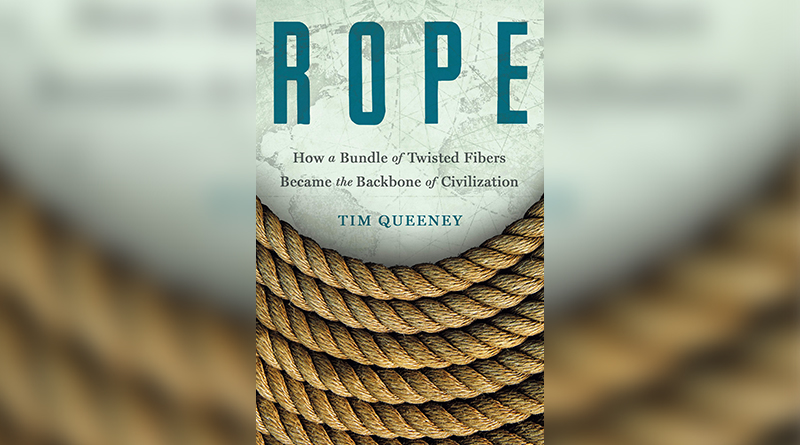
St. Martin’s Press, New York
by Bill Morris
Tim Queeney, former editor of Ocean Navigator magazine, has penned in a single volume what is no doubt, in any language, the most exhaustive study of rope — from its humble beginnings in antiquity to the high-tech strands we use today.
Queeney uses a fun, storytelling style to relate the gradual evolution of ropemaking, starting with the work of ancient hominins 50,000 years ago to the high-tensile polymer and alloy strands used in the manufacture of rope today. Blending historical events and the everyday lives of ropemakers and users over the millennia, with the gradual evolution of ever-stronger and weather-resistant twisted fibers, Queeney shows us how cordage has played a major role in virtually every aspect of life, from simple string for binding and fishing, to hanging and lynching, record-keeping, clothing, boat building, sails and rigging, and most recently, space exploration.
To open his discussion, the author describes the earliest known fragments of thin rope, which were used by Neanderthals to bind flakes of flint to wooden handles to form the earliest known axes and other cutting tools. These implements, essential to hunting and food preparation, were bound by fibers joined and twisted together, following the same logical pattern we use today: three sets of fibers, each bound with an S twist, then a Z twist to bring the three strands together, forming a rope.
The importance of rope in human society grew to embrace virtually every aspect of life, including, of course, boat building and handling. The ancient Egyptians, Queeney explains, used rope to bind lengthy pieces of wood in shipbuilding long before iron nails and hammers were invented. Ironically, these early vessels shared the advantage of a lack of rust, owing to the rope-bound planks on their hulls.
The advantage of rope for the early Egyptians was not only seen in the ships they deployed on the Mediterranean and Red Seas. Over 4,000 years ago, the Egyptians built pyramids by stacking 2 1/2-ton blocks of limestone, a feat, says Queeney, that could not possibly have been undertaken without the use of long lengths of rope to pull them up an incline. In 2004, coils of rope 4,000 years old were found in a cave in Mersa Gawasis on Egypt’s Red Sea coast, providing substantial evidence for Queeney’s theory. In the photo included in Queeney’s book, the long coils of rope look identical to what you find in your local hardware store today.
The author also explains how, until the development of nylon and Dacron polyester, hemp and manila fibers were the only materials available for mountain climbing, spelunking, sail rigging and anchoring, and countless other applications. Hemp fibers are strong and rot-resistant, while manila rope offers a slight bit more stretch, which made it safer than hemp for mountain climbers before the advent of nylon.
From ancient wooden ships to modern motorboats and sailboats, rope, in its many types, sizes, and weaves, has been an indispensable tool for all boaters. Before the age of steam and diesel engines, Queeney explains, rope could be employed to pull a ship where there was no wind with a technique called “warping.” By dropping a large rowboat in the water with a team of rowers, the small craft, towing the ship’s anchor, could be rowed several hundred feet forward of the ship, where the anchor was set so crew at the ship’s bow could turn the windlass, hauling in rope and pulling the ship forward.
Rope is used in modern boat construction as well. Wood-planked boats are caulked with rope made of oakum, a “fibrous material of intertwined strands” separated from hemp, Queeney explains. The oakum rope is driven tightly into the space between two hull planks, so when the hull is returned to the water, the wooden planks swell, squeezing the oakum so tightly that water cannot pass through the seams.
Another type of rope-making material Queeney covers is metal fiber, which continues to play an important role in boating, particularly sailing. The first metallic ship rigging was made of stretched iron fibers coiled in the same manner as traditional rope. Today, sailors use stainless steel wire and rope to support masts and haul up sails.
Queeney also provides an extensive overview of modern polymers, from the oldest, which is nylon, through Dacron polyester, Kevlar and other synthetics used in boat construction, sails, yacht cordage, clothing and other uses. He points out how polyester and more recently, “Twaron, Technora, Spectra, Dyneema, Vectran, and Xylon,” are much stronger than nylon. Most of these, as we sailors know, are also highly sought after for standing and running rigging on modern sailing vessels.
The author’s unique style of relating the origins and modern applications of rope in its many forms is grounded in his decades of writing and editing in the boating genre. His ability to transform what may appear to some as a dry subject into a fascinating narrative is a rare talent that keeps us readers informed and engaged. He mixes chemistry and engineering with healthy doses of humor, impelling us to read further, marking the pages for further review.
Queeney served for many years as editor of the former Ocean Navigator, a magazine dedicated primarily to offshore sailing, and he continues to teach celestial navigation for budding offshore sailors. He also continues to pen articles and books at his home in Cape Elizabeth, Maine, and we can certainly look forward to more of his fine work in the future.