Illegal, Unreported, and Unregulated (IUU) fishing remains a persistent and growing threat to marine biodiversity, sustainable fisheries, and global food security. Approximately 11 to 26 million tons of fish, 15 to 30% of the global catch, are taken illegally or without reporting each year. This haul is valued between $10 billion and $23.5 billion annually.

At the core of the issue are three overlapping categories that define IUU fishing. Illegal fishing involves operations without licenses, the use of banned gear, or fishing in closed zones. Unreported fishing refers to failure to report or deliberate misreporting of catch data. Unregulated fishing occurs in unmanaged areas and often targets vulnerable species.
These categories rarely operate in isolation. Rogue vessels often engage in all three: sneaking into restricted areas, disabling tracking transponders, and falsifying their catch. The result is a chaotic and damaging free-for-all on the high seas.
The consequences aren’t just ecological. IUU fishing disproportionately targets high-value, vulnerable species like Patagonian toothfish, bluefin tuna, and sharks, which undermines science-based quotas and sustainable harvests. The use of destructive gear such as bottom trawls, fine mesh nets, and unmonitored longlines accelerates damage by tearing up coral reefs and seagrass beds, vital habitats that took millennia to form.
The economic ripple effect is equally severe. IUU fishing fuels a black market that undercuts legitimate fisheries, eroding livelihoods in coastal communities that rely on regulated, small-scale operations. Those playing by the rules are left at a disadvantage, while governments lose vital revenue needed to fund oversight and enforcement.
Even data, the foundation of smart fisheries management, suffers. When illegal and unreported hauls go untracked, stock assessments become skewed, turning quota-setting into a guessing game. The perception of weak enforcement only compounds the problem, leading law-abiding fishers to question whether it’s worth staying honest.
Despite the challenges, there’s growing momentum to fight back. Governments, non-government organizations (NGOs), and conservation tech leaders are advancing a toolbox of coordinated solutions. The Port State Measures Agreement (PSMA), which entered into force in 2016 and now includes over 80 countries including the U.S., empowers port authorities to turn away vessels suspected of IUU activity unless they can prove compliance.
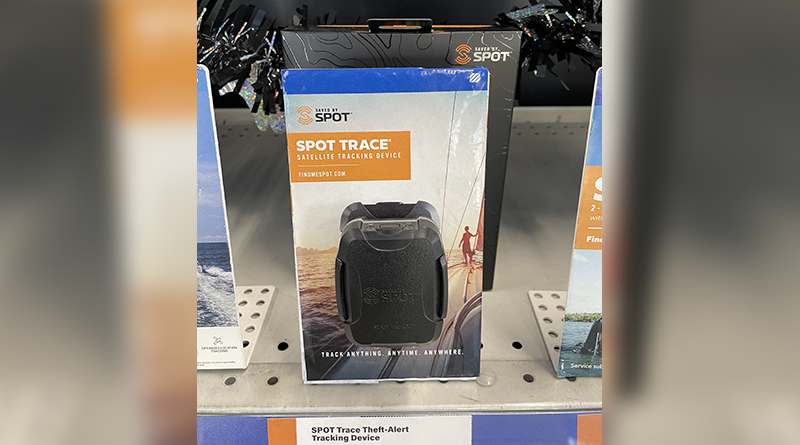
Technology is proving a game-changer. Automatic Identification Systems (AIS) and Vessel Monitoring Systems (VMS) allow global tracking of vessel movements. Tools like Global Fishing Watch and Skylight analyze this data to flag suspicious behavior, such as when ships “go dark” near marine protected areas.
Meanwhile, the supply chain is under new scrutiny. Certification programs like the Marine Stewardship Council (MSC) and the U.S. Seafood Import Monitoring Program (SIMP) demand traceability for key species, making it harder for poachers to launder their catch through legitimate markets.
This fight is especially urgent in California, which boasts over 840 miles of biologically rich coastline and one of the most advanced fisheries enforcement regimes in the country. The California Department of Fish and Wildlife (CDFW) Law Enforcement Division coordinates land, sea, and air patrols across both state and federal waters. Electronic catch documentation is mandatory for commercial fisheries, and enforcement officers don’t hesitate to prosecute violators who falsify records or fish out of season.
Federal partners such as NOAA Fisheries and the U.S. Coast Guard play a critical role, particularly at major ports like Los Angeles/Long Beach and San Diego, where strict SIMP enforcement ensures imported seafood complies with U.S. standards.
While illegal fishing doesn’t always make the front page, California’s enforcement records show how persistent and creative violators can be. In recent years, agencies have uncovered a string of high-profile violations — each underscoring the scale of the threat and the importance of maintaining an aggressive enforcement presence.
For example, take the red abalone poaching incident in Mendocino County in 2025. Despite the species being off-limits since 2018, poachers were caught harvesting them during coordinated low tide enforcement patrols.
In another case from 2023, wardens in Dana Point Harbor apprehended suspects using untagged hoop nets to exceed legal lobster catch limits. Violations included taking undersized and berried lobsters, the latter being critical to the species’ reproduction and recovery.
On August 1, the California Department of Fish and Wildlife (CDFW) shared an enforcement update on its Facebook page. The incident is an example of IUU fishing — Illegal, Unreported, and Unregulated fishing. In this case, illegally poaching lobster constitutes illegal fishing because it violates fisheries laws or regulations, such as closed seasons, size limits, quotas, or licensing requirements established by the governing authority.
The Facebook post read:
“CDFW wildlife officers were on coastal patrol the night of Aug. 1 when, at around 11 p.m., they spotted lights and suspicious activity near Royal Palms Beach in the San Pedro neighborhood of Los Angeles.
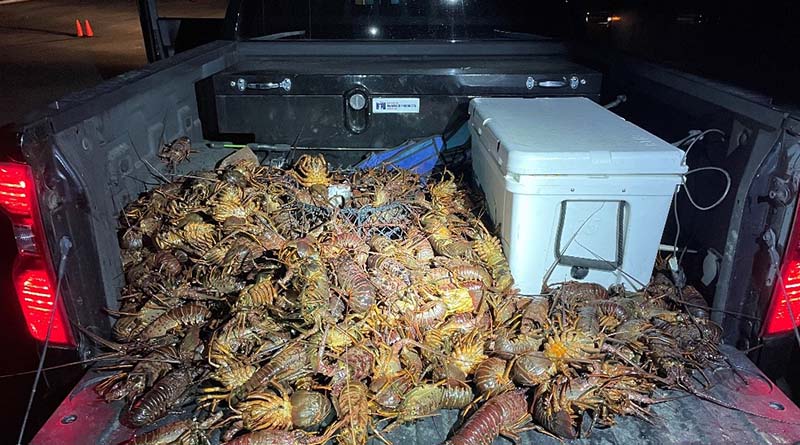
The officers observed four individuals in wetsuits and diving gear actively taking spiny lobsters and returning to shore throughout the night. Both the recreational and commercial spiny lobster season in Southern California had closed months before in March. At about 3 a.m., the suspects left the area. Wildlife officers initiated contact and the suspects attempted to flee on foot. A short search led to the suspects who were apprehended without further incident. Here’s what the wildlife officers found in the back of their truck:
236 spiny lobsters taken during the closed season, 210 of which were undersized
No fishing licenses
No required measuring devices
During the open lobster season, the possession limit is seven per person with a minimum size of 3 and ¼ inches measured in a straight line on the back from the rear edge of the eye socket to the rear edge of the body shell. Fortunately, most of the poached lobsters were still alive and were safely returned back into the ocean after a quick count and photographs for evidence. All four individuals were cited for multiple misdemeanor violations, including:
• Taking lobster during the closed season
• Possessing undersized lobster
• Commercialization without a license
• No fishing license
• No measuring device
See something serious? Report it and help protect California’s fish and wildlife. You can:
• Call CalTIP at (888) 334-2258 – available 24/7
• Text “CALTIP” + your message to 847411 (tip411).
• Download the CalTIP app from Apple’s App Store or Google Play to send tips anonymously.”
The problem isn’t limited to shellfish. In 2020, a CDFW sting in San Francisco Bay dismantled a poaching network targeting white sturgeon, a species with slow growth and limited reproduction. Poachers were using illegal gillnets and falsifying records to smuggle the fish and its roe as black-market caviar.
Pot tampering is another form of fisheries theft, as seen in a 2021 Monterey Bay case where fishers raided competitors’ crab pots. Undercover surveillance led to fines and license suspensions, reinforcing that theft between legal operators is also a violation of both the law and the sustainability ethic.
Even technological loopholes are exploited. In 2019, a vessel operating near Point Dume disabled its AIS system and failed to report its catch while deploying illegal gillnets just outside a marine protected area. Thanks to satellite and aerial tracking, officers impounded the vessel and felony charges were filed.
Then there’s the lesser-known but equally profitable market for sea cucumbers. In 2017, southern California authorities intercepted traffickers hauling illegal shipments bound for overseas markets, revealing a black-market operation worth tens of thousands of dollars.
Beyond enforcement, science-based nonprofits amplify the state’s efforts. Oceana California campaigns for mandatory AIS tracking on all commercial vessels, not just large ones. Heal the Bay supports expansion of marine protected areas and mobilizes citizen scientists to monitor water quality and marine life. The Environmental Defense Center pushes for legal reforms in high-risk fisheries and more transparent reporting.
But this fight isn’t just for governments and NGOs. Consumers have power, too. Choosing certified seafood, such as products marked with the MSC label or those listed as a “Best Choice” by Seafood Watch, pressures the supply chain toward traceability and responsibility. If you’re at the local grocer or in a restaurant, asking where your fish comes from is one small gesture to turn the tide against IUU fishing.
And if you spot something shady? Speak up. California’s confidential CalTIP hotline (1-888-334-2258) has helped crack down on everything from trophy fish poaching to industrial-scale fraud.
The scale of IUU fishing is daunting, but it’s not insurmountable. With new tech and rising transparency, the rules are being rewritten. International agreements like the PSMA are tightening port controls. Domestic agencies like CDFW, NOAA, and the Coast Guard are stepping up patrols. And perhaps most importantly, more people are paying attention.
California’s experience proves that with a balanced mix of regulation, innovation, enforcement, and public engagement, we can fight back. Our oceans feed us, employ us, and protect us. And they deserve the same in return.
Conservation, in the end, isn’t just about fish. It’s about fairness, food security, and upholding the principle that those who follow the rules shouldn’t be punished by those who don’t. With vigilance, transparency, and cooperation, we can turn the tide on illegal fishing and keep the sea’s bounty alive for generations to come.