Just a few weeks ago, The Log declared that the summer bites were yellow, highlighting the outstanding yellowtail fishing taking place from Ventura to San Diego.
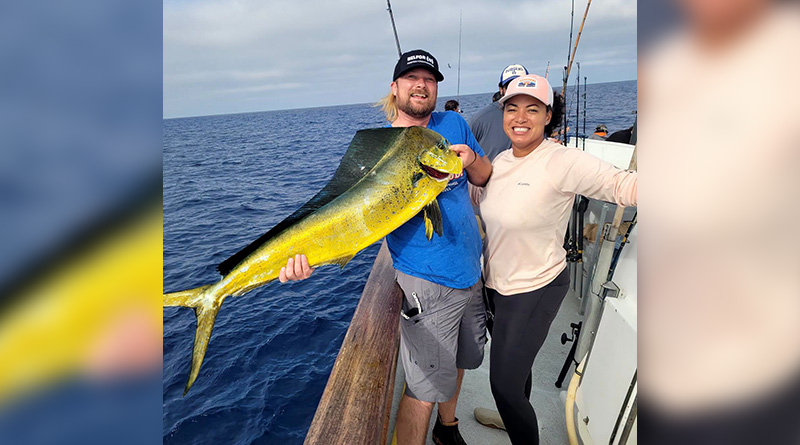
A colorful dorado was landed aboard the Western Pride during a recent half-day trip out of Newport Beach, a reminder that warm-water species are already making an appearance and that this summer could offer excellent offshore fishing opportunities. Photo courtesy of Davey’s Locker.
Well, it’s time for an update.
The summer bites are officially turning from yellow to yellow, blue and green.
Dorado have entered the chat.
From Newport Beach to San Diego, anglers are beginning to see one of the ocean’s most colorful visitors making its annual appearance. Davey’s Locker recently reported a dorado caught aboard the Western Pride during a half-day trip, while boats farther south have been posting impressive catches of dorado alongside yellowtail, bluefin tuna and even yellowfin tuna.
For many anglers, the first bright flash of “green and gold” sliding over the rail marks the true beginning of Southern California’s offshore season. It’s the kind of catch that instantly changes the mood on deck. Cameras come out, anglers gather around for photos, and suddenly everyone starts looking a little harder at the next kelp paddy drifting across the horizon.
The last truly memorable dorado bite occurred in 2022, when unusually warm water pushed large schools of mahi-mahi within range of Southern California’s sport boats and private boaters. Decks were stained red after nonstop action, and fish holds filled with brilliant yellow, green, and blue fish that looked more like something from the tropics than from waters just a few dozen miles off the California coast.
With El Niño once again warming local waters, recent fish counts suggest those exciting days may be making a return.
Known as dorado, mahi-mahi or dolphinfish, these fast-growing pelagic predators typically roam offshore waters 15 to 100 miles from shore. Their shimmering iridescent colors seem almost unreal, shifting between electric blue, metallic green and brilliant gold depending on the angle of the sunlight. Even after they’re landed, many continue to flash vibrant colors for several minutes, making them one of the most photogenic fish in the ocean.
Male dorado, commonly called bull dorado, are easily identified by their large squared-off forehead. Females have a much more rounded head profile and are generally smaller, although both are capable of blistering runs and spectacular aerial displays.
Their beauty is only matched by their attitude.
Once hooked, dorado rarely stay in the water for long. They leap repeatedly, shake their heads violently and make lightning-fast direction changes that keep anglers scrambling around the deck. Their explosive strikes, colorful appearance and willingness to bite make them one of the most exciting species available to Southern California anglers during warm-water years.
Unlike some offshore species that can be notoriously picky, dorado are aggressive predators. They often patrol beneath floating kelp paddies, debris and other offshore structure, waiting to ambush passing baitfish. Finding the right kelp paddy can quickly turn a quiet day into a wide-open bite.
According to Dana Wharf Sportfishing, anglers heading offshore should make live bait their first choice when targeting dorado.
An angler proudly displays a vibrant dorado caught aboard the Producer, where recent offshore trips have been producing excellent action on dorado along with steady catches of yellowtail and bluefin tuna. Photo courtesy of H&M Landing Facebook page.
Dana Wharf Sportfishing: Tackle & Technique for Dorado
According to Dana Wharf Sportfishing, sardines and small mackerel remain the most productive live baits for dorado. Private boaters are encouraged to spend a little extra time catching live mackerel before heading offshore, as having a few healthy mackerel in the bait tank can pay dividends once productive kelp paddies are located.
Hook size should match the bait. Dana Wharf recommends 1/0 to 4/0 hooks, or even 5/0 hooks for larger mackerel. Sardines fish well on size 1 to 3/0 hooks, while anglers using anchovies should downsize even further to size 2 or 4 hooks.
Circle hooks are an excellent option because they typically pin the fish in the corner of the mouth, helping keep the line away from the fish’s teeth. Traditional J-hooks, however, continue to produce excellent results as well.
One mistake many anglers make is fishing too small of a bait. Dana Wharf notes that dorado have enormous mouths and will aggressively attack surprisingly large offerings. Even relatively small mahi will attempt to swallow a full-sized mackerel.
For tackle, Dana Wharf recommends fishing 15- to 30-pound line paired with a fluorocarbon leader of equal strength. The fluorocarbon provides additional abrasion resistance while still presenting the bait naturally.
Once hooked, anglers should keep steady pressure on the fish without overpowering it. Dorado are famous for repeated jumps and violent head shakes, making a properly adjusted drag and a high rod tip essential for keeping the hook buttoned up throughout the fight.
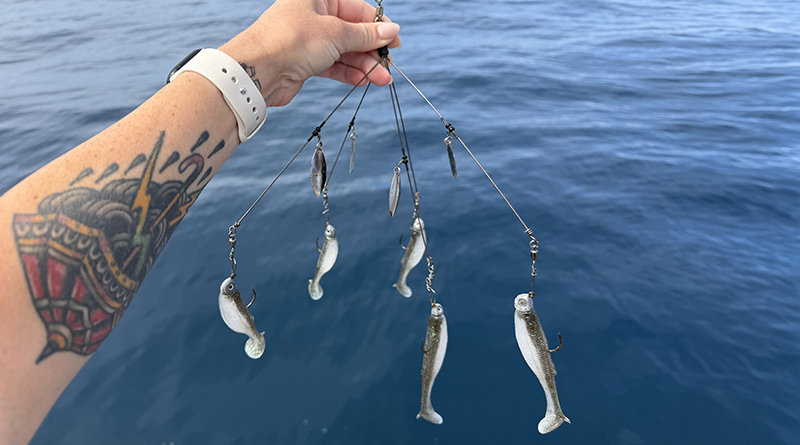
Artificial lures can also be extremely effective. Surface irons and poppers often produce explosive strikes, although Dana Wharf cautions that airborne dorado have a habit of throwing heavy metal lures during their acrobatic leaps. Green and pink trolling lures remain classic dorado colors, while smaller tuna feathers and slow-trolled live mackerel around kelp paddies can also produce excellent action.
According to Dana Wharf Sportfishing, dorado are the complete package: they grow incredibly fast, fight hard, display spectacular colors and are exceptional table fare, making them one of the most anticipated warm-water visitors each summer.
Crew members aboard the Grande display an impressive offshore catch that included bluefin tuna, yellowtail, yellowfin tuna and dorado, highlighting the diverse warm-water fishing opportunities currently available off Southern California. Photo courtesy of H&M Landing Facebook page.
The arrival of dorado comes at a time when yellowtail fishing continues to produce throughout Southern California. Long considered one of the region’s premier game fish, yellowtail remain a favorite among local anglers thanks to their brute strength and relentless determination to reach the nearest kelp stringer, reef or rocky structure once hooked.
Whether it’s a school-sized 8- to 12-pound “firecracker” or a mossback pushing 40 pounds, yellowtail continue to deliver some of the hardest-fighting action available close to home. Their versatility also keeps anglers guessing. On any given day they might be found breezing under birds, cruising beneath kelp paddies, staging along offshore banks or patrolling island reefs.
Bluefin tuna have also maintained their remarkable run, with boats continuing to post fish from overnight and multi-day trips. Several recent reports have even included yellowfin tuna, another encouraging sign that warmer water continues to push tropical species farther north.
Taken together, it creates an offshore fishery that rivals anything seen in recent years.
It’s not often that anglers have realistic opportunities to catch yellowtail, bluefin tuna, yellowfin tuna and dorado during the same stretch of the season, yet that is exactly what Southern California’s offshore fleet is beginning to experience.
For anglers who have been waiting all year for offshore conditions to hit their stride, this may be the time to fuel the boat, stock the bait tank and keep a close eye on the latest fish counts.
After all, few things compare to watching a bright green-and-gold dorado explode on a bait beside a floating kelp paddy before launching itself skyward in a shower of spray.
The summer bites may have started out yellow.
Now they’re yellow, blue, and green.
And if the current fish counts are any indication, Southern California’s offshore season is only getting started.