State health officials cite changing domoic acid levels as California updates recreational and commercial fishing regulations.
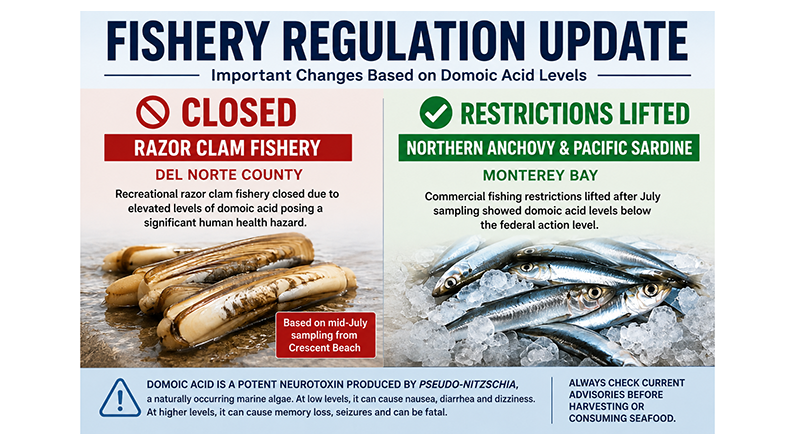
The California Department of Fish and Wildlife (CDFW) has announced two changes to California fisheries following updated testing for domoic acid, closing the recreational razor clam fishery in Del Norte County while lifting commercial harvest restrictions on northern anchovy and Pacific sardine in Monterey Bay.
CDFW Acting Director Valerie Termini ordered the closure of the recreational razor fishery after state health agencies determined that razor clams collected from Crescent Beach in Del Norte County contained domoic acid levels exceeding the federal action threshold for human consumption.
The closure follows sampling conducted in mid-July and is intended to protect public health from exposure to the naturally occurring marine toxin.
Domoic acid is produced by Pseudo-nitzschia, a type of naturally occurring marine algae that periodically blooms along the California coast. While fish and shellfish can accumulate the toxin without showing signs of illness, people who consume contaminated seafood may experience symptoms ranging from nausea, diarrhea and dizziness to short-term memory loss, seizures and, in severe cases, death.
While the Del Norte closure affects Northern California, Southern California boaters and anglers are no strangers to domoic acid advisories. Harmful algal blooms have periodically affected fisheries along the state’s coastline in recent years, underscoring the importance of checking current health advisories before harvesting shellfish or consuming locally caught seafood.
At the same time, CDFW announced that commercial fishing restrictions on northern anchovy and Pacific sardine harvested in Monterey Bay for human consumption have been lifted. Recent sampling found domoic acid concentrations in both species had fallen below federal action levels, allowing commercial harvest to resume.
The agency noted that these actions illustrate the dynamic nature of California’s marine ecosystem, where harmful algal bloom conditions can change rapidly and affect different fisheries in different regions of the state.
Meanwhile, the recreational razor clam fishery in neighboring Humboldt County remains closed due to elevated domoic acid levels. That closure has been in place since May 2024 and will remain in effect until state health officials determine the shellfish are once again safe for consumption.
CDFW said it will continue working with the California Department of Public Health and the Office of Environmental Health Hazard Assessment to monitor domoic acid levels through ongoing sampling and testing.
Anglers and shellfish harvesters can find current fishery closures and health advisories on CDFW’s website or by calling the department’s Domoic Acid Fishery Information Line at (831) 649-2883. The California Department of Public Health also maintains a Biotoxin Information Line for the latest seafood consumption advisories at (800) 553-4133.