Slip Scamper: Boaters report that the annual “slip scamper” wasn’t as difficult this spring as it was last year. Slip scamper is the sort of race to reserve a good slip for all or most of the summer before they’re all filled up. Prime summering-over marinas are found in La Cruz, Puerto Vallarta, La Paz, Puerto Escondido, Topolobampo, Guaymas, San Carlos, Puerto Peñasco and Ensenada.
Evidently more than the average number of cruising sailboats and motor yachts opted to vacate the lower latitudes before the approach of hurricane season 2025, thus leaving more slips available for boaters who want to summer over in Mexican waters.
As of July 25, many U.S. and Canadian boaters on the marine radio nets report they are presently finishing up their Baja Bash and returning to home waters. But on a recent trip down to Ensenada, my husband John Rains noticed that quite a few returners are now berthed in Ensenada for all or part of the summer. Why stop here?
ENSENADA
Ensenada lies at latitude 31°50’ North, well north of where recorded hurricanes roam, so theoretically at least, Ensenada does qualify as a hurricane hole. And this latitude satisfies most yacht insurance requirements.
The three main marinas in Ensenada are Hotel Marina Coral (inside its own breakwater 2.75 n.m. north of Ensenada Harbor), Ensenada Cruiseport Village Marina located within the cruise ship moles in the middle of Ensenada Harbor, and Marina Baja Naval, the smaller marina tucked in just northeast of the cruise ship moles. Naval is pronounced na-VAHL.
See photo: Captain Jeff Stansfield of Ventura registers his 43’ Passport “Joy” with Victor Garcia, head of Marina Baja Naval’s customer service.
Ensenada’s floating fuel docks lie inside Marina Coral and Cruiseport Village, while boat repair yards with Travelifts are found at Marina Baja Naval and Gran Peninsula Marine Center, located on the harbor’s north end.
Both these boat yards also offer long-term dry storage, so summering over in Ensenada – either in or out of the water – can be a comfortable and economical option. The harbor’s busy container port is about to move out to El Sauzal, a fishing port five n.m. north; that will improve the main harbor’s ambiance for tourism. Passenger ferry service to and from San Diego is supposed to start in December, 2028, so stay tuned.
EXIT STRATEGY
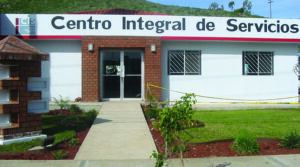
But if you’re homeward bound instead, all recreational boaters exiting Mexico are legally required to stop in Ensenada, the last “port of call” for northbound vessels, to officially clear out of the country by visiting the CIS office. See photo. While clearing out, skippers receive a unique document called a Zarpe, or exit paper. This is one of the many documents U.S. Customs agents expect to see from all vessels entering the U.S.
My experience in previous years is that U.S. Customs boarding agents have not always asked to see our Zarpe from Mexico. But 2025 is not a normal year. Given all the recently heightened attention to immigration, border security and especially to people arriving from Mexico, I think it’s best for boaters to stop in Ensenada and get their Zarpe.
Ensenada’s CIS office building is located on the busy main highway coming into town, called Avenida Teniente Jose Azueta. The 1-story red brick and white stucco building is only one block north of the harbor’s northernmost corner. It sits directly across the street from Arjona marine store and next door to a port building labeled Secretaria de Marina and Capitania de Puerto. CIS stands for Central Integral de Servicios. Inside (see photo) are five service windows for all the agencies you’ll need to clear in or out of Mexico. Have all your papers ready and start at the window for INM or Immigration.

WINDOW FARTHER SOUTH
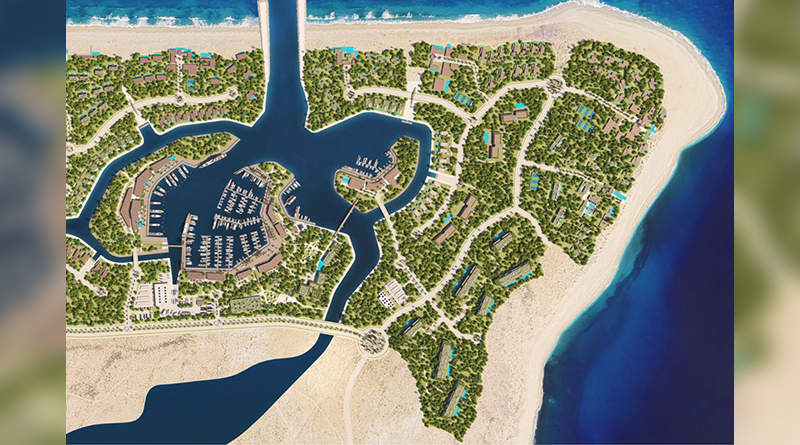
Another new marina is envisioned in Mexico, this one to be carved into the dramatic white sand point called Punta Arena de la Ventana – better known to Sea of Cortez boaters as La Ventana, meaning The Window – located about 50 n.m. southeast from La Paz. See diagram.
Peninsula of Dreams S.A. de CV proposes to dredge out a 446-slip interior yacht basin with stone breakwaters and an entrance channel connected to the sea, according to David Flores of The Gringo Gazette. The complex would include 7,000 hotel rooms, 7,000 residences, an airstrip, beach clubs, golf courses, soccer fields, schools, parks, worker housing, three desalination plants, a wastewater treatment plant, roads, and electrical systems, all on 8,700 acres that cover most of the white sandy point.
According to the developer’s environmental impact report, the desal plants would extract 14.5 million gallons of seawater per day and generate about 8 million gallons of brine daily, to be discharged 300 meters offshore at depths over 20 meters.
However, this dreamy development is being opposed by several hundred local panguero fishermen and a local research group ORGCAS, a nonprofit founded by six women, marine biologists, lawyers, researchers, and educators. ORGCAS says it collaborates with coastal communities in Baja California Sur to protect marine ecosystems while supporting local livelihoods.
Although SEMARNAT authorized the marina complex in 2016, ORGCAS argues that the permit for the marina and desalination plants should be revoked due to their threat to the region’s rich biodiversity and to the many communities that depend on the area’s natural resources.
ORGCAS believes SEMARNAT didn’t understand the long-range problems. “They believe desalination is a magic solution. But there’s no clear plan for brine management,” ORGCAS’s scientific coordinator, Frida Lara, told the The Gringo Gazette. “It also consumes huge amounts of energy in a region dependent on polluting fuel oil.”
La Ventana Point pokes out into the Cerralvo Channel, an area of strong currents that attract diverse marine species, some recorded as blue, gray, humpback, orca, fin and pygmy sperm whales. Cerralvo Channel is a breeding ground and hunting-training area for these mammals.
Pangueros involved in the dispute live in the surrounding villages of Agua Amarga, El Sargento, La Ventana, Los Planes, Boca del Álamo, and El Cardonal. But their pangas have been fenced out of the property and they hesitate to speak in fear of reprisals.
Have you ever anchored or fished along La Ventana’s white sand beach? Or have you ever anchored in Bahia de los Muertos six miles south of there? If they build it, I will include it in my guidebook “Mexico Boating Guide.” But meanwhile, please let me know what you think about a new marina there by contacting me at [email protected]