How the Thing Meant to Save Your Gelcoat Is Secretly Out to Destroy It
By: Katherine Clements (who’s absolutely never done this before)
There’s no piece of boating equipment more loyal, more dependable, and more tragically misunderstood than the humble fender.
Fenders exist for one noble purpose: to keep your boat from grinding its beautiful gelcoat or fresh paint into a dock like a block of Parmesan on a cheese grater. They are the unsung heroes of marina life, dutifully hanging between fiberglass and wood, absorbing the sins of poor docking angles and overconfident approaches.
And yet, despite this noble mission, fenders have quietly become one of the leading causes of cosmetic damage on recreational boats.
How? Simple.
Picture this.
You’ve just fueled up. Or loaded bait. Or maybe you’re late for the bite and the radio chatter says the fish are foaming a mile outside the harbor. Adrenaline rises. Lines come off in record time. Engines into gear. You smoothly glide away from the dock like a seasoned pro.
You feel accomplished. Efficient. Nautically impressive.
And then, about 200 yards later, you hear it.
Thump. Thump. Thump. Thump.
You look back.
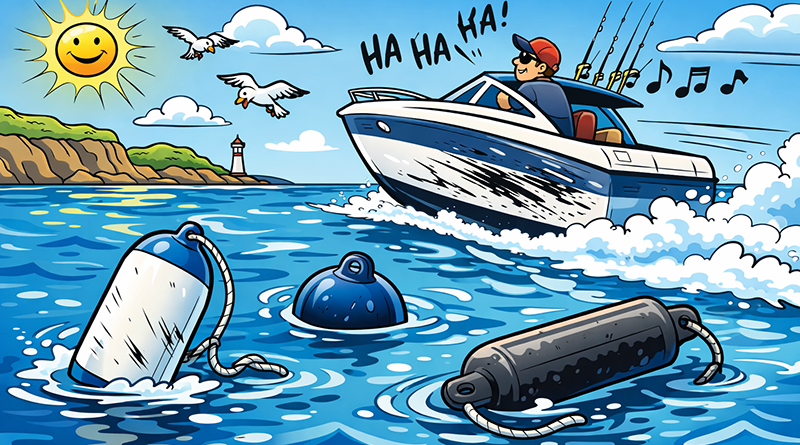
Your fenders — still heroically tied to the rail — are now being towed at 12 knots like oversized blue sea mines, repeatedly slamming into the side of your hull with the enthusiasm of a toddler with a drum set.
Or worse.
They are not there at all.
Gone.
Somewhere between the fuel dock and the harbor entrance, they slipped their lines and now float aimlessly, waiting to be adopted by another boater who will say, “Hey, free fender.”
The irony is breathtaking.
The very object designed to protect your paint has now either:
- A) Beaten it senseless at cruising speed
B) Escaped entirely
C) Left black scuff marks down the side of your boat that no amount of compound will ever fully erase
This phenomenon is so common, it should be listed in the owner’s manual under “Inevitable Events” — right after, “You WILL forget to put the drain plug in at least once.”
Fenders, you see, are not the problem. It’s the boater’s deep and unwavering belief that once the boat leaves the dock, the fenders will magically handle themselves.
They will not.
They’ll trail. They’ll bang. They will swing wildly into your gelcoat like a pendulum of regret. They’ll wedge themselves between the hull and rub rail and carve artistic, permanent arcs into your finish.
And if you do remember to pull them in, you’ll inevitably toss them onto the deck where they’ll roll around underfoot like inflatable bowling balls for the rest of the trip.
Because nothing says “professional mariner” like tripping over your own fender while trying to gaff a fish.
But the true masterpiece of the fender paradox happens at the bait dock.
You arrive. You deploy the fenders with pride. Perfect spacing. Textbook seamanship. You load bait. You untie. You leave in a hurry because everyone else is leaving in a hurry.
You forget the fenders.
You notice three minutes later.
You circle back sheepishly while five other boats judge you in silence.
This is boating.
The fender isn’t just a tool. It’s a test of character. A psychological exercise. A mirror reflecting our greatest maritime flaw: impatience.
And so the lesson is simple.
The next time you leave the dock in a rush, remember:
The fender isn’t your enemy.
But if you forget about it for even 30 seconds, it absolutely will be.