Why buying $120 worth of surface irons doesn’t automatically qualify you to throw one.
By: Innocent Bystander on Deck
There are certain moments on a Southern California sport boat that instantly unite complete strangers.
The captain yelling, “Fresh one!”
Someone hooking a yellowtail on their first cast.
The unmistakable sound of a backlash so catastrophic it deserves its own Coast Guard incident report.
And then there’s the one everyone recognizes immediately. And that’s the guy with $120 worth of brand-new surface irons walking toward the corner of the boat.
You know exactly who he is.
He was at Hogan’s Sporting Goods the night before because someone told him yellowtail were boiling on surface iron.
“Which one should I buy?” he asked.
The answer, apparently, was “all of them.”
Mint. Blue and white. Mint and white. Sardine. Bird poop. Scrambled egg. Dorado. Chrome. Glow. If it had paint on it and a treble hook hanging off the back, it somehow found its way into his shopping basket.
He walked out convinced he’d just purchased success.
Unfortunately, nowhere during that shopping trip did anyone ask the most important question.
“Can you throw one?”
Now, before anyone starts pointing fingers, this isn’t his fault.
Surface irons have a way of making fishing look deceptively easy.
Watch someone who’s been doing it for twenty years; it almost seems effortless. The rod loads, the jig sails halfway to Catalina, lands as soft as a feather, and immediately begins that hypnotic side-to-side wobble that somehow convinces yellowtail to make terrible life decisions.
It looks so simple that every newcomer thinks, “I can do that.”
What they don’t realize is they’re watching the product of several thousand casts, countless donated jigs, and more than a few embarrassing moments they’d rather forget.
Our hero hasn’t reached that chapter yet.
The morning starts quietly enough. People are fly-lining sardines. Somebody is already asleep on the bait tank. Another guy is explaining to anyone within earshot that he “had limits yesterday.”
Then it happens.
A deckhand points toward a foamer.
“Fresh one! Surface iron!”
The boat instantly transforms.
Veterans are already reaching for rods that have been rigged since they left the dock. They’re clipping on irons with the speed of a NASCAR pit crew.
Meanwhile, our guy remembers he owns approximately eighteen pounds of polished metal.
He opens his tackle bag.
The next thirty seconds resemble someone trying to untangle Christmas lights while riding a mechanical bull.
Every surface iron has somehow hooked another surface iron. One is attached to a sweatshirt. Another has found the zipper. A third appears to have permanently embedded itself in the tackle tray.
Finally, after enough clanging to wake the sea lions, he emerges holding what was almost certainly the most expensive jig Hogan’s had in stock.
Because if you’re going to make your first overhead cast, you might as well risk the premium model.
Then comes the knot.
Every experienced angler notices it.
Nobody says anything.
The knot has the general appearance of something tied by a six-year-old trying to secure a Christmas present with dental floss. It vaguely resembles a San Diego Jam Knot if you’ve only ever heard one described over a bad cell phone connection.
The deckhand glances at it.
Looks away.
Looks back again.
You can almost hear him thinking, Well…we’re about to learn something.
Then our hero begins the walk.
If you’ve spent enough time on sport boats, you know this walk.
It’s amazing how thirty complete strangers suddenly become emotionally invested in another person’s cast.
Conversations stop.
People instinctively take one small step backward.
One deckhand casually moves the gaff out of the way.
The veteran surface-iron fishermen give him room, not because they’re polite, but because they’ve developed an excellent understanding of the danger zone surrounding a first-time overhead caster.
He reaches the corner.
Plants his feet.
Stares toward the yellowtail foaming a hundred feet away.
This is it.
He takes a deep breath.
The jig swings behind him.
Further.
Further.
One old-timer quietly mutters, “That’s far enough.”
It was, in fact, not far enough.
Instead of allowing the rod to load naturally, he attempts to personally throw across the entire Pacific Ocean.
Every muscle in his body contributes.
His shoulders.
His back.
His knees.
Muscles modern science hasn’t even named yet.
The rod bends.
The jig accelerates.
The entire boat watches.
For one glorious second, everyone thinks he might actually pull it off.
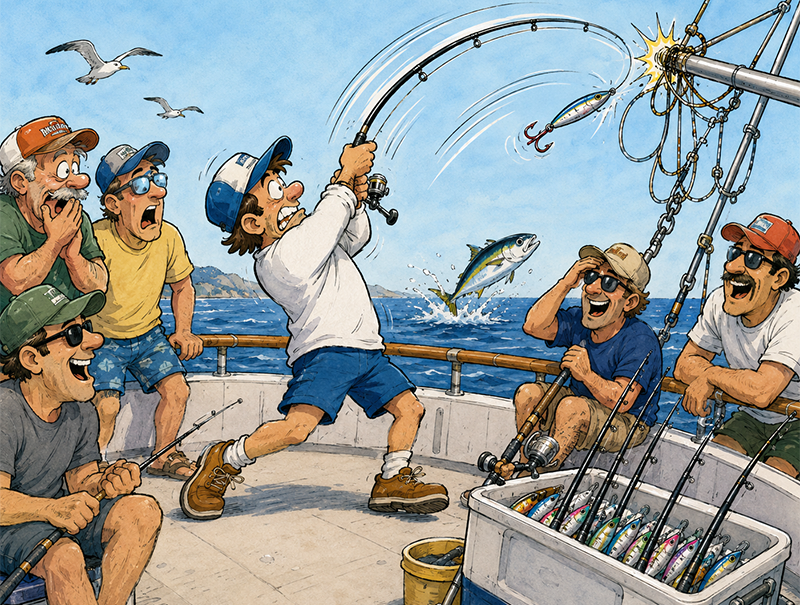
Then the jig leaves the rod tip at approximately a 70-degree angle.
Straight up.
It climbs higher than the gulls.
Higher than the radar.
If there had been air traffic over Dana Point that morning, someone would have filed paperwork.
Every head tilts upward.
The captain leans out of the wheelhouse.
Nobody says a word.
They’re all tracking it.
Gravity eventually remembers it has responsibilities.
The jig begins falling back toward Earth.
Not toward the ocean.
Toward the boat.
It threads itself through enough rigging to qualify as modern art before finally coming to rest hanging from the outrigger.
Silence.
The deckhand sighs.
“I’ll get it.”
Our hero gives the rod one determined tug.
This is where the knot, having seen enough, decides it no longer wishes to participate.
It simply lets go.
The jig launches free from the rigging like a missile, whistles across the stern, narrowly misses somebody’s coffee, clears two trolling rods and disappears forever into the Pacific Ocean.
One hundred and twenty dollars’ worth of surface irons.
And somehow the very first one is already gone.
“I think my knot slipped,” he says.
No.
It retired.
Here’s the funny part.
Nobody laughs at him.
Not really.
Because every single experienced surface-iron fisherman on that boat has been exactly where he is.
Every one of them once thought buying the right jig was the secret.
Every one of them tied knots they were convinced would hold forever.
Every one of them has accidentally donated expensive tackle to Poseidon for reasons they’d rather not discuss.
The difference is that somebody eventually showed them how to do it correctly.
One of the deckhands walks over, cuts off what’s left of the knot and quietly ties a proper San Diego Jam. Then he spends a few minutes explaining that the secret to an overhead cast isn’t brute force. The rod does the work. You simply let it.
The next cast goes about thirty feet.
The one after that reaches forty.
By the end of the afternoon, one finally sails cleanly across the water, lands softly beyond the edge of the foamer and starts swimming exactly the way a surface iron should.
The deckhand smiles.
“There you go.”
No standing ovation.
No yellowtail.
Just one good cast.
But every veteran on the boat knows exactly what just happened.
They’ve witnessed the moment someone stopped trying to throw a jig…and started learning how to fish one.
So yes, by all means, stop by Hogan’s Sporting Goods and buy that new surface iron. Buy two. Buy six. Support your local tackle shop.
Just remember that the most valuable thing on the boat isn’t the shiny jig tied to the end of your line.
It’s the deckhand standing nearby who can teach you how to make sure it actually reaches the water.