How to tie line for dummies like me. Sometimes the cheapest fishing lesson costs you an hour and a half of your life and the temper tantrum of a 2-year-old (I’m 34).
The other day, I found myself standing in my garage with a brand-new spool of fishing line, a spinning reel, and what I assumed would be a quick 10-minute project. I thought to myself, “I’d love to get this done on my own and prove to myself that I can hold my own against the others in the angling world.”
Ninety minutes later, I had learned two new knots, questioned every decision that led me to buying my own line, and was one minor inconvenience away from launching the entire reel across the driveway.
The good news? I can now tie a uni knot and an inverted uni knot like I’ve been doing it for years.
The bad news? None of that mattered if the line wasn’t going onto the reel correctly.
Somehow I had managed to create a masterpiece where only half the spool filled with line while the other half sat completely empty. It looked less like a professionally spooled reel and more like a middle-school science project.
As it turns out, there is actually a right way to do this.
The first mistake many anglers make happens before the line ever touches the reel.
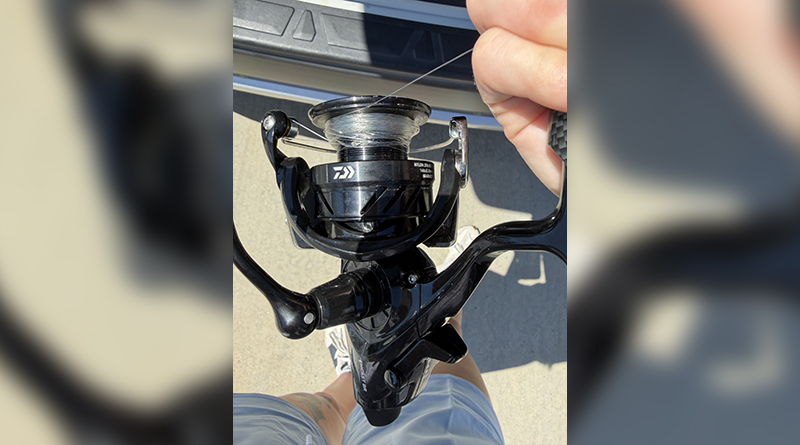
Start by running the line through the first guide on your rod (if your reel is attached to your rod). Then, and this is the step everyone forgets at least once, open the bail. If you tie your knot before opening the bail, congratulations. You’re about to cut it off and start over.
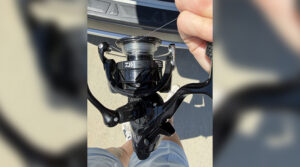
Next, wrap the line around the spool.
While an arbor knot has been the longtime standard, many anglers now prefer the inverted, uni knot because it cinches down so the knot lays flat against the spool instead of leaving a bulky bump. That low-profile connection helps the line load more evenly and keeps the knot from sticking up beneath the first wraps of line.
Once the knot is snug, trim the tag end, close the bail and begin reeling.
Now comes the part that had me talking to myself in the garage.
For most spinning reels, the line should come off the manufacturer’s spool counterclockwise as you wind it onto your reel. Matching the direction the line comes off the filler spool with the direction it goes onto the reel greatly reduces line twist. If you start reeling and immediately notice loops or coils forming, simply flip the filler spool over and continue.
Keep steady tension on the line while reeling. Pinch it lightly with your fingers or use a soft cloth to keep it packed tightly and evenly across the spool.
If the line begins piling up on only the top or bottom of the reel, that’s usually a reel setup issue involving spacers or shims. But if only half the spool seems to be filling because the line is laying unevenly while you’re loading it, stop and check your spool orientation, tension and whether the line is feeding smoothly.

Fill the spool until the line sits about one-eighth of an inch below the lip. Overfill it — and you’ll be dealing with wind knots; Underfill it — and you’ll lose casting distance.
After all of this, I finally understood the process.
I also came to another realization.
For less than six bucks, Hogan’s can do it in about three minutes.
So yes, I now know how to tie an inverted uni knot. I know why the line has to come off the filler spool in the correct direction. I know how to avoid line twist. And, I know how full the spool should be.
Will I spool my own reels again?
Maybe.
Or maybe I’ll save myself an hour and a half, keep my sanity intact, and let the folks at Hogan’s spool the reel for less than six bucks. That gives me plenty of time to do what I apparently do best: grab a copy of The Log and reread my current favorite article, “The Summer Bites Are Yellow,” convince myself I need just one pack of hookup baits (and somehow walk out with four), a new Hogan’s T-shirt, and a lighter wallet. At that point, I might be the one who needs to call the AFTCO Angler Hotline. Sometimes the smartest knot you tie is the one that gets you into the tackle shop.