By: Eric Colby
One thing boaters learn quickly is that, with the exception of personal watercraft, boats don’t have brakes. If a captain wants to hold a vessel in one spot, it takes an anchor, sometimes more than one.
But there’s more to it than just picking up an anchor at a yard sale, attaching a line to it and tossing it over the side. The key to having the right anchor aboard is choosing one based on the boat’s size, the sea state in which it’s going to be used and the type of bottom on which it’ll be used.
“The anchor type depends on the bottom you’re going in, sand, rock, grass,” said Tom Dessel, president at Coast Marine in Newport Beach, CA. “The size depends on weight of the boat, and you also need to take into account the space available on the bow of the boat.”
There are as many as eight different types of anchors available for most pleasureboats, including power and sail. The most popular type of anchor for most boats is known as a fluke anchor, which many people refer to as a Danforth. It stows flat, which is a bonus on most family or fishing boats where space is always a concern. When deployed, this type of anchor holds well in mud or sand, even in a current. It can work in a rocky setting, but it’s not the best application. The fluke anchor has a good holding power-to-weight ratio. Fortress makes a lightweight aluminum fluke anchor available in a range of sizes.
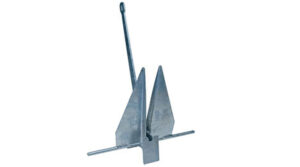
Image courtesy of West Marine
Plow and scoop anchors, including names like Manson Supreme, Rocna, CQR, Delta and Claw probably have the best all-around holding ability in varying bottom conditions. They can often reset themselves if the wind or current changes direction and newer “scoop” designs are equipped with round bars that self-right the anchor, turning it right-side up.
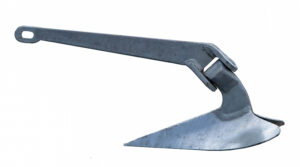
Image courtesy of west marine
Use a plow/scoop anchor to hold a boat in place in grass, mud or sand. These anchors don’t have the wide flukes, but their design makes them more awkward to deploy by hand. The plow/scoop is better for use with a bow-roller or windlass and heavier powerboats and sailboats often have one of these as their primary anchor.
Claw anchors are prized because they set easily and hold in most conditions, but they don’t work as well in clay or heavy grass bottoms.
Smaller vessels like personal watercraft or skiffs often come with a mushroom anchor. These are small and often finished with a PVC coating, making them easier to stow in an onboard compartment.
Other anchor styles include grapnel, navy, and shallow-water poles that are basically spikes that you drive into the bottom to secure a line.
Once the type of anchor is selected, it’s time to choose a weight. An anchor’s weight is based on the type, the size of the boat, and where the boat is used. West Marine, Lewmar, and Fortress all have charts to arrive at the right decision. The majority of anchors come in stainless-steel, aluminum, and galvanized steel. To give an example, a 9-pound Delta anchor is recommended for a boat in the 20-foot range. For a 40-foot boat, the anchor size moves up to about 35 pounds. A 9-pound Danforth anchor is rated for a 27-foot boat.
One term that’s frequently tossed about with anchors is “holding power.” When an anchor penetrates the seabed, suction created by the bottom material and the weight of the material on the anchor creates resistance. Obviously, in rocky bottoms, the anchors or flukes can’t dig in, so they grab onto appendages, which can be precarious. The holding power of modern anchors varies between 10 and 200 times the anchor’s weight.
The line used to deploy an anchor is called a “rode” and the length of the rode used in an anchoring situation is called the “scope.” The scope refers to the length of the rode in relation to the distance of the boat’s bow to the bottom. Do some research to determine the correct scope for anchoring your boat.
A Helping Hand
To make anchoring easier and save the backs of boatowner and crew, many boats have a windlass, which is basically a winch that lowers the anchor into the water and then retrieves it with the push of a button. On boats that most readers of The Log would be familiar with, a windlass is battery-powered, while windlasses on large yachts are sometimes hydraulic.
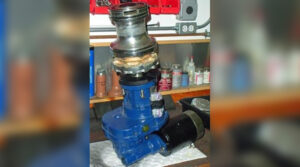
Becoming proficient using a windlass takes practice. To lower the anchor, the user shouldn’t just hold the button and let it free-fall to the bottom. “Most windlasses release 75 feet of chain per minute,” said Dessel. “Look at your watch, pay attention. Chain counters are nice, but you need to reset them and calibrate every time you let the windlass out.”
When retrieving the anchor, one needs to do so carefully, easing off the “up” button when the anchor is getting close to the roller or bowsprit where it rests. Slamming the windlass into the roller creates a shock load that can crack or break the metal keys that connect the driveshaft to the gearbox. Get the anchor close to home and then use a rope to snug the anchor tight.
When it comes to maintaining a windlass, Dessel says bad seals are the biggest contributor to problems that allow water to get into the machinery’s inner workings. To keep the interior components lubricated, windlasses either have oil or grease. “When you get water intrusion, the grease gets liquefied,” he said.
Vertical windlasses need more service than horizontal units because the former is all facing upward. Water from washing down the deck, rain or spray when running can get under the chain wheel. The seal under the deck plate needs to be checked frequently because if it dries and cracks, it can let in water.
In windlasses that are lubricated by oil, they are usually about 75% full. If water gets in, when the drive gear starts moving, the water and lubricant get pressurized. It will work its way past the compromised seal and the windlass could run out of oil. The water and oil could also migrate into the motor and saturate the fuel coils, which run hot.
When the windlass is not operating, reach in and feel around the motor. If your hand comes out with water and oil, it’s a sign that the gears are going bad.
Maxwell windlasses have a sight glass where an owner can check the fluid level, which is supposed to be about 50%. If the fluid looks murky, there’s water in it. If this happens, the whole windlass may need to be disassembled and rebuilt, which can cost from $850 to $1,650.
To stay ahead of maintenance, Dessel recommends replacing deck seals every two years. He also stressed the importance of selecting the correct sized rode for a given boat and windlass. For example, a 35-foot boat should use a 5/6” chain.
A windlass can be installed as an aftermarket accessory, but it can be a complicated, expensive process. Start by examining the section of the bow where the windlass will be installed. When it’s not in use, the anchor should lay flat and be secure. There also needs to be room for the batteries that power the windlass and the cables. These devices draw some serious voltage and the cabling needs to safely carry that power to the windlass.
Dessel said that he’s installed a windlass on boats as small as 18 feet. For a typical 24- to 28-foot boat, the cost is going to include the windlass, about 200 feet of rope rode, and 50 feet of chain. Add in the chain and the cabling and the cost for the windlass and equipment is around $3,000. The installation typically takes about six to eight hours at $175 per hour.