As recreational boaters explore ways to reduce their environmental footprint — like those featured in the accompanying article, “Eco-Friendly Boating for Cleaner Water Ahead” — California’s ports are also taking major steps toward cleaner operations. In that same spirit of sustainability, the Port of Hueneme recently marked a key milestone on its journey to becoming the first zero-emissions port in the country. On July 16, port officials unveiled their second STAX Engineering emissions capture and control barge, expanding their clean air efforts and reinforcing their role as a leader in maritime sustainability.
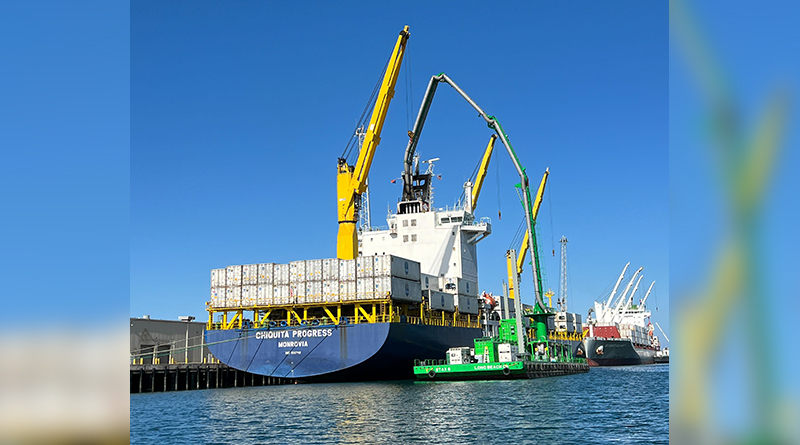
Known as STAX 6, the new barge joins its twin at Hueneme’s commercial terminals, making the port one of only a few in California to operate this kind of advanced technology at every terminal it serves. The system connects to vessels while they’re docked, pulling emissions straight from their exhaust stacks and scrubbing them clean before anything hits the air.
“STAX removes 99% of particulate matter (PM) and 95% of nitrogen oxides (NOx), two pollutants which can cause smog and contribute to respiratory issues,” said Zach Baliva, PIO & Director of Communications for The Port of Hueneme. “The barges connect a long, flexible system to a vessel’s smokestack via a 250-foot crane.”
Rather than requiring ships to undergo costly retrofits, STAX barges hook directly to a vessel’s exhaust pipe while it’s at berth. The emissions are then funneled into an onboard system that filters out harmful substances. It’s a mobile solution that works with a variety of vessels — especially valuable for ports like Hueneme that border residential neighborhoods and agricultural communities.
According to Baliva, “We use the STAX barges for both container vessels and now RORO vessels. Usage depends on ship schedules and safely maneuvering vessels in/out of port, but we have been actively deploying both barges all week.”
“For us, being a community-serving port means taking sustainability seriously,” said Jess Ramirez, President of the Oxnard Harbor District Board of Commissioners in a news release. “That’s why we continue to lead with innovation and invest in technologies like STAX that deliver real, measurable results.”
As the port expanded from one STAX barge to two, lessons learned from the initial deployment shaped its operational strategy. “We learned a lot about scheduling, safety, and logistics so we can safely and efficiently operate two STAX barges within our small harbor without causing bottlenecks or delays,” Baliva explained. “Our deployment here will have benefits for technology improvements and advancements to best utilize the system in different operating conditions. Congestion-free gates are critical to an operating port known for speed and customer service and we’re pleased to deploy two STAX barges without causing negative impacts to these factors.”
The launch event drew attention from local media outlets like KCLU and KYET, who interviewed port leaders, elected officials, and clean air advocates before touring the new barge. The STAX unveiling was just one part of a larger demonstration of the port’s ZE30 roadmap — its strategic plan to reach zero-emissions operations by the end of the decade.
Now that both terminals are equipped with STAX barges, the Port expects measurable results in local air quality. “We take local air quality very seriously and have installed our own air quality monitors in various locations,” said Baliva. “Now that both terminals are implementing STAX technology, we expect to capture hundreds of tons of PM and NOx per year. Doubling down on our partnership with STAX will significantly increase our emissions mitigation capacity as we continue to move this and other sustainable efforts forward.”
That roadmap includes not only emissions capture but also shoreside power, electrification of cargo-handling equipment, and new systems for air quality management. According to Kristin Decas, CEO of the Port of Hueneme, the port’s commitment to reducing emissions isn’t just about environmental compliance — it’s about building a port that works for both commerce and community.
“Commerce and sustainability can go together, and we’re proving that at the Port of Hueneme,” said Decas in the news release. “We’re safeguarding our role as a vital trade hub while protecting the health of our neighbors.”
Baliva emphasized that the STAX barges are just one element of a broader and evolving sustainability strategy. “The STAX barges, while not ZE, are an essential part of the Port’s broader emissions reduction efforts under our One More Step to 2030 push as part of our PHRESH (Port of Hueneme Reducing Emissions Supporting Health) campaign. STAX barges help us reduce air pollution from at-berth ships while we pursue additional electrification and green measures. We now have almost $200 in funding to revamp our infrastructure and ensure electrification and clean energy are the foundation for all we do to move cargo at Hueneme.”
The STAX milestone also ties into broader efforts happening up and down the Southern California coast. In Los Angeles and Long Beach, ports are investing in electric and hybrid ferry technology, renewable fuels, and zero-emission excursion vessels. San Diego is continuing its leadership in environmental certification programs like Green Marine, maintaining top scores in emissions control, waste management, and community impact categories.
Together, these steps show that ports and boaters alike have opportunities to help make local waterways cleaner. While large-scale infrastructure like STAX barges grab headlines, individual actions — like switching to non-toxic cleaners, installing solar panels, or using electronic safety flares — contribute to the same goal.
For more information on the Port of Hueneme’s ZE30 roadmap, STAX barge technology, and its role as one of California’s Green Marine–certified ports, visit portofh.org.