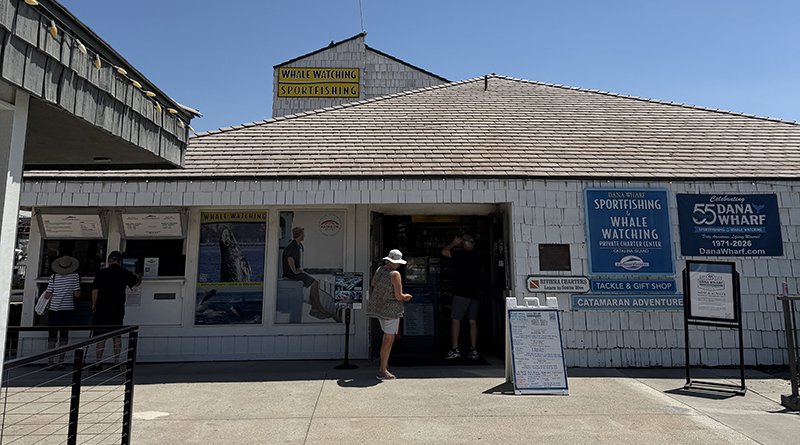
As construction reshapes the landside harbor, Dana Wharf Sportfishing & Whale Watching, Catalina Express and other waterfront operators are modifying how they do business to keep fishing trips, whale watching, Catalina transportation and recreational boating moving.
DANA POINT — Dana Point Harbor is changing, but the reason many people come here in the first place is not going anywhere.
As the harbor prepares to enter Phase 4 of its sweeping revitalization project this fall, the transition will become increasingly visible. Familiar buildings will close, businesses will move, demolition will begin and portions of the commercial core will look very different from the Dana Point Harbor generations of Southern Californians have known.
Yet beyond the construction fencing, some of the harbor’s most fundamental operations will continue doing what they have done for decades: getting people onto the water.
Dana Wharf Sportfishing & Whale Watching and Catalina Express will remain open throughout construction, temporarily shifting their landside operations into trailers near the new Dana Point Harbor parking structure. Fishing trips, whale watching excursions, private charters and ferry service to Catalina Island are expected to continue without interruption.
For a harbor built around access to the Pacific, keeping those operations moving is significant. Dana Wharf and Catalina Express are more than individual businesses occupying commercial space. They’re among the engines that bring people into Dana Point Harbor, introducing visitors to offshore fishing, whale watching and Catalina Island while generating the foot traffic that supports the broader waterfront community.
Their decision to adapt rather than suspend operations means that even as the harbor undergoes its face-lift, visitors will still be able to arrive with a fishing rod, binoculars or a suitcase and head for the water.
For Dana Wharf co-owner Donna Kalez, one message is particularly important as construction approaches.
“We’re not going to be closed even for a day,” Kalez said.
That distinction matters as neighboring restaurants and retailers prepare for a much different construction experience.
Dana Wharf’s operation is uniquely tied to its fleet. The company cannot simply pack up and reopen somewhere else for the duration of construction.
“There’s no location that I could go to with 11 boats,” Kalez said. “It’s not like we can just move across the street while the construction is being done and then move back. We just can’t do that.”
Instead, the company is adapting around the work.
Dana Wharf and Catalina Express will use temporary check-in offices near the parking structure. Customers will report to the trailers and then be directed or escorted to their vessels. Dana Wharf also plans to operate a smaller retail area and maintain space associated with its private charter business.
Kalez expects Dana Wharf to work from the temporary facilities for approximately 15 months, although the construction schedule could change.
The arrangement may be temporary, but for Dana Wharf, there is something remarkably familiar about it.
When the family business began operating in 1971, Dana Point Harbor itself was still being built. Dana Wharf worked from a trailer while construction took place around it, selling tickets and sending passengers to boats even before the harbor as locals now recognize it was complete.
More than five decades later, history is repeating itself.
“We’re full circle,” Kalez said. “We were in a trailer before the harbor finished. We were able to operate in a trailer, take people out on the boat, and everything was being built around us while we were in our trailer.”
It’s an irony she never expected to experience.
“I never ever thought in a million years that we would be back in trailers,” Kalez said.
There is another connection to those early days. Kalez’s father, Dana Wharf founder Don Hansen, and longtime harbor businessman Bob Mardian, owner of Wind & Sea Restaurant, signed their leases on the same day, Kalez said. Mardian had to wait for his restaurant building to be completed, while the nature of Dana Wharf’s operation allowed the company to get started.
“All we needed to do was sell that ticket and send the people on their way,” Kalez said.
That same basic formula will help keep the business operating through another period of construction more than 55 years later.
For Dana Point, the continuity has implications beyond the ticket counter.
Sportfishing boats and whale watching vessels create a steady exchange between the harbor and the ocean. Passengers arrive early, grab coffee or breakfast, park their cars, purchase tackle and supplies, spend hours offshore and often return to the harbor looking for a meal or somewhere to continue their day. Catalina Express passengers similarly use Dana Point as a gateway to the island, bringing another stream of visitors through the harbor.
Maintaining those activities during redevelopment helps ensure Dana Point Harbor remains an active waterfront rather than simply a construction zone.
They also preserve something less measurable: the harbor’s identity.
Dana Point is not only a collection of restaurants, shops and new buildings. Its character is rooted in boating, fishing, sailing, marine education and access to the sea. The businesses and organizations that continue operating during construction will help maintain that connection while the physical harbor changes around them.
Across the harbor, Capt. Dave’s Dana Point Dolphin and Whale Watching Safari will remain open, as will the Ocean Institute, Pure Watersports, Dana Point Yacht Club, Dana West Yacht Club and Aventura Sailing Association.
Important public boating and waterfront facilities also will remain accessible. The boardwalk, Baby Beach, Dana Point Fishing Pier, Embarcadero, launch ramp, fuel dock and bait barge are all expected to stay open during construction.
The Dana Point Harbor Certified Farmers Market will continue each Wednesday from its new location near the parking structure.
Together, those operations mean there will still be plenty happening in Dana Point Harbor even as portions of the commercial area transition into the next phase of redevelopment.
For visitors, however, the experience may require a little more patience and a willingness to adjust familiar routines. Check-in locations may move, pedestrian routes may look different and construction activity will become part of the harbor landscape for a time.
The businesses staying open are adjusting their own routines for the same reason: to make sure customers can continue enjoying the harbor.
“Our customers mean everything to us, and we go above and beyond to make sure that they can access everything and not have any interruption,” Kalez said.
That commitment will become increasingly important after this special edition publishes Aug. 28.
Wind & Sea Restaurant is scheduled to close Sept. 15 ahead of demolition. Other remaining Wharf businesses, including Art Sea Gift Chateau, Frisby Cellars, Golden Galleon Boutique, Turk’s, Coco Bloom Coffee, Top Brass, Proud Mary’s, and Vintage Yacht Club, are expected to remain open through Oct. 31.
The approaching closures make this a particularly bittersweet period for longtime harbor businesses.
Kalez said watching neighboring businesses prepare to leave has been difficult.
“It’s very excruciating,” she said. “It’s really interesting for me. It’s very sad.”
For residents and visitors who want to support the Dana Point business community during the transition, the options extend beyond the construction area.
Just across Golden Lantern is Dana Marina Plaza, where restaurants, retailers and service businesses aren’t impacted by the harbor revitalization project. Kalez encourages harbor visitors to make the short walk across the street and patronize those businesses as well.
That support could become an important part of navigating the next chapter of Dana Point Harbor.
Major waterfront redevelopment inevitably comes with disruption. Buildings can be replaced, parking patterns can change and longtime gathering places can temporarily disappear. What keeps a harbor functioning during that process are the people and businesses willing to find another way to operate.
In Dana Point, that may mean selling fishing tickets from a trailer. It may mean checking in for a Catalina ferry beside a parking structure instead of at the familiar Wharf. It may mean following a temporary route to reach a boat or walking a little farther to find lunch.
But the boats will still leave.
For Southern California anglers, Dana Wharf will still offer a way offshore. Whale watchers will still be able to head out in search of dolphins and migrating whales. Catalina travelers will still be able to board a ferry for the island. Sailors, paddlers and recreational boaters will continue using the harbor, while the Ocean Institute will continue connecting visitors with Dana Point’s maritime environment.
That continuity deserves attention during a period when closures can easily dominate the conversation.
The harbor’s redevelopment is ultimately about what Dana Point Harbor will become, but the businesses remaining open are responsible for helping preserve what it already is while that transformation takes place.
For Dana Wharf, there is perhaps no better illustration of that persistence than the temporary trailer itself. The company began by operating amid construction, helping introduce people to a harbor that was still taking shape. Now another generation of the family business is preparing to do almost exactly the same thing as Dana Point Harbor is rebuilt for another era.
The surroundings may change, but the job remains remarkably similar: sell the ticket, point people toward the dock and get them out on the Pacific.
And throughout the harbor’s face-lift, that may be one of the most reassuring signs of all.