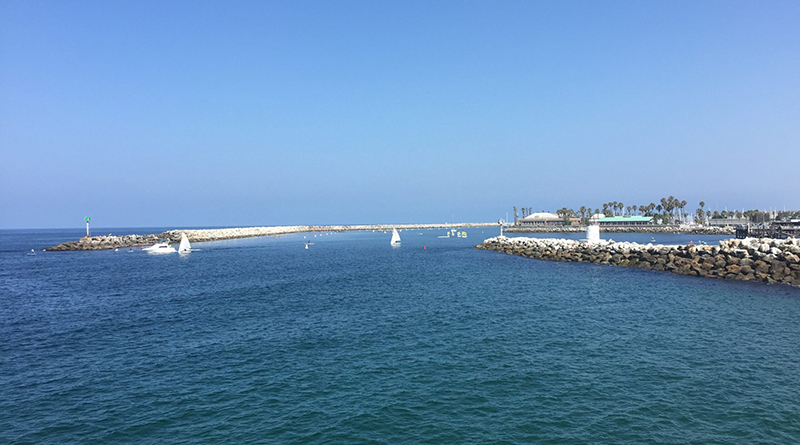
REDONDO BEACH — Repair work on the King Harbor Breakwall is continuing into the fall, with crews placing massive armor stones along the structure as the U.S. Army Corps of Engineers addresses areas damaged by decades of exposure to waves and ocean conditions.
Originally expected to be completed by the end of September 2026, the project is now anticipated to continue through mid-November after additional areas requiring repair were identified.
Construction began this last June on the 22nd and is taking place at various locations along the breakwall. Because the work requires a barge that periodically relocates as repairs progress, boaters should expect the active construction zone to shift throughout the project.
The repairs come after U.S. Army Corps of Engineers inspections documented an acceleration of damage to the breakwater, according to Shawn Davis, public affairs specialist for the agency’s Los Angeles District.
The Redondo Beach-King Harbor Breakwater is a rubble-mound, shore-connected structure built in phases by the City of Redondo Beach and the Army Corps. Its history dates to 1937, and it’s been modified and repaired several times since then — with the most recent major repair work occurring in 1999.
Structures of this type naturally experience wear as they absorb the force of waves year after year. The Army Corps inspects the breakwater annually to assess its condition and track the progression of damage.
“Damaged areas can create structural vulnerabilities which can occasionally progress rapidly, resulting in localized breaching or failure of the structure if left unaddressed,” Davis said. “Recent inspections had shown an acceleration of damages and therefore USACE determined that repairs were necessary.”
Despite the deterioration being addressed, Davis emphasized that the breakwater remains fully functional and continues to perform as designed.
The structure is particularly robust, with a crest height of approximately 20 feet, and was strengthened following events in 1988. Davis said a catastrophic failure isn’t considered likely in the immediate future.
Rather, the current work is intended to address vulnerable areas before they can develop into larger problems and restore portions of the breakwater to their authorized dimensions.
Doing that requires some particularly heavy material.
Crews are removing and resetting existing armor stone while also adding new stones weighing between 6 and 20 tons each. The new rock is being transported by barge from Catalina Island and placed using a water-based crane.
“Repairs will restore the breakwater to its optimal height, width and slopes as it continues to protect King Harbor and its infrastructure,” Davis said.
That protection is particularly important to the marinas, docks, vessels, and other facilities located behind the breakwater.
By absorbing and reducing incoming wave energy, the structure helps create the more protected waters within King Harbor. Davis described the breakwater as essential to protecting harbor infrastructure, although he noted that it’s not designed to prevent all overtopping during particularly large swells or significant weather events.
As work has progressed, crews have discovered that more of the structure requires attention than initially anticipated.
“Completion is now expected in mid-November,” Davis said. “Some additional work areas were added to the contract based on damages that had developed since the last survey of the structure was completed.”
Despite the expanded scope, Davis said construction is progressing well. Crews have placed more than 1,300 tons of new armor stone on the breakwater to date.
The work also extends beyond the breakwall itself. A staging area on Mole B is supporting the project, reducing some parking availability in the area. Spaces adjacent to Moonstone Park also have been used for construction staging and related activities.
Efforts have been made to maintain access to Moonstone Park throughout construction and allow the Lanakila Outrigger Club to continue operating. The City of Redondo Beach and local harbor stakeholders also have coordinated with the Army Corps by providing schedules for community events and other harbor activities to help minimize conflicts between construction and public use of the waterfront.
Earlier in the project, the construction schedule was adjusted around several major summer events. Work was paused during portions of Independence Day weekend and for the Santa Barbara Race in July.
As construction moves into its final stages, however, the most important consideration for boaters is maintaining a safe distance from the equipment.
The barge used for the project relies on anchor wires that can extend into the harbor, creating a potential hazard for vessels traveling too close to the active construction area.
“Boaters and harbor users should exercise caution when transiting the area near the construction, and be wary of the anchor wires from the barge that extend into the harbor,” Davis said.
The Army Corps has been working with local officials and the contractor to maintain a safe working environment as repairs continue.
Because the barge and construction vessels may relocate as work advances, an area that was clear during a previous trip through King Harbor may later become part of the active work zone. Boaters should remain alert for construction traffic, slow down when appropriate and give barges, cranes, anchor lines, and crews ample room.
For harbor users, the temporary construction activity is part of maintaining a structure that has stood between King Harbor and the open Pacific for decades.
After nearly three decades since its last major repair, the current project is intended to restore damaged portions of the breakwater so it can continue doing that job.
Construction is now expected to be completed well before the end of this November.