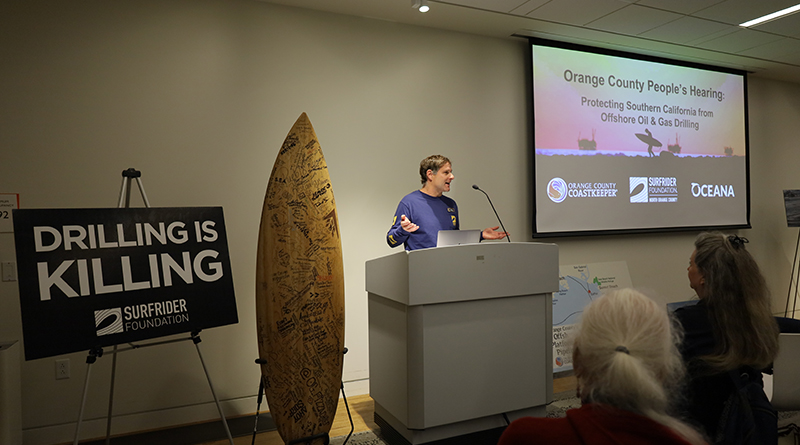
A broad coalition of Tribal leaders, elected officials, business owners, environmental advocates, fishers, and coastal residents gathered in Costa Mesa this week to voice strong opposition to the federal government’s proposal to expand offshore oil and gas drilling along California’s coastline. According to a December 8, 2025, news release from Orange County Coastkeeper, more than 100 people attended a community “people’s hearing” organized by Coastkeeper, the Surfrider Foundation, and Oceana. The gathering served as a unified call to protect Southern California’s waters, fisheries, beaches, and economies from the risks posed by new offshore drilling.
The event began with a detailed presentation outlining the U.S. Department of the Interior’s proposal to open vast areas of federal waters to new offshore oil and gas leasing. The plan includes the entire California coast, the Gulf of Mexico, Alaska, and the Arctic. Organizers walked attendees through the timeline and process for submitting official public comments to the Bureau of Ocean Energy Management before the January 23, 2026, deadline.
Following the presentation, a long list of speakers stepped forward to give remarks, including U.S. Representatives Dave Min and Ted Lieu, Orange County Supervisor Katrina Foley, California Assemblywoman Cottie Petrie Norris, California Coastal Commissioner Ray Jackson, Costa Mesa Councilmember Arlis Reynolds, business leaders, environmental groups, Tribal representatives, coastal recreation advocates, and commercial fishers.
The Coastkeeper news release highlighted the strong presence and powerful voices of local Indigenous leaders, who emphasized the deep cultural, spiritual, and ecological ties between their communities and the coastal waters of Southern California. Shannon Wingfield, Tribal Secretary for the Juaneño Band of Mission Indians, Acjachemen Nation, said offshore drilling threatens both cultural heritage and the survival of marine species that Indigenous people have depended on for thousands of years. According to the news release, Wingfield stated that the proposed expansion “ignores Tribal sovereignty, threatens the migration paths of whales and orcas, poisons the fish our people have harvested for thousands of years, and invites another catastrophic spill.” Wingfield urged federal officials to reject the proposal in order to safeguard the ocean “for the generations yet to come.”
Tina Calderon, Director of the Ocean Protectors Program for the Sacred Places Institute for Indigenous Peoples, echoed those concerns, describing the ocean as “a sacred being that must be protected at all costs.” Calderon pointed to historic spills along Southern California, including in Huntington Beach and Refugio State Beach, as well as recent events in Monterey County, as examples of the lasting damage caused by offshore extraction. Calderon said, according to the Coastkeeper release, that oil spills “occur frequently and cause irreparable damage,” while pollution and climate impacts compound the harm. She urged Californians to use their voices and votes to oppose the federal plan.
Many speakers reflected on the region’s lived experience with oil contamination, particularly the 2021 Amplify Energy pipeline spill in Huntington Beach that shuttered fisheries, closed beaches, halted boating and tourism activity, and disrupted local businesses whose livelihoods depend on a healthy coast. The Coastkeeper release noted that Michaela Coats, Southern California Regional Manager for the Surfrider Foundation, said Orange County residents “understand exactly what’s at stake” because they have witnessed the consequences firsthand. Coats said the spill harmed wildlife, closed waters to fishing, and damaged the coastal economy, adding that Surfrider’s network “will use every tool we have to stop new drilling.”
For many, the question was not simply whether drilling is risky, but whether there is any remaining justification for expanding it. Ray Hiemstra, Associate Director of Policy and Projects at Orange County Coastkeeper, said in the release that the state has spent more than a decade working with stakeholders to responsibly retire aging offshore rigs, not add more. Hiemstra stated that “major oil companies have already stepped away from offshore drilling here,” noting that the practice provides minimal benefit to Californians while placing coastal ecosystems and economies in jeopardy.
Oceana’s California Field Representative, Lisa Gilfillan, emphasized that opposition to offshore drilling has been bipartisan in California for decades. She said the proposed expansion threatens hundreds of thousands of coastal jobs, military training areas, and the state’s long-term investment in clean energy. Gilfillan encouraged residents to participate in the public comment process, adding, “We all agree, drilling here is just not worth the risk.”
Orange County Supervisor Katrina Foley echoed that sentiment, referencing the long-term impacts of the 2021 spill. Foley said the event “harmed our wetlands, wildlife, local businesses, and the health and safety of our coastal communities,” and argued that California should focus on clean energy and coastal resilience rather than expanding aging infrastructure that continues to fail.
From the federal level, Representative Dave Min called offshore drilling “catastrophic for California,” citing the economic stakes. Min said the risk of spills jeopardizes the coastal economy, which generates $44 billion a year, and noted that the proposal “poses an unacceptably high risk” in exchange for limited benefit. California Coastal Commissioner Ray Jackson added that opposition to drilling transcends political boundaries, stating that when leaders as different as Gavin Newsom and Ron DeSantis agree on something, “the message is unequivocal.”
Local businesses also spoke out, highlighting the importance of a clean coastline to both tourism and the commercial fishing community. Grant Bixby of the Business Alliance for Protecting the Pacific Coast said the coalition includes more than 65,000 businesses and 500,000 fishing families. According to the Coastkeeper release, Bixby stated that spills are not a possibility but “a certainty,” and argued that coastal communities “cannot risk 95% of our coastal economy’s GDP to grant special treatment to 5%.”
Throughout the evening, the message was consistent: offshore drilling threatens the long-term health of Southern California’s waters and coastal way of life. Speakers called on residents to engage in the federal comment process, emphasizing that public participation is a critical step in preventing new drilling leases from moving forward.
According to Orange County Coastkeeper, the people’s hearing in Costa Mesa was designed to give the community a voice in a process that many feel is moving forward without adequate public engagement. With the January 23 deadline approaching, organizers hope the strong turnout and unified opposition will inspire more Californians to weigh in and help shape the future of the state’s coastline.