Westwind Sailing gives newcomers a place to start, helping sailors build the skills and confidence that can eventually lead to independent sailing, Catalina crossings and chartering larger boats.
Every confident skipper started somewhere.
Before sailing to Catalina, chartering a boat for the weekend or taking the helm in a faraway destination, there was a first lesson: learning how the wind moves a boat, figuring out what all those lines do and discovering that getting back to the dock can be just as important as leaving it.
For Southern Californians interested in making that transition, Westwind Sailing provides a place to begin right in Dana Point Harbor.
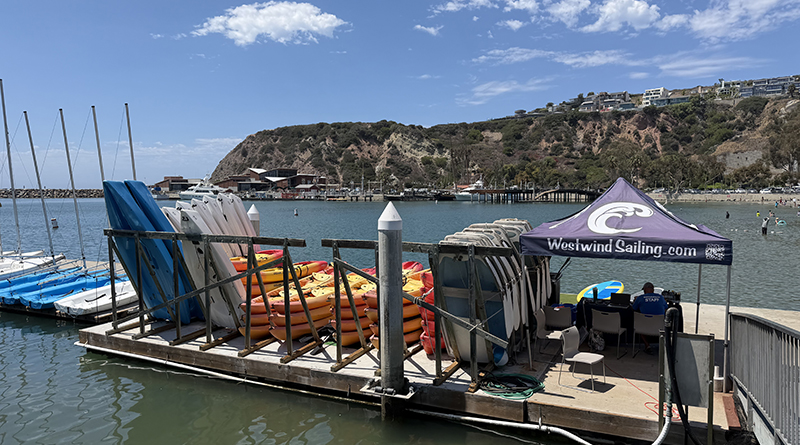
Operating from the OC Sailing & Events Center near Baby Beach, Westwind Sailing introduces children, teens and adults to sailing through programs designed to make getting onto the water approachable, whether someone has never stepped aboard a sailboat or already has experience and wants to become more capable.
For adults who are not quite ready to commit to a full course, Executive Director Diane J. Wenzel said the easiest way to find out whether sailing is for them is Westwind’s Intro Sail Clinic.
“This is a one-day clinic where you go from zero to hero in 2.5 hours,” Wenzel said.
No previous boating or sailing experience is required. During the clinic, students are introduced to basic sailing terminology, learn how to rig the boat and practice fundamental sailing skills from Westwind’s dock in the harbor’s West Basin.
From there, the progression becomes more structured.
Students interested in continuing can move into Sailing Level 1 and Level 2 courses. Wenzel said Westwind uses a building-block approach, with adult instruction taking place aboard sloop-rigged 14-foot Catalina Capri dinghies. Each class combines a review of previously learned material with new theory, practical experience on the water and a debrief afterward.
That approach allows skills to develop gradually rather than expecting a new sailor to absorb everything at once.
New sailors learn the fundamentals, including boating safety, terminology, rigging, steering, sail trim, tacking and jibing. On a smaller sailboat, those lessons become immediately tangible. Pull a line and the sail changes shape. Turn the tiller and the boat responds. Misread the wind and the boat has a way of letting you know.
After completing Level 2, students can take an assessment to join Westwind’s Sail Club, where qualified members can check out equipment on weekends and continue practicing. Intermediate Sail Clinics give Level 2 graduates another opportunity to refine their skills while still working under the supervision of Westwind instructors.
But knowing how to operate a sailboat and being ready to skipper one independently are two different things.
Becoming confident at the helm requires time on the water and exposure to different situations. Sailors need to learn how to read changing wind and weather, maneuver around other vessels, leave and return to the dock and make decisions when conditions do not go exactly according to plan.
For Wenzel, there is no substitute for actually being aboard the boat.
“Practical time on the water is paramount in our programs as our main focus is educational boating safety, and this is best achieved by logging hours in a sailboat,” Wenzel said. “We have found that reinforcement, repetition and experience help to shape strong, safe sailors.”
Westwind also introduces those lessons early. Its youth programs serve children ages 6 and older through sailing classes, camps and a club, using RS Tera, RS Q’ba and Catalina Capri 14 sailboats.
For many students, the goal may simply be gaining enough confidence to enjoy sailing locally. For others, that first lesson is the beginning of a much bigger plan.
Southern California offers a natural incentive to keep learning. Just beyond Dana Point Harbor is an entire coastline to explore, and approximately 30 miles offshore sits Catalina Island.
Getting there under sail requires considerably more than knowing how to tack and jibe. A skipper has to consider weather, sea state, navigation, traffic, vessel systems and emergency preparedness while assuming responsibility for the people aboard.
The progression from beginner to skipper, therefore, is less about completing a single class and more about steadily adding skills and experience.
And sailors do not necessarily have to buy a boat to begin doing it.
Westwind’s location at the OC Sailing & Events Center is an important part of that accessibility. The public waterfront facility has provided a home for sailing and recreational programs that allow members of the community to get onto the water without first owning a vessel or securing a slip.
The center opened in 1985 and, according to Wenzel, was designated as a public-access boating education facility under the Tideland Grant. More than 40 years later, she said the facility is ready for updates that could improve its functionality and accessibility.
Those conversations are particularly significant as the rest of Dana Point Harbor undergoes its larger revitalization.
Management of the OC Sailing & Events Center has shifted over the years from OC Harbors, Beaches and Parks to OC Dana Point Harbor and now OC Parks. As plans for the area move forward, Wenzel said Westwind hopes improvements will strengthen the center’s educational role rather than change the public purpose it has served for decades.
Westwind would like to see the future facility include a second story with expanded learning areas and updated technology, along with overnight accommodations, locker rooms, showers, a kitchen and meeting rooms. Wenzel also emphasized the importance of preserving a home for the other public programs operating from the center, including the Mariner Sea Scouts, Dana Outrigger Canoe Club and Jazzercise.
“OCSEC is a gem for the County and has the potential to be a state-of-the-art educational boating and recreation facility for the community,” Wenzel said.
The organizations operating from the center, she added, have played an important role in preserving both the facility and its original purpose.
“We hope that future generations can enjoy this public facility for years to come,” Wenzel said.

That future matters because the center provides the starting point for sailors who may eventually want to take their skills much farther.
Once sailors are ready to move into larger cruising boats and formal certifications, Dana Point offers opportunities to continue that progression.
Aventura Sailing, also based in Dana Point Harbor, provides American Sailing certification courses and operates a sailing club with a charter fleet. Its programs can provide a next step for sailors interested in developing the qualifications and experience necessary to operate larger keelboats, pursue coastal cruising or eventually charter boats for multi-day trips.
That creates a fairly unique pathway within one harbor.
Someone can begin with no sailing experience, spend an afternoon learning the fundamentals at Westwind, progress through its courses and build confidence by logging time on the water. If larger cruising boats become the goal, that sailor can continue into advanced education, certifications and charter opportunities.
Where that progression ultimately leads is up to the sailor.
It could mean an afternoon sail outside Dana Point Harbor, taking friends out without an instructor aboard or eventually setting a course for Catalina. For others, the goal may be earning the experience and certifications necessary to charter a sailboat somewhere else in the world.
The important part is that becoming a sailor does not have to begin with owning a sailboat.
It begins with learning how to sail one.
And as Dana Point Harbor changes around it, Westwind Sailing is working to make sure there remains a public place where future sailors can take that first step.