Life underway has changed dramatically for boaters over the past two decades. GPS has replaced dead reckoning, chartplotters have replaced folded paper charts on the nav table, and autopilots quietly handle long stretches of steering that once demanded constant attention from the helm. Yet inside the cabin, one role has remained just as demanding as ever: the person trying to prepare a meal while the boat heels, rocks, slams, and shifts beneath their feet.
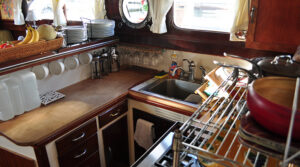
For the cruising sailor, the galley is less a kitchen and more a constantly moving workstation where balance, organization, and efficiency matter just as much as ingredients. While navigation has grown more automated, cooking at sea still requires careful planning, clever design, and the right equipment. The difference between a frustrating, messy meal and a smooth, satisfying one often comes down to a handful of thoughtful galley details that many boaters overlook until they are already offshore.
One of the most underrated features in any cruising galley is a deep, double sink. At first glance, it seems like a luxury, but offshore it becomes a critical piece of safety and organization. Two deep basins — ideally at least ten inches — create a secure place to set hot pots, dirty dishes, cutting boards, or even a thermos that needs filling. Because they self-drain at almost any angle of heel, they serve as a natural catch-all when the boat lurches unexpectedly. One side can function as a rinse station while the other holds items steady, preventing the kind of chaos that can quickly turn a simple cleanup into a balancing act.
Water management is another challenge that becomes very real on longer passages, which is where a foot-operated manual water pump proves its value. Electric pumps are convenient but tend to encourage waste and add mechanical complexity. A manual pump, on the other hand, forces measured use while providing a reliable backup if electrical systems fail. Many experienced cruisers install two: one for fresh water and one for salt water. Using salt water for the initial wash cycle or hand rinsing conserves precious fresh water while still allowing for effective cleaning. It’s a simple system that quietly enforces water discipline without the need for constant thought.
Cooking itself presents its own set of challenges when the boat is moving, and few tools are as helpful offshore as a durable pressure cooker. Not only does it significantly reduce cooking time and fuel use, but the sealed design prevents food from sloshing out when the boat rolls unexpectedly. Meals that might normally require constant attention can be safely contained, allowing the cook to step away briefly without worrying about spills or burns. The key is choosing a model built to withstand the marine environment and repeated use in a moving galley.
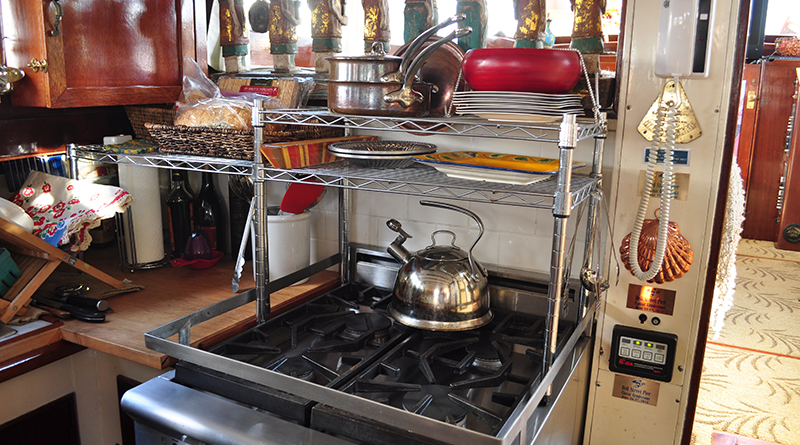
Equally important are the pots and pans themselves. Nesting cookware sets that fit neatly together save precious storage space, but their true value shows when they fit securely within the stove’s potholders. Offshore, a pot that shifts even slightly can create both a mess and a safety hazard. Choosing cookware that matches the stove and locks into place ensures that meals stay where they belong, even when the sea has other plans.
Perhaps the most overlooked feature in any galley, however, is the cupboard latch. Anyone who has heard the crash of plates and utensils spilling onto the cabin sole after a hard roll understands how critical this small detail can be. Many boats come equipped with push-button or elbow-style catches that can open unexpectedly when leaned against in a seaway. Toggle-style latches, which simply turn to lock or unlock the door, tend to be far more reliable. With proper adjustment, they also prevent the constant rattling that can make a long passage feel even longer.
Taken together, these seemingly small considerations transform the galley from a liability into a functional, efficient workspace. For cruising sailors, thoughtful galley design isn’t about luxury; it’s about safety, conservation, and making daily life aboard more manageable. The cook may still have the hardest job on the boat, but with the right setup, that job becomes far less stressful and far more enjoyable.
As more boaters venture farther from the dock for overnight trips, coastal cruising, or extended passages, attention to galley ergonomics and equipment becomes just as important as sail trim or navigation electronics. A well-designed galley does not just produce better meals; it contributes to morale, safety, and the overall success of life at sea.