SAN PEDRO — On the Los Angeles Waterfront, a tall ship can be many things at once.
It can be a working sailing vessel, a floating classroom, a link to an era when people and cargo crossed oceans under sail and, for a young person who’s never imagined a life on the water, an introduction to a maritime career.
That combination of history, education, and hands-on experience is at the heart of the Los Angeles Maritime Institute (LAMI), which is entering its 35th year connecting young people — and the public — to Southern California’s maritime world.
Now, LAMI is preparing to expand that role as part of the Los Angeles Waterfront STEM Network, a partnership bringing together AltaSea at the Port of Los Angeles, Battleship IOWA, Friends of Cabrillo Marine Aquarium, Los Angeles Harbor College, and LAMI to create a coordinated Science, Technology, Engineering and Mathematics (STEM) education and workforce ecosystem along the San Pedro waterfront.
The idea is to turn the waterfront itself into a classroom.
Through the participating organizations, students can encounter marine science, ocean technology, maritime history, traditional sailing, and potential career pathways without leaving the Los Angeles Harbor area. Plans for the network include hands-on STEM education, certificate programs, paid internships, apprenticeships, mentorships, educator training and community engagement.
For LAMI, participation builds upon something the organization has practiced for decades: experiential education aboard traditionally rigged sailing vessels.
Alice Taylor, LAMI’s director of sales and marketing, said the organization’s replica vessels help bring maritime history to life by showing students an era when sailing ships were essential to moving people and goods by sea.
That experience can be particularly meaningful for fourth- and fifth-grade students encountering subjects such as westward expansion in school.
“Stepping aboard a large sailing vessel that young people have only read about — or seen in pictures — is a strong argument for experiential education,” Taylor said. “We’re the embodiment of experiential education — and have been for years.”
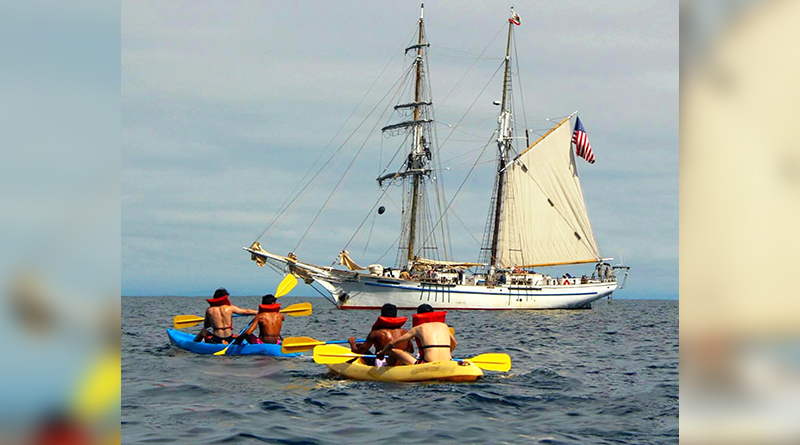
Instead of looking at a sailing vessel in a photograph, students can stand on deck, handle lines, observe the rigging, and begin to understand how people once relied on wind, seamanship, navigation, and cooperation to travel.
LAMI’s role in maritime education also extends beyond its own youth programs. Taylor said the organization is a part of USC’s Maritime Studies program, providing another connection between the vessels working along the San Pedro waterfront and formal maritime education.
From Maritime History to Maritime Careers
Preserving the past, however, is only part of the equation.
Taylor said LAMI recognizes that its position on the waterfront gives the organization an opportunity to help train the next generation of mariners. Securing the funding necessary to expand that work remains an important goal.
The need to introduce young people to maritime careers has also led LAMI to develop a new Mariner-in-Training program.
“The need to interest young people in maritime careers is crucial,” Taylor said.
The program represents a natural extension of the lessons already taught aboard LAMI vessels. Sailing a traditionally rigged ship requires teamwork, communication, responsibility and practical seamanship, providing young participants with exposure to skills and working environments that exist beyond recreational sailing.
That workforce component also fits into the larger purpose of the new Waterfront STEM Network. A student could be introduced to marine ecosystems through Cabrillo Marine Aquarium, learn about emerging ocean technology at AltaSea, encounter naval and maritime history aboard Battleship IOWA, sail aboard a LAMI tall ship, and then discover educational and career pathways through Los Angeles Harbor College.
For some students, the experience may simply create a stronger understanding of the ocean and the port. For others, it could provide an introduction to a profession they had never considered.
Keeping the Ships and Their Stories Alive
Providing those experiences requires considerably more work than simply raising the sails.
Maintaining wooden and traditionally rigged vessels is an ongoing undertaking, and LAMI has the advantage of having a working shipyard and its Building G facility at the Port of Los Angeles and West Harbor.
Taylor pointed to those facilities as an important part of LAMI’s preservation work, allowing the organization to maintain and restore the vessels that serve as its classrooms.
Perhaps no vessel illustrates that work better than the Swift of Ipswich.
Built in Ipswich, Massachusetts, in 1938, the square-topsail schooner was designed as a reduced-scale interpretation of the Revolutionary War-era American privateer Swift. The vessel later belonged to actor James Cagney and his brother, William, before eventually becoming part of LAMI’s history.
For years, Swift of Ipswich carried students as part of the organization’s early youth programming. It also became part of the broader Southern California maritime community, including serving as the setting for weddings at sea.
Taylor said some of the couples married aboard the schooner years ago now hope to return to celebrate milestone anniversaries aboard the vessel.
That will require finishing an extensive restoration.
The project has included major structural work to the wooden vessel, and restoration continues as LAMI seeks additional funding to complete it. Once returned to service, Swift of Ipswich would not simply represent a preserved piece of maritime history. It would once again become a working educational vessel, allowing another generation to experience the ship firsthand.
For Taylor, the schooner is an example of why maritime preservation matters.
“So many students sailed her in the early years of LAMI,” she said.
A View of Los Angeles From the Water
LAMI’s connection to San Pedro is difficult to separate from the history surrounding it.
Historic photographs of the early Los Angeles Waterfront show sailing vessels occupying a harbor that would eventually become one of the world’s busiest port complexes. LAMI’s ships provide a visual link between those earlier waterfronts and the container ships, terminals, tugboats and other working vessels operating there today.
“It never grows old being able to see the port from the waterside,” Taylor said. “It really brings home the amazing role the port plays in Los Angeles.”
Over nearly 35 years, generations of students have had that opportunity.
Taylor estimates that approximately 140,000 people have sailed with the organization over the years, creating experiences that sometimes continue influencing participants long after they leave the ship.
That impact became particularly apparent during a memorial for LAMI founder Captain Jim Gladson, when former students returned and spoke about how their experiences with the organization had shaped their lives.
For LAMI, those stories illustrate why bringing young people onto the water matters. Not every student who steps aboard will become a professional mariner, but the experience can create a connection with the ocean, the working waterfront and Southern California’s maritime heritage that is difficult to replicate from shore.
The Public Can Come Aboard, Too
Those experiences aren’t limited to school groups.
LAMI offers two regular public-facing sailing programs each month. Its Community Sunset Sails take passengers onto the water on select Saturday or Sunday evenings throughout the year, while Explore the Coast/Explora la Costa provides a monthly bilingual eco-education sailing experience.
The organization also participates in Port of Los Angeles and San Pedro Chamber of Commerce events through vessel tours, exhibits and other activities.
During LA Fleet Week, LAMI hosts its Festival of Sail, bringing visiting tall ships and cannon battles to the waterfront.
Volunteers are another important part of the organization. LAMI maintains an extensive volunteer program that allows members of the community to become directly involved with its vessels and programs, extending the connection between the tall ships and the people who live around them.
LAMI’s reach also extends to Long Beach through its Children’s Maritime Institute and American Pride, the official tall ship of Long Beach.
Together, those programs demonstrate that LAMI’s tall ships aren’t being preserved simply to remain tied to a dock or admired from shore.
They’re meant to work.
They carry students, teach history, introduce seamanship, provide a platform for STEM education, and give the public a chance to experience the Los Angeles Waterfront from a perspective generations of mariners knew well.
As LAMI joins its waterfront partners in building new pathways into STEM education and blue-economy careers, the technology students encounter may be dramatically different from anything sailors aboard traditional schooners could have imagined.
The underlying lesson, however, remains remarkably familiar.
The maritime world is best understood by getting out onto the water and becoming part of it.