With El Niño strengthening and Southern California anglers already enjoying yellowtail, yellowfin, and other warm-water opportunities, another prized game fish is beginning to make itself known.
Southern California anglers have had plenty of reasons to keep the word “yellow” in their fishing vocabulary lately.
Yellowtail continue to provide action along the coast, around the islands, and offshore, while yellowfin tuna have joined a season already marked by unusually warm water and appearances from species anglers typically associate with trips farther south. Dorado have been in the mix, too. And even more exotic possibilities have kept anglers looking offshore.
Not very fish worth talking about, however, has “yellow” in its name.
White seabass are beginning to show themselves in catches along the Southern California coast, offering anglers another reason to pay attention to what is happening closer to home while El Niño continues to develop.
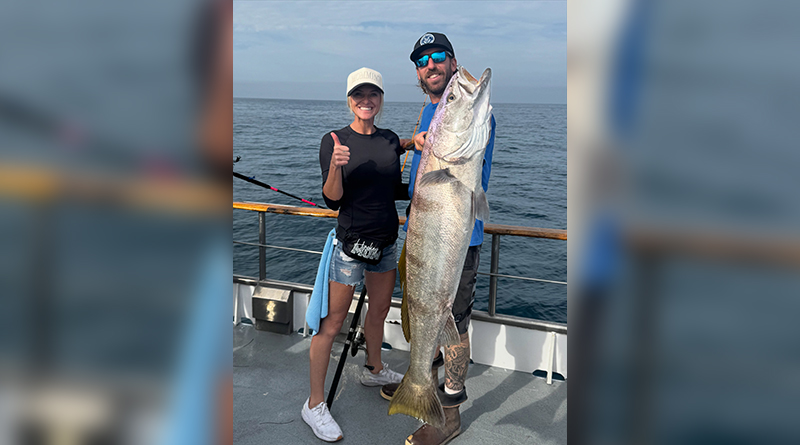
A recent catch aboard Dana Wharf Sportfishing’s Clemente Sportfishing provided one example when an angler landed a 30-pound white seabass while fishing a live sardine.
“Not every fish we’ve been catching has the word ‘yellow’ in it!” Dana Wharf Sportfishing wrote in a Facebook post accompanying the catch.
The fish may not carry the novelty of a wahoo or inspire the same offshore scramble as a school of yellowfin, but a quality white seabass is one of Southern California’s premier catches.
Elsewhere along the California coast, anglers have been encountering larger fish as well. Recent catches have included white seabass approaching the 50-pound class, including fish taken by anglers who were originally targeting yellowtail. Reports from farther north also have indicated white seabass activity alongside other productive coastal fisheries.
That doesn’t necessarily mean El Niño is solely responsible for every white seabass showing up on the end of a line. White seabass are native to California waters and have long been an important part of the state’s recreational fishery. Their movements can be influenced by water temperature, spawning behavior, food availability, and concentrations of squid and other forage.
What is notable this season is the broader ocean environment in which anglers are finding them.
The National Oceanic and Atmospheric Administration (NOAA) reported in August that El Niño is strengthening and is expected to continue intensifying through the end of the year. At the same time, portions of the California coast, particularly central and Southern California, continue to experience marine heatwave conditions. Those changing ocean conditions are already providing Southern California anglers with an unusually diverse mix of fishing opportunities.
Sea surface temperatures approaching 80 degrees have been reported in some areas around Southern California this summer. Yellowfin tuna have pushed within range of local full-day boats, dorado have been encountered around offshore kelp paddies and yellowtail have provided consistent opportunities from coastal waters to the islands and offshore banks.
Against that backdrop, the arrival of a big white seabass can almost seem understated.
It shouldn’t.
White seabass, Atractoscion nobilis, are prized among California anglers for their size, power and reputation for being frustratingly difficult to locate. Despite the name, white seabass aren’t actually bass. They belong to the croaker family, Sciaenidae, making them relatives of species such as corbina and spotfin croaker.
They also get big. A 30-pound fish is enough to turn an otherwise ordinary trip into a memorable one, while larger specimens can push well beyond that mark.
Finding them is often the difficult part.
White seabass commonly associate with kelp beds, rocky structure and areas holding concentrations of forage. Squid grounds can be particularly productive, and anglers frequently target the fish around Southern California’s islands and coastal kelp zones.
That habitat also influences the tackle anglers use.
A practical white seabass setup generally begins in the 25- to 50-pound line range. These fish have a reputation for being line-shy, making lighter tackle useful when the bite is difficult. When fish are feeding aggressively, however, moving toward 40- or 50-pound tackle can provide an advantage, particularly around kelp.
Braided line in roughly the 30- to 80-pound range paired with an appropriate monofilament or fluorocarbon topshot can provide additional capacity and strength. Braid also can help anglers when a hooked fish heads into kelp, although landing a large seabass around heavy structure still requires patience and careful pressure.
Live squid remains one of the traditional favorites when available, with fresh dead squid another productive option. Live sardines can also produce, as demonstrated by the recent 30-pound Dana Point fish.
Hook size should match the bait, with approximately 2/0 to 5/0 hooks covering many squid presentations. A sliding egg sinker can range from about a half-ounce to several ounces depending on current and depth, while a dropper-loop setup paired with a heavier torpedo sinker gives anglers another way to put bait near the bottom.
Artificial lures should not be overlooked either. Large white fluke-style soft plastics rigged on substantial lead heads have become another option, particularly when anglers need to cover water or imitate squid and other forage.
Whatever the presentation, anglers also need to know California’s regulations before putting a white seabass in the fish box.
The recreational white seabass fishery is open year-round. California Department of Fish and Wildlife regulations establish a minimum size of 28 inches total length, or 20 inches alternate length. The normal daily bag and possession limit is three fish.
Southern California anglers have an additional seasonal restriction. In waters south of Point Conception, only one white seabass may be taken per person from March 15 through June 15. From June 16 through March 14, the regular three-fish daily bag and possession limit applies.
For anglers filleting white seabass aboard a vessel, fillets must measure at least 19 inches long and retain an intact 1-inch-square patch of silver skin.
Anglers also should remember that marine protected areas and other location-specific restrictions can affect where fishing is permitted, even when the species itself is open. CDFW recommends checking current regulations before fishing because regulations can change during the year.
For now, the combination of warm water and an increasingly diverse Southern California fishery is giving anglers plenty of choices.
Those choices may make it tempting to point the bow offshore every morning in search of tuna, dorado or whatever warm-water surprise might appear next. The ongoing yellowtail bite provides another obvious target and has been difficult to ignore.
But white seabass have a way of reminding Southern California anglers why some of the best catches don’t require an exotic name.
A 30-pound seabass on a sardine, a larger fish pulled from the kelp or the possibility of a 50-pound-class fish inhaling a bait intended for a yellowtail can change the direction of a fishing day very quickly.
El Niño may be cooking, the water may be warm and Southern California’s fishing mix may continue getting more interesting as fall approaches.
Just don’t get so distracted by everything yellow that you forget to look for a little silver.