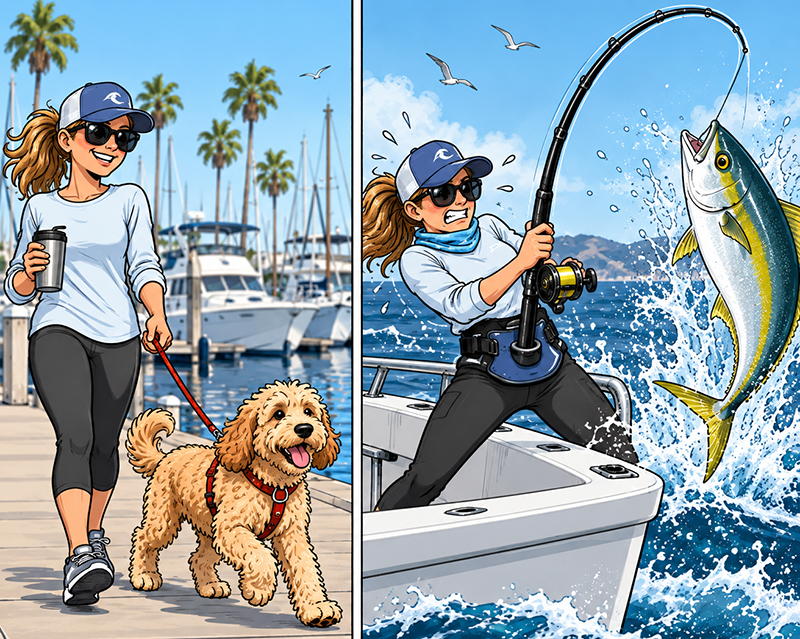
The answer involves physics, hydrodynamics, and the unfortunate realization that the yellowtail on the end of your line has several advantages you do not.
There are certain moments in fishing when the numbers stop making sense.
You hook a 17-pound yellowtail, and suddenly you’re leaning against the rail, rod doubled over, drag singing and wondering whether something weighing roughly the same as a small dog is about to pull you into the Pacific.
Which raises an important question: Why?
A 17-pound dog has four legs. It has claws. It has access to solid ground. If anything should be capable of dragging you around, it seems like it should be the dog.
And yet, put a leash on a 17-pound terrier and you’re probably still in charge.
Put a hook into a 17-pound yellowtail and apparently negotiations are over.
The explanation begins with one important distinction: weight is not the same thing as pulling force.
A 17-pound fish weighs 17 pounds, but that doesn’t mean it can only exert 17 pounds of force on your fishing line. The fish is actively accelerating, swimming, changing direction, and pushing against the water around it. The amount of force that eventually reaches the angler depends on several factors, including the fish’s acceleration, swimming mechanics, water resistance, tackle, and direction of travel.
In other words, you’re not fighting a 17-pound object.
You’re fighting a 17-pound athlete.
Fish such as yellowtail and tuna are particularly good examples because their bodies are designed for efficient, sustained swimming. Powerful muscles drive the tail from side to side, pushing water backward and propelling the fish forward.
That water matters.
Water is roughly 800 times denser than air, which means a fish has a substantial medium against which it can generate thrust. Its tail essentially acts like an ultra-dynamic propulsion system, moving water in one direction to send the fish in another.
Your dog can’t do that.
The dog gets the sidewalk.
Four Legs Aren’t Everything
Our hypothetical 17-pound dog does have one major advantage: four points of contact with solid ground.
But that advantage has limits.
A dog’s ability to pull you across the sidewalk depends heavily on traction. Its paws push backward against the ground, and friction allows the dog to propel itself forward. Eventually, however, there’s only so much force a lightweight canine can apply before its paws begin slipping.
The dog’s relatively low body weight limits how much traction it can generate.
The fish faces a different set of circumstances. It’s enveloped by the substance it uses to propel itself.
And unlike the dog pulling mostly horizontally on a leash, a fish can attack your dignity from several directions.
It can dart away from the boat. It can dive. It can turn broadside. It can circle beneath you. It can change direction just as you’ve convinced yourself that you’re finally gaining line.
A fish turning sideways also presents more surface area to the water, which increases resistance. Now you’re not simply pulling against the fish’s swimming effort; you’re also dealing with the water pushing against its body.
Anyone who’s tried to pull a bucket through the water understands the concept.
A bucket sitting on the dock isn’t particularly intimidating.
Lift that same bucket from the ocean floor to the surface, and suddenly it has opinions.
Then There’s Your Fishing Rod
The experience is amplified by the equipment connecting you to the fish.
Your rod bends under load and stores energy. Your reel’s drag controls how much resistance the fish encounters before line begins leaving the spool. The line transfers all those changes in force directly back to your hands.
A fish suddenly accelerating therefore produces a dramatically different sensation than simply holding something of equivalent weight.
Imagine hanging a 17-pound weight from your fishing line. Heavy, sure.
Now imagine that weight suddenly accelerating away from you, stopping, changing direction and accelerating again.
Welcome to yellowtail fishing.
Drag settings also help explain why anglers can successfully fight fish that are much stronger than their line might initially suggest.
The drag allows line to leave the reel once the force reaches a certain level. Instead of creating an immovable connection between angler and fish, the system gives under pressure.
That protects the line, knots and hooks while forcing the fish to expend energy during its runs.
Essentially, the fish gets to run.
It just has to pay for every yard.
Not Every 17-Pound Fish Is Equal
There’s another important piece of the equation: species.
A 17-pound yellowtail is going to provide a very different fight than a 17-pound halibut.
Body shape, muscle composition, swimming behavior and physiology all influence how a fish fights.
Pelagic species such as tuna, yellowtail, and bonito spend much of their lives swimming. Their streamlined bodies, powerful tails, and muscular systems are built to move efficiently through open water.
Other species rely on different strategies.
A halibut may use its broad body against the water and head toward the bottom. A calico bass can make a determined run for structure. A tuna may simply decide that the horizon looks nice and begin heading toward it.
Same ocean. Different methods of ruining your forearms.
Then there are the truly powerful pelagic fish.
A 17-pound yellowtail is one thing. Scale the same basic swimming machinery up to a 100-, 200- or 300-pound tuna — the physics become much less amusing for the person holding the rod.
There’s a reason anglers use fighting belts, harnesses, heavy tackle, and the rail when targeting big tuna.
At some point, “I’ll just hold onto it” stops being a strategy.
The Ocean Is Part of the Fight
Perhaps the biggest misconception is thinking the angler is fighting only the weight of the fish.
You’re really dealing with an entire moving system.
There’s the fish generating thrust. There’s water resistance acting against its body. There may be current working in one direction and the boat drifting in another. The fish may be diving while the angler is pulling upward. Meanwhile, the rod is flexing, the drag is slipping and the person holding everything together is beginning to question why fishing is considered recreation.
All of those forces combine to create what you feel at the rod.
That’s also why weighing a fish afterward can occasionally seem insulting.
You spend 20 minutes getting dragged around the stern. Your arms hurt. Someone had to move three rods out of your way. You nearly lost the fish under the boat twice.
Finally, it comes aboard.
“Seventeen pounds.”
Seventeen?
You’ve met Labradoodles heavier than this thing.
But put that Labradoodle in the Pacific, give it a streamlined body, fins, a powerful tail and millions of years of evolutionary refinement for swimming, and perhaps the comparison becomes a little fairer.
Until then, the fish has the advantage.
So the next time a relatively modest yellowtail has you braced against the rail, remember that you aren’t struggling to lift a 17-pound object.
You’re attached to 17 pounds of muscle generating thrust in dense water, capable of accelerating in three dimensions, while your fishing tackle efficiently transfers its bad attitude directly into your arms.
Your 17-pound dog might have four legs.
The yellowtail has the Pacific.
And apparently, that’s enough.