



By: K. “Tangled Line” Clements
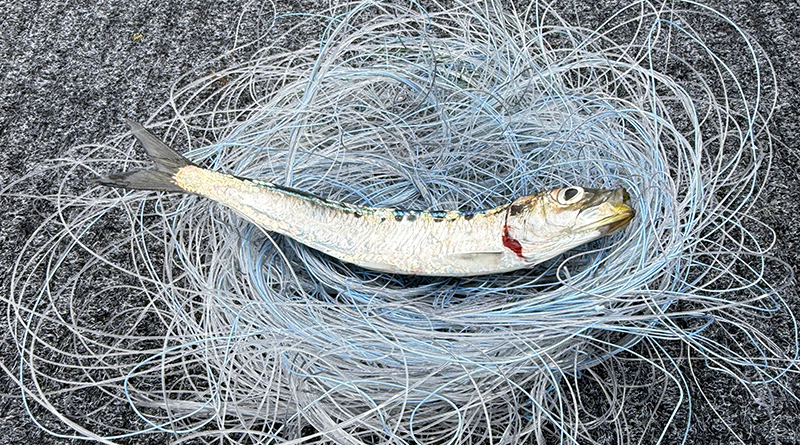
In a bold crossover between marine innovation, questionable craftsmanship, and emotional attachment to bait, a local angler has reportedly created a “bird nest” made entirely of used fishing line, designed specifically for deceased anchovies to “rest peacefully.”
The structure, discovered wedged between a leaning dock cart and a five-gallon bait bucket that hasn’t been washed since last summer, is being described by its creator as “part conservation effort, part art installation, and part closure.”
According to the angler, the nest was assembled after realizing that several anchovies had “passed on” before fulfilling their destiny of being eaten by something much larger and angrier.
“They deserved better,” the angler explained, while carefully tucking another anchovy into the monofilament weave. “They lived hard. They swam fast. And now they need somewhere safe to sleep.”
The nest itself is a complex lattice of tangled fluorocarbon leaders, sun-bleached mono, and at least one inexplicable section of braided line that nobody remembers spooling on in the first place. Its origin story is painfully familiar: a drag set just loose enough to invite chaos, a cast launched with confidence, and a spool that immediately decided to spin faster than the line leaving it. The result was a sudden backlash, followed by the angler’s universal response — one hopeful thumb press and the quiet realization that the damage was already done.
From there, things escalated quickly. Each half-hearted attempt to pull free a loop only tightened the others, transforming a simple overrun into a full-blown avian-grade structure. Decorative touches include a rusty hook added for “character,” a broken snap swivel providing “structural integrity,” and the faint scent of sardine oil that suggests this project began emotionally and ended with poor decision-making.
Experts agree the nest is remarkably realistic, in the sense that it looks exactly like what happens when an angler ignores early warning signs, blames the reel, adjusts the drag mid-disaster, and ultimately decides the problem is no longer mechanical but philosophical. Whether the drag was too loose or the angler simply refused to acknowledge personal responsibility remains a matter of debate, though the evidence suggests both played equal roles.
The anchovies, now gently laid to rest in the center of the nest, are arranged head-to-tail “for warmth,” despite the fact that they are fish and also not alive. The angler insists this detail matters.
“They’re more comfortable this way,” she said. “You can tell.”
Birds, for their part, have shown limited interest in the nest, likely due to the aggressive presence of treble hooks and the overwhelming aura of unresolved bait-related guilt. One seagull reportedly approached the structure before immediately reconsidering its life choices and leaving the harbor altogether.
Environmentalists have not officially weighed in, though several have privately noted that while fishing line should not be used for bird nests, this particular application is unlikely to attract wildlife unless they’re actively seeking chaos.
The project has already inspired copycats. One nearby boater is rumored to be working on a “mausoleum” for expired squid, while another claims to be crocheting a hammock out of old spectra “just in case the mackerel get tired.”
When asked if the nest would be dismantled and the line properly disposed of, the angler appeared genuinely offended.
“This is a memorial,” she said. “You don’t just throw away history.”
Plans for future expansions include a “nursery wing” for half-frozen sardines, a braided-line dreamcatcher to ward off skunk days, and a small plaque that read: Gone But Still Smelly.
At press time, the anchovies remained peacefully nestled, the fishing line remained irrevocably tangled, and the angler remained convinced that this was, without question, the healthiest way to process a slow bite.


