By William Rowland
Maritime humor can take many shapes, from bawdy limericks to ribald shanties, good-hearted ribbing to Salty Satire.
With April Fool’s Day just around the corner, it’s only fitting to think about practical jokes. Harmless ones, of course. Clever ones, naturally. The kind of playful tricks where both instigator and target enjoy a healthful laugh with a double shot of esprit de corps.
Take this scenario, for instance:
Imagine that you’re the captain of an early-’60s Wheeler motor yacht. It accommodates six to eight folks, including your first mate, and has a round-trip range of around 50 nautical miles (give or take).
On April 1st, you have a 1/3-day charter booked with five passengers (three women, two men) for a sightseeing cruise no further out than 27 nautical miles from Honolulu Harbor, Hawaii.
Except for a married couple, your passengers have never met each other. Until they boarded your boat, they were all complete strangers.
Smell anything fishy yet, captain?
What if I told you that the married couple brought nearly a dozen pieces of luggage stuffed with millions in cash? One of the women (a petite brunette) is dressed like a farm-girl pinup, while the other (a sultry redhead) dons a full-length, form-fitting sequined cocktail dress!
At this point — if you and your first mate aren’t complete numbskulls — you’d have to have some suspicion that something is awry.
This charter has “April Fools” written all over it. Maybe a trickster back at the harbor pub sent this “situation comedy” of motley misfits your way to settle a score. Or, maybe, just to have a little innocent fun.
Lucky for you, you’ll be back in three hours.
Maintaining a sense of humor is part of the seafaring culture. It always has been. Sailors, fishermen, and boaters have been playing jokes on each other for centuries. It breaks the monotony, relieves tension, and builds camaraderie among people who love the seafaring lifestyle.
Still, seasoned mariners know something important: a practical joke shouldn’t ever come at the expense of safety. Not now. Not ever. If a joke risks someone’s safety, equipment, or navigation, it isn’t funny. It’s just damn foolish.
With that stern warning out of the way, here’s a few examples of maritime practical pranks at Sea — just in time for April Fool’s Day.
A Rookie’s First Voyage: the Perfect Mark for a Practical Joke
Every crew has one. The newbie. And maritime culture has a long tradition to welcome a new arrival: the errand for a nonexistent item.
Few gags are older than sending a rookie to fetch something that doesn’t exist, such as a “left-handed screwdriver,” a “bucket of prop wash,” or a “gallon of striped paint.”
Fishing boats add their own variations. Deckhands have been dispatched to find “sky hooks,” “line stretchers,” or some other mythical piece of gear supposedly stored on the neighboring vessel.
The beauty of the joke is simple psychology. The rookie doesn’t want to look inexperienced. So off they go, wandering from boat to boat, earnestly asking for equipment that no one’s ever seen.
Laughter follows. Usually friendly. Sometimes loud.
Initiation complete.
The best crews make sure the gag ends quickly and harmlessly. At some point, of course, someone breaks the news. Because while the comic relief is highly enjoyed, nobody cares for a gag that drags on for too long or distracts from real work on deck. (The new guy has to earn his keep, after all.)
The Phantom Vessel Trick
Night watch. Quiet seas. Long hours. All, perfect conditions for a little mischief.
Picture the wheelhouse after midnight. The engines hum steadily. Radar glows softly in the dark. Outside, the horizon is little more than black water and scattered lights.
Now imagine a mysterious light appearing astern. Some mischievous crews have been known to release small battery lanterns attached to floating buoys behind the vessel. From the bridge, the light looks like another boat following at a distance.
Others have adjusted reflectors or lights to create a “ghost contact” on radar.
For a while, the watchstander tries to identify the unknown vessel.
Eventually the truth surfaces. Hopefully with a relieved, smiling sigh.
Fishing Boat Shenanigans
Commercial fishing crews are known for pulling some of the best tomfoolery on the unwitting. Long seasons will do that. When the days blur together and the weather keeps everyone on edge, humor becomes a survival tool.
Some jokes are simple, such as a lightly greased handrail coated in fish oil; a rubber crab hidden among the day’s catch; or a plastic lobster waiting inside a bait bucket.
Then there’s the classic phantom bite.
One fisherman secretly ties a string to another’s fishing line and gives it an occasional tug. The victim feels the strike, sets the hook with enthusiasm, and reels in … absolutely nothing.
Radio Waves and Tall Tales
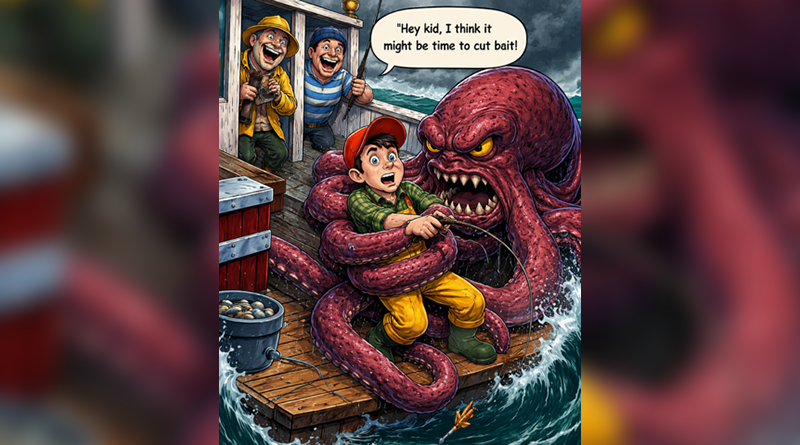
When marine radios became common in the 20th century, the opportunities for mischief-making expanded. Some boaters began making playful transmissions over working channels, including Imaginary vessels with ridiculous names; gag weather forecasts (“chance of rough waters, followed by an expulsion of this morning’s Denver omelet”); or reports of a “giant squid sighting.”
One classic example might sound something like:
“Attention all vessels … forecast calling for scattered beer cans and a 100 percent chance of tall tales at the marina bar tonight.”
Dockside Mischief
Back at the marina, pranks continue, sometimes overnight. The morning light reveals the work of jokesters, such as boats decorated with plastic flamingos or hundreds of sticky notes adorning the deck.
One popular trick involves mounting a small air horn under a friend’s captain’s chair. The next morning, the unsuspecting skipper sits down at the helm and suddenly announces their presence to the entire harbor.
Retaliation often follows, turning marinas into quiet battlefields of harmless one-upmanship.
Crossing the Line — The Equator Line
Perhaps the most famous bit of maritime foolishness — which is as much good-natured hazing as it is tradition — is the Line Crossing Ceremony, a rite of passage which dates back centuries. It’s part theater, part prank, part celebration.
The Line Crossing Ceremony takes place when a vessel passes over the equator for the first time.
First-time crossers, called “pollywogs,” face trials overseen by veteran sailors, who are known as “shellbacks.”
Costumes appear. “Mythical sea creatures” roam the deck. Someone inevitably plays Neptune, ruler of the seas. The pollywogs might crawl through nauseating (e.g., slimy and odorous) obstacle courses; be forced to answer ridiculous and unanswerable questions; be ordered to wear clothing in unconventional ways; directed to clean the head with tools ill-equipped for the task; and even walk a plank into the briny sea at the Prime Meridian.
Embarrassing? Likely. Memorable? Definitely. The point is tradition, camaraderie, and morale. When it’s over and done, the pollywogs become shellbacks and the day’s history is entered into the ship log for posterity.
Why Mariners Love a Prank
Life on the water isn’t easy. Weather changes quickly. Equipment fails. Long hours and hard work can wear down even experienced crews. Humor helps.
A well-timed joke can defuse tension after a rough day. It creates stories to be told for years afterward at dockside bars and marina cookouts. More importantly, it builds bonds between people who must rely on one another when conditions turn serious.
The Unwritten Rules
Veteran boaters understand the unofficial code of maritime humor. It should be harmless, end quickly, and leave everyone with a hearty laugh. It should never endanger a crew member, damage equipment, nor interfere with navigation or communication.
As one dockside philosopher once put it: “If nobody’s laughing afterward, it wasn’t a prank; it was just a bad idea.”
A Tradition That Won’t Sink
Today’s boats are filled with technology: GPS chartplotters, satellite communications, digital radar. But the spirit of maritime humor hasn’t changed much since the days of wooden ships and canvas sails.
Walk any marina dock and you’ll hear the stories: The rookie sent searching for nonexistent gear; the mysterious light trailing the boat at midnight; the rubber fish hiding in the catch. They’re part of boating culture now. And with April Fool’s Day here, the stories feel especially apropos.
And for those captains out there — just be wary of passengers bringing more luggage than necessary for a three-hour tour.