New qualifying structure aims to improve racing, increase team exposure and prepare the championship for future expansion.
SailGP is introducing a new race format for the remainder of its 2026 season, a move league officials say will improve competition on the water while creating a more engaging experience for fans watching from shore and around the world.
Beginning with the remaining events in Season 6, the league’s 13 national teams will be divided into two qualifying fleets rather than racing together in one large fleet. The top two teams from each group will then advance to a four-boat final to determine the event winner.
According to SailGP CEO Sir Russell Coutts, the change represents the next step in the league’s evolution as it prepares for continued expansion.
“The first five years of SailGP were about proving the concept,” Coutts said. “Would this product work? Would it be commercially sustainable? The next phase is all about scaling the league, growing attendance at events, increasing broadcast audiences and delivering a more consistent product.”
Coutts said consistency extends beyond the racing itself to include the fan experience, event venues, broadcast production, hospitality offerings and the overall championship calendar.
The new format also prepares SailGP for additional teams joining the championship. A 14th team is expected to compete next season, and league officials have previously expressed ambitions of eventually growing to 20 national teams competing in 20 or more events worldwide.
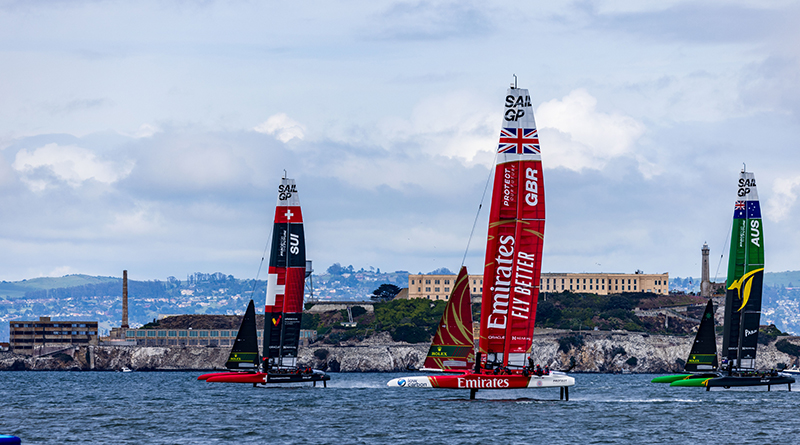
One of the primary reasons behind the change is improving the quality of racing, particularly during lighter wind conditions. While seeing all 13 F50 catamarans charging toward the start line created an impressive visual spectacle, Coutts said the larger fleet often resulted in uneven racing once the boats spread across the course.
In lighter winds, the airflow disturbed by the rigid wingsails can significantly affect boats sailing behind the leaders. As a result, teams near the front often enjoyed cleaner air while those farther back struggled in more turbulent conditions, making it difficult to remain competitive throughout the fleet.
By reducing the number of boats competing in each qualifying race, SailGP believes the racing will remain closer and more competitive from start to finish.
The revised format is also expected to improve television coverage.
League officials analyzed previous broadcasts and found that larger fleets naturally drew cameras toward the leading pack, leaving teams farther back with limited exposure. Under the split-fleet format, more teams are expected to spend time racing in contention, increasing their visibility during live broadcasts.
“At first, some teams thought they’d get less coverage because they were only racing in half the races,” Coutts said. “But when we analyzed the coverage, it became clear that in the old format the cameras naturally focused on the leading pack and the teams at the back received little airtime.
“Now, more teams spend more time racing in the mix, which means they receive more broadcast coverage. From a commercial perspective, that’s a real benefit for the teams.”
The format is also intended to make SailGP easier for casual viewers to follow.
With fewer boats on the racecourse at one time, storylines become easier to understand, and the broadcast team can devote more attention to tactical battles throughout the fleet rather than attempting to follow action spread across a much larger racecourse.
The shorter intervals between races also create a more streamlined broadcast. Rather than lengthy breaks between fleet races, SailGP expects to reduce turnaround times to approximately three minutes, allowing broadcasters to maintain momentum while scheduling commercial breaks more efficiently.
The new qualifying format debuted during the Emirates Great Britain Sail Grand Prix in Portsmouth, where the fleet was divided into Groups A and B for five qualifying races before the top two teams from each group advanced to a four-boat final.
Spain, helmed by Diego Botín, captured the Portsmouth title after defeating Sweden, Canada and Switzerland in the winner-take-all final. Sweden, led by Nathan Outteridge, finished second, followed by Canada’s Giles Scott and Switzerland’s Sébastien Schneiter.
Although Australia placed seventh in Portsmouth, Tom Slingsby’s crew remains atop the overall Season 6 standings with 66 points after eight of 13 events. Spain sits second with 54 points, followed by Sweden with 47. The United States team, skippered by Taylor Canfield, is fourth with 46 points and remains firmly in contention heading into the final five events of the season.
The championship now moves to Sassnitz, Germany, on Aug. 22-23 before continuing to Valencia, Spain; Geneva, Switzerland; Dubai, United Arab Emirates; and concluding in Abu Dhabi on Nov. 28 & 29.
Each SailGP event features identical, one-design F50 foiling catamarans capable of reaching speeds approaching 60 mph. Teams race boats with standardized equipment, including interchangeable wingsails, foils and sails selected according to forecast conditions, placing the emphasis squarely on crew work, tactics and boat handling rather than equipment advantages.
More than $12.8 million in prize money is available during the 2026 season. Each event winner earns $400,000, while the overall season champion receives an additional $400,000. The team that captures the winner-take-all Championship Final Race at the end of the season will take home a $2 million prize.
For Southern California sailing fans, the format change offers another example of SailGP’s continued evolution as one of the sport’s fastest-growing professional leagues. With the championship emphasizing stadium-style racing, close competition and television-friendly formats, league officials believe the split-fleet system will help position SailGP for its next phase of international growth while delivering tighter racing on the water.