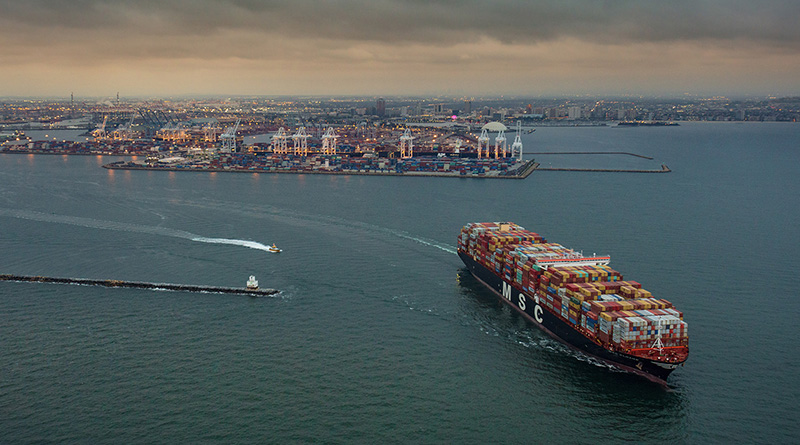
Despite a year marked by trade uncertainty and shifting global dynamics, Southern California’s two largest ports continue to demonstrate resilience, reliability, and operational strength. The Port of Long Beach and the Port of Los Angeles finished 2025 with one of the strongest cargo years on record, reinforcing the region’s role as the nation’s leading gateway for international trade.
At the Port of Long Beach, officials project that 2025 will become the busiest year in the port’s history, surpassing the record 9.6 million cargo containers moved in 2024. Strong cargo volumes earlier in the year, driven in part by importers moving goods ahead of tariff changes, helped propel the port toward a new annual milestone.
Through the first 11 months of 2025, the Port of Long Beach handled 9,047,477 twenty-foot equivalent units (TEUs), representing a 2.9% increase compared to the same period last year. November marked the port’s second-busiest November ever, with 817,561 TEUs processed, even as volumes eased slightly from the record levels seen in November 2024.
Imports in November totaled 400,505 TEUs, while exports reached 110,122 TEUs. Empty container movements totaled 306,934 TEUs. While those figures reflected modest year-over-year declines, port officials emphasized that cargo continued to move smoothly with no congestion or operational disruptions.
“Cargo moved at a steady rate with no congestion or disruptions at the Port of Long Beach as consumers, businesses and supply chain partners endured an extraordinary amount of uncertainty caused by shifting trade policies throughout 2025,” said Port of Long Beach CEO Mario Cordero. He added that the port expects a moderate increase in cargo volumes in 2026.
Long Beach Harbor Commission President Frank Colonna credited the port’s workforce and terminal operators for maintaining efficiency throughout the year. “We are closing in on a record year thanks to the outstanding work of our waterfront workforce and terminal operators who have moved a tremendous amount of cargo throughout 2025,” Colonna said, noting the importance of keeping goods flowing during the holiday shopping season.
Just up the coast, the Port of Los Angeles is also finishing 2025 on a high note. With one month remaining in the year, the port has already processed 9,447,731 TEUs, putting it on track to exceed 10 million TEUs and secure its third-best cargo year on record.
In November, the Port of Los Angeles handled 782,249 TEUs, a 12% decline from the elevated levels seen in November 2024. Loaded imports totaled 406,421 TEUs, while loaded exports reached 113,706 TEUs. Empty container movements came in at 262,122 TEUs. Port leaders characterized the slowdown as a normalization following last year’s unusually strong volumes.
“Even with all the trade uncertainty, we’ll finish 2025 north of 10 million TEUs, putting this year firmly in our top three of all time,” said Port of Los Angeles Executive Director Gene Seroka. “All that cargo moved without congestion and not a single ship backed up.”
Seroka emphasized that the port’s performance reflects the coordinated efforts of longshore labor, truckers, terminal operators, rail partners, and logistics stakeholders. That reliability, he said, is a key reason importers and exporters continue to rely on Southern California ports even amid volatile market conditions.
Together, the Ports of Long Beach and Los Angeles handle roughly 40% of the nation’s containerized imports, making their performance a bellwether for the broader U.S. supply chain. In 2025, both ports demonstrated an ability to absorb high cargo volumes, adjust to policy-driven demand shifts, and keep goods moving efficiently through one of the world’s most complex logistics networks.
As global trade continues to evolve, port officials at both facilities are looking ahead to 2026 with cautious optimism. While market conditions remain uncertain, the operational success of 2025 underscores the enduring importance of the San Pedro Bay port complex as a cornerstone of U.S. commerce and economic stability.