They don’t make a sound, they don’t take up much space, and they’ll never get the glory your polished brightwork or roaring twin diesels might receive — but zinc anodes might just be the most important piece of gear protecting your boat. These small sacrificial blocks of metal are on the front lines of the ongoing battle against galvanic corrosion, taking the damage so your expensive engine parts and underwater gear don’t have to.
Zinc anodes, often just called “zincs,” act as decoys in the electrochemical tug-of-war that happens when dissimilar metals sit in an electrically conductive environment, like saltwater. The process, known as electrolysis or galvanic corrosion, naturally targets metal components on a boat, especially propeller shafts, rudders, trim tabs, and cooling systems. But when properly maintained, these anodes literally give themselves up to corrosion so your hardware doesn’t have to. They’re like the bodyguards of your boat’s vital metal parts, absorbing the hit so your systems stay safe and intact.
Anodes are typically made of zinc, aluminum, or magnesium depending on where you boat. Zinc is traditionally used in saltwater, aluminum performs better in brackish water, and magnesium is ideal for freshwater. If you boat in multiple environments or leave your vessel in the marina for extended periods, it’s worth reevaluating which anode material suits your location best.
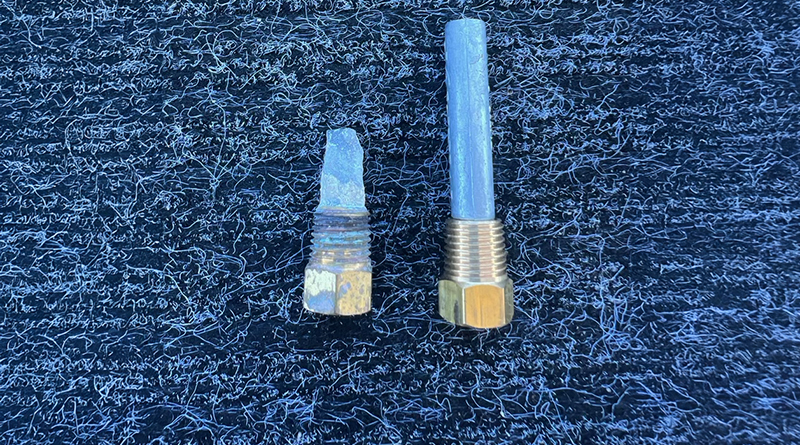
One type of anode that often gets overlooked, until it causes a problem, is the pencil zinc. These narrow, rod-shaped anodes are tucked deep inside your engine’s cooling system and are responsible for protecting components like aftercoolers and heat exchangers. They’re threaded into a brass plug and inserted into engine housings, absorbing the brunt of internal corrosion before it can cause damage to these critical and often costly systems.
Like all sacrificial anodes, pencil zincs don’t last forever. Their service life can be surprisingly short depending on a number of factors: high salinity, warm water, stray electrical currents in the marina, the amount of exposed metal on your boat, and even the size or quality of the anode itself. In busy marinas or during peak boating season, a pencil zinc might only last three to six months. Under lighter use or in cleaner waters, they can hold out for nearly a year. But regular inspection is key.
Veteran marine mechanics recommend checking your pencil zincs every one to three months, especially during periods of heavy use or if your boat lives in a slip surrounded by electrical activity. A failing pencil zinc often looks pitted, chalky, or uneven. If it’s halfway gone, it’s time for a replacement. Ignore it, and you risk letting corrosion run wild inside systems you really don’t want to replace.
Changing a pencil zinc may sound simple, but it’s one of those maintenance tasks where attention to detail matters. Use the right tools: a wrench to hold the brass plug and split-jaw pliers to handle the zinc itself. Tighten the zinc into the plug securely, but not too tightly. It’s a soft metal and overtightening can cause it to snap, potentially leaving you with a broken stub jammed in place. And if the anode works loose, it can end up inside your heat exchanger, causing a whole different kind of headache.
Another common mistake? Forgetting to remove the price tag. That little sticker might not seem like a big deal, but over time, it can disintegrate, clogging passages and restricting flow inside your cooling system. It’s a small oversight that can lead to a surprisingly large problem.
Some mechanics apply a soft thread sealant, like Tef Gel, to the plug threads to help with corrosion resistance and make future removal easier. Just be sure not to overdo it. Again, overtightening the plug or zinc can crack the housing and create an entirely new set of issues.
If the brass plug itself is looking worse for wear but still structurally sound, it may not need to be replaced. Corrosion can be removed with a controlled application of muriatic acid; though, as always, this method requires caution, gloves, and good ventilation. When used carefully, this can extend the life of your components and save you a trip to the chandlery.
None of these steps take much time, and all of them protect the long-term health of your boat. Let a zinc go too long without replacement, though, and you might be in for some expensive surprises. Corroded heat exchangers, damaged shafts, and weakened thru-hull fittings are all within the realm of possibility when anodes are ignored.
As the saying goes among dockside technicians, zincs are there to “distract the corrosion gremlins” before they chew their way through your marine investments. It’s a colorful image, but an accurate one. These tiny metal martyrs might not get much attention, but they deserve a spot on every boater’s maintenance checklist.
Next time when you find yourself elbow-deep in your bilge or craning over the transom to clean your prop, give a nod to the humble zinc anode. It’s taking one for the team. And that team is your boat, your wallet, and your peace of mind.