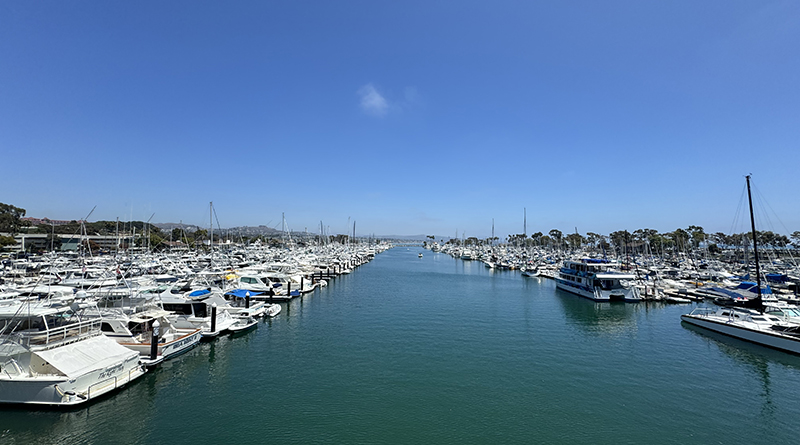
It starts with a harbor. Tucked along the Orange County coastline, Dana Point Harbor has always felt like more than just a place to launch a boat. The cliffs that frame its entrance and the calm waters that stretch from its slips out to the Pacific make it an almost tailor-made starting point for adventure. For many, it’s a gateway to Catalina Island, a sportfishing trip, or an afternoon sail. But for countless others, Dana Point has become synonymous with something far more extraordinary: the chance to look a whale in the eye.
The story of how Dana Point earned its title as the Dolphin and Whale Watching Capital of the World weaves together passion, persistence, and a natural environment teeming with life. Today, it’s one of only a handful of Whale Heritage Sites on the planet and the very first in the United States. But this reputation didn’t happen overnight. It came from decades of local dedication, a pioneering spirit, and companies like Captain Dave’s Dolphin & Whale Watching Safari that dared to reimagine what a day at sea could be.
Captain Dave Anderson and his wife, Gisele, didn’t start with a business plan or a fleet of vessels. Back in the early 1990s, the couple was sailing a small boat, enchanted by the marine world just offshore. They loved sharing that experience with others, and soon their weekends were spent taking passengers out to glimpse dolphins and whales gliding past the bow. What began as a hobby quickly turned into a calling, and eventually into one of Southern California’s most respected whale watching companies.
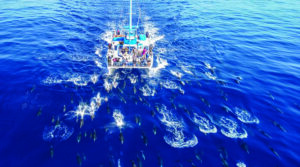
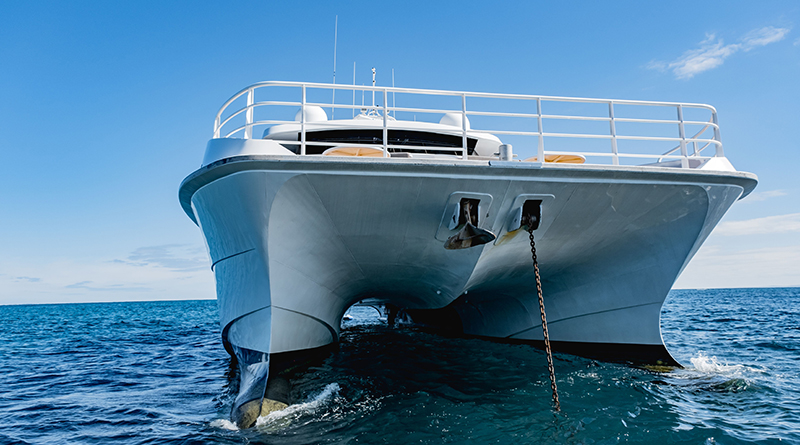
By 2007, the business took a giant leap forward when Captain Dave purchased Manute’a, a 50-foot catamaran from the Pacific Whale Foundation in Maui. With room for nearly 50 passengers and wide, stable decks, it was a major upgrade from the family’s first 35-foot sailing catamaran. But as remarkable as Manute’a was, Captain Dave wanted something that didn’t exist anywhere else. He dreamed of a way for passengers to step below deck and meet whales and dolphins at eye level — to be immersed in their world without getting wet.
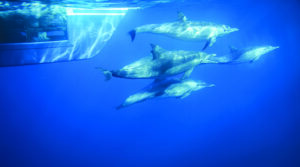
That dream became the underwater viewing pods. The idea was simple in theory but revolutionary in practice: cut into the hulls of Manute’a and install thick, bulletproof glass panels that would allow passengers to step into pods beneath the surface. From there, they could look out into the ocean and watch dolphins dart past, gray whales lumbering by, or even a curious humpback rolling over to take a closer look.
Of course, cutting holes into a boat wasn’t something the Coast Guard embraced right away. The project faced rejection after rejection. Naval architects drafted studies to prove the pods would be safe. Captain Dave filmed himself inside the pod location at sea, demonstrating its stability during choppy conditions. After months of effort, Washington eventually passed the decision back to Long Beach, where the local office finally gave the green light. By 2009, the world’s first underwater viewing pods were open to the public.

Passengers who climb down into those pods today describe it as surreal. Unlike a glass-bottom boat, where the view is limited to whatever drifts by beneath the keel, the pods surround visitors with water on all sides. Dolphins zip past in coordinated bursts, their clicks and whistles echoing as if they’re communicating with their new spectators. Whales sometimes pass close enough to fill the window with mottled gray skin or a massive fluke. For many, the experience feels less like observing wildlife and more like sharing space with it. As Gisele Anderson explains, “When you’re in our unique underwater viewing pods and a pod of dolphins swims alongside — close enough that you could almost reach out and touch them if not for the glass — it literally feels as if you’re one of the pod. The way the animals look at you, eye to eye, creates the most amazing connection you may ever have with wild creatures.”
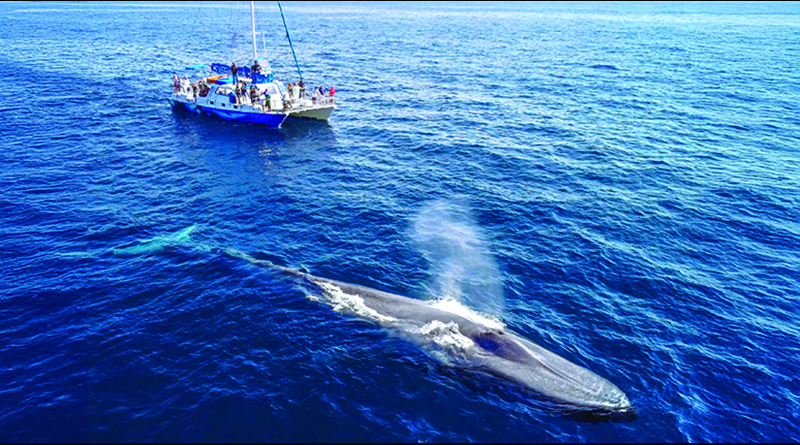
It’s innovations like these that helped define Dana Point’s identity. But beyond any single company, the harbor itself offers conditions that set it apart from other whale-watching destinations. Just minutes after leaving the docks, boats reach deep water where whales and dolphins thrive. The local seas are often calm and glassy in the mornings, making trips smoother for families and first-time visitors. And then there’s the sheer diversity: gray, blue, humpback, fin, and minke whales frequent these waters, with the occasional surprise appearance by orcas or pilot whales. Tens of thousands of dolphins — and sometimes stampedes of hundreds — add an unforgettable spectacle.
As Anderson puts it, “Dana Point is the trademarked Dolphin and Whale Watching Capital of the World® and North America’s first Whale Heritage Area. The designation, awarded by the World Cetacean Alliance, recognizes that we have distinguished ourselves as a place that celebrates, conserves, protects, researches, and creates around dolphins and whales. Combined with our close proximity to deep coastal canyons where the animals feed, this makes Dana Point an incredibly unique and special destination.”
It’s no wonder Dana Point was recognized in 2021 as the first Whale Heritage Site in the United States, joining an elite group of destinations in Australia, South Africa, and Spain. The honor wasn’t just about wildlife abundance. It was also about heritage, culture, education, and sustainability. Dana Point’s whale watching industry has always emphasized responsible practices, prioritizing the well-being of marine life and working to educate passengers about the ecosystems just offshore.
Earning that distinction took local collaboration. For decades, Dana Wharf Sportfishing & Whale Watching and Captain Dave’s Dolphin Safari competed for passengers. The rivalry was fierce at times, with both companies vying for tourists and residents eager to see the ocean’s giants. But eventually, the two realized they shared something bigger than competition: a chance to put Dana Point on the global map. They teamed up to pursue the Whale Heritage Site designation, highlighting the harbor’s unmatched access to whales, its long-running Festival of Whales, and its strong cultural ties to the migration patterns that have defined the region for centuries.
That collaboration harkens back to the early days of the industry. In the 1960s, Don Hansen, founder of Dana Wharf, pioneered the first whale watching tours off Southern California. What started as an experiment soon became a new form of tourism, and Hansen later launched the Festival of Whales to celebrate the gray whales that pass Dana Point each year on their journey between Alaska and Mexico. The event has since grown into a beloved annual tradition, with parades, educational programs, and community gatherings that blend conservation with celebration.
Today, the Festival of Whales remains a cornerstone of Dana Point’s cultural identity, drawing thousands of visitors every spring. It reflects the same philosophy that underpins the Whale Heritage Site designation: that whales and dolphins aren’t just tourist attractions but integral parts of the community’s story.
The abundance of wildlife certainly helps. On any given day, tours may encounter multiple whale species and dolphin pods so large they stretch to the horizon. Marine biologists estimate that 450,000 common dolphins live between Southern California and Baja California, giving the region the highest density of dolphins anywhere in the world. The spectacle is so reliable that Dana Point tours often promise sightings year-round, a claim few other destinations can make.
The combination of natural abundance, community heritage, and innovation has positioned Dana Point as a model for sustainable marine tourism. Organizations like the World Cetacean Alliance and World Animal Protection view Whale Heritage Sites as the future of wildlife interaction, emphasizing authentic encounters in the wild rather than captivity. Dana Point’s operators share that vision, encouraging people to skip the tanks and see dolphins and whales where they belong: in the ocean.
That mindset is part of why locals sometimes compare Dana Point to the Serengeti. Just as safari-goers wouldn’t fly to Africa to see lions in a zoo, visitors here are urged to skip captive shows and head out on the water. The ocean off Dana Point offers its own safari, a living ecosystem where predators, prey, and massive migrations unfold daily.
For visitors, a whale watching tour here feels like stepping into that story. A two-and-a-half-hour trip may include the towering spout of a blue whale, the acrobatics of a humpback, and the dazzling spectacle of dolphins racing the bow. On some days, passengers might even witness the start of the gray whale migration, a journey that has repeated for centuries and still defines much of Dana Point’s identity.
Both Captain Dave’s and Dana Wharf continue to play central roles in this experience. Captain Dave’s offers tours aboard Manute’a and several other vessels, from small, fast Zodiacs to luxury options. Each trip combines education with awe, often led by naturalists who explain the science and behavior behind what passengers are seeing. Dana Wharf, meanwhile, continues its long tradition with comfortable boats, family-friendly pricing, and decades of experience passed down from Don Hansen himself. Together, the two companies ensure that Dana Point lives up to its reputation as the dolphin and whale watching capital of the world.
For the community, whale watching isn’t just a business — it’s a legacy. It ties the harbor to the natural cycles of the Pacific, brings families together each spring for the Festival of Whales, and cements Dana Point’s place on the global stage as a destination defined by its connection to the sea. It’s a story of passion, persistence, and partnership, told not just in history books but in every dolphin stampede and whale fluke that breaks the surface.
As Anderson reflects, “We love what we do — all of us, the entire team. We’ve been incredibly blessed by God, and sharing what we love and experience every day — the ocean and its animals — is both a gift and a privilege.”
And for the passengers who step into Manute’a’s underwater pods, it’s something even more personal. To be eye-to-eye with a whale or a dolphin, watching it glide effortlessly through its world, is to understand why Dana Point fought to earn its title and why it continues to protect it. For a few breathtaking minutes, the glass disappears, the boundary between species fades, and the only thing left is wonder.
Dana Point isn’t just a harbor. It’s a heritage, a living Serengeti of the sea, and a reminder that some of the greatest adventures in the world can begin just seven miles offshore.