Oarfish have been making waves in Southern California this year, quite literally, as these mysterious deep-sea creatures keep washing ashore. On November 6, 2026, a researcher from the Scripps Institution of Oceanography discovered a 10-foot-long specimen at Grandview Beach in Encinitas. This marked the third time this year an oarfish had been found on local shores, following similar incidents in La Jolla Cove and Huntington Beach earlier this year. Their sudden appearances have reignited public fascination with this rare species and the folklore that surrounds it.
These creatures, often described as the sea’s answer to dragons or serpents, are among the longest bony fish in the world, reaching lengths of up to 30 feet. With their elongated, ribbon-like bodies and shimmering silvery scales, they have inspired myths for centuries. The dorsal fin running the length of their bodies adds to their otherworldly look, giving rise to old tales of sea monsters. Oarfish inhabit the dark depths of the ocean, living between 650 and 3,300 feet below the surface. As deep-sea dwellers, they rarely encounter humans, preferring the mesopelagic and bathypelagic zones of the world’s oceans. Their diet mainly consists of plankton, crustaceans, and squid, which they filter from the water using specialized gill rakers.
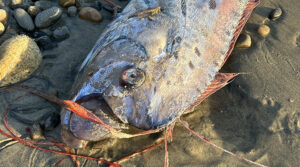
Their sudden appearances on California’s beaches, however, are not just biologically intriguing but also culturally significant. In Japanese folklore, oarfish are seen as messengers from the sea gods, believed to warn of impending earthquakes and tsunamis. Known as “Ryūgū-no-tsukai,” or the “Messenger from the Sea God’s Palace,” their strandings have long been considered ominous. This belief gained traction after several oarfish were discovered along Japan’s coastline shortly before the devastating 2011 Tōhoku earthquake and tsunami. Although no scientific evidence supports a direct link between oarfish appearances and seismic activity, the legend endures, blending superstition with a sense of awe.
The reasons why these elusive creatures end up on beaches remain a subject of scientific inquiry. Some experts speculate that environmental changes such as rising ocean temperatures, pollution, or even underwater seismic disturbances might disorient them, leading them to venture into shallower waters. Others believe that illness or injury may play a role, weakening the fish and making them vulnerable to ocean currents. In some cases, their strandings could simply be a result of natural death, with their buoyant bodies floating to the surface and eventually washing ashore.
For marine scientists, each oarfish stranding offers a rare opportunity to study these enigmatic creatures up close. Researchers at institutions like the Scripps Institution of Oceanography have collected samples from the recent strandings to analyze their biology, health, and the potential causes of their beaching. These studies could shed light on their life cycle, behavior, and the broader environmental factors affecting them. As a species that resides in the deep sea, oarfish are also considered indicators of ocean health, providing valuable insights into the impacts of climate change and human activities on marine ecosystems.
While science seeks answers, the public remains captivated by the sheer rarity and mystique of the oarfish. Their appearances are a reminder of how little we truly know about the depths of the oceans, where creatures like these silently dwell. For many, spotting an oarfish feels like catching a glimpse of the unknown — a fleeting connection to the deep sea’s secrets.
The fascination with oarfish spans both cultural and scientific realms, blending ancient beliefs with modern curiosity. Whether their strandings are harbingers of doom, as folklore suggests, or simply the natural consequence of life in the ocean’s harsh environments, these extraordinary creatures continue to inspire awe. As researchers dive deeper into the mysteries of the oarfish, each discovery brings us closer to understanding not only their world but the vast and largely uncharted ocean they call home.