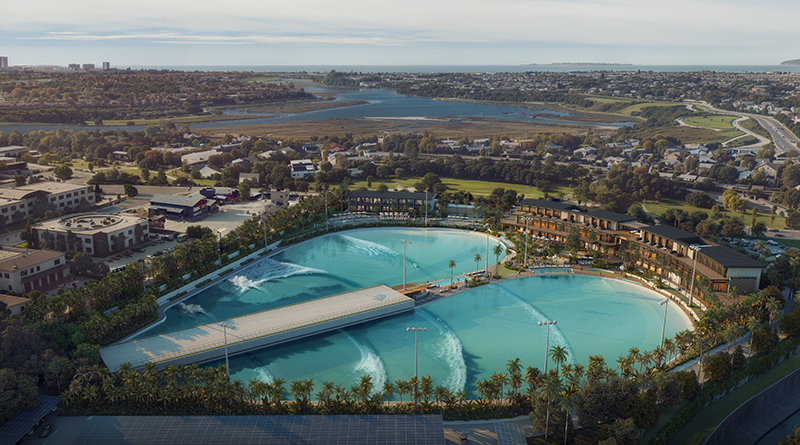
In the Nov. 21, 2025, issue of The Log, we reported on the Newport Beach City Council’s unanimous approval of a major recreation proposal known as Snug Harbor Surf Park — a nearly 60,000-square-foot development that would have brought Orange County’s first wave pool, along with a surf academy, restaurant, wellness center and athlete accommodations, to a portion of the Newport Beach Golf Course.
Just weeks later, that approval has been reversed.
At a recent council meeting, members voted 6-0, with Councilmember Noah Blom recusing himself, to rescind the previously approved general plan amendment that would have allowed the project to move forward at its originally proposed scale. The decision followed certification by the Orange County Registrar of Voters that a citizen-led petition had gathered the required 6,118 valid signatures to either force the council to rescind the approval or place the matter before voters in an election later this year.
Rather than pursue a ballot measure, the council chose to withdraw its earlier approval.
Councilmember Erik Weigand clarified during the meeting that a wave pool could still technically be constructed on the property under current zoning rules, but only at a much smaller scale, as it would be treated as an outdoor recreational use rather than a large-scale development. He noted during the meeting that there was little appetite to spend city funds on an election to resolve the matter.
The original amendment, approved in October, increased allowable development space from 20,000 square feet to 59,772 square feet. That expansion was a key element in allowing the surf park vision to move forward as designed.
Whether the developer intends to pursue a scaled-down version of the project remains unclear. The development team declined to comment.
Opposition to the project had been organized by the group Save Newport Beach Golf Course, led by volunteer chair Benny Hallock, who argued that the golf course is an important community asset and that artificial waves are unnecessary in a city located just three miles from the ocean. Hallock previously told other news outlets that wave pools are “trendy, shiny objects that fail under financial reliability,” adding that the technology is “glitchy and unproven,” and questioning whether Newport Beach should serve as a testing ground.
At the same time, Hallock emphasized in public comments reported elsewhere that the group respects property rights and recognizes that the golf course needs revitalization, but hopes a solution can be found that preserves the course for future generations.
The land in question consists of three parcels, two of which operate under a 55-year lease that is nearing expiration. The third parcel is county-owned. With the wave pool proposal now uncertain, it’s not clear whether the landowner will continue operating the property as a golf course or consider alternative uses, nor is it known if other parties may seek to lease the property for different purposes.
Under the original proposal, the wave pool and its amenities would have replaced three holes of the course, along with the driving range, restaurant, bar and pro shop. Plans included a three-story, 50-foot-tall building housing a surf academy, shop, restaurant, fitness space and yoga studio, as well as a second structure providing short-term accommodations for athletes. The development was projected to attract approximately 700 daily visitors, with an additional 280 restaurant patrons.
Councilmember Sara Weber described the process, in comments reported by other outlets, as “very complex from the beginning,” acknowledging the strong feelings expressed by both supporters and opponents. She noted that while Newport Beach had an opportunity to consider a significant recreational amenity, she also understood the deep community attachment to the golf course.
Several similar wave pool projects are already underway in Southern California, including facilities in Palm Springs, Palm Desert and Oceanside. If constructed as originally envisioned, Snug Harbor Surf Park would have been the first of its kind in Orange County.
For now, the future of the project remains unclear. What is certain is that the conversation about how this land will be used, and how the community balances recreation, development, and preservation, is far from over.