With expert advice from avid boater marine maintenance specialist, David Townsend.
By: Katherine Clements with contributions from David Townsend
A flooded marine engine isn’t just inconvenient—it’s a high-stakes problem that can turn a great day on the water into an expensive repair bill. Saltwater inside an engine’s cylinders can cause hydrolock, a condition where incompressible water prevents pistons from moving. In the best case, you’ll be dealing with contaminated oil and some cleanup. In the worst case, you’re looking at bent connecting rods, scored cylinder walls, and a full engine rebuild. That’s why quick action matters.
According to avid boater marine maintenance specialist, David Townsend, “First thing you do when you know your engine is flooded: turn it off! Turn your battery selector switch to ‘off’ so that nobody can accidentally turn the engine on. From there, the job is twofold—stop the intrusion, and clear the water before corrosion or mechanical damage sets in.”
How Seawater Gets Into an Engine
Most inboard and sterndrive propulsion engines sit at or below the waterline. That location is convenient for weight distribution, but it means the exhaust system is always working to keep water out as much as it’s working to move exhaust gases out. Two key components in that defense are the exhaust riser and the flapper valve.
The exhaust riser creates a “hump” in the exhaust system, routing hot exhaust gases upward before they travel down toward the outlet. In a wet exhaust system, it also mixes in cooling water from the raw-water pump to bring down exhaust temperature. This design keeps the exhaust hose from melting and, just as importantly, keeps seawater from running backward into the engine when the boat is pitching in waves or sitting stern-low at idle. Riser height and integrity are critical—if the riser corrodes through internally, loses its elevation due to sagging mounts, or is replaced with a shorter part, seawater can bypass this protection.
The flapper valve, also called an exhaust shutter, is another simple but critical safeguard. Installed near the exhaust outlet, it’s a one-way check valve that opens when exhaust gases push out and closes when water pressure pushes in. Without a working flapper, waves, wakes, or a following sea can push water right back through the exhaust hose. A missing, torn, warped, or stuck-open flapper is essentially an open door for water intrusion.
Water can also find its way into the cylinders through other scenarios:
- Improper installation – If the exhaust is plumbed below the manufacturer’s recommended height or without a proper siphon break, water can siphon in after shutdown.
- Faulty anti-siphon valve – If it sticks open, it can let water run back into the system.
- Extended cranking – When bleeding a fuel system, the raw-water pump is still turning. Each revolution adds a small amount of seawater to the exhaust until it backs up into the engine.
When multiple failures align—such as a corroded riser and a missing flapper in rough seas—the risk of a flood increases dramatically.
What to Do if Your Engine Floods
If you suspect water has entered your engine, resist the urge to start it. Turning it over with water inside the cylinders can cause instant, severe damage. For engines with a turbocharger and aftercooler, remember that those components can also fill with water and will need to be drained and flushed.
If the flooding happened within the past 24 hours:
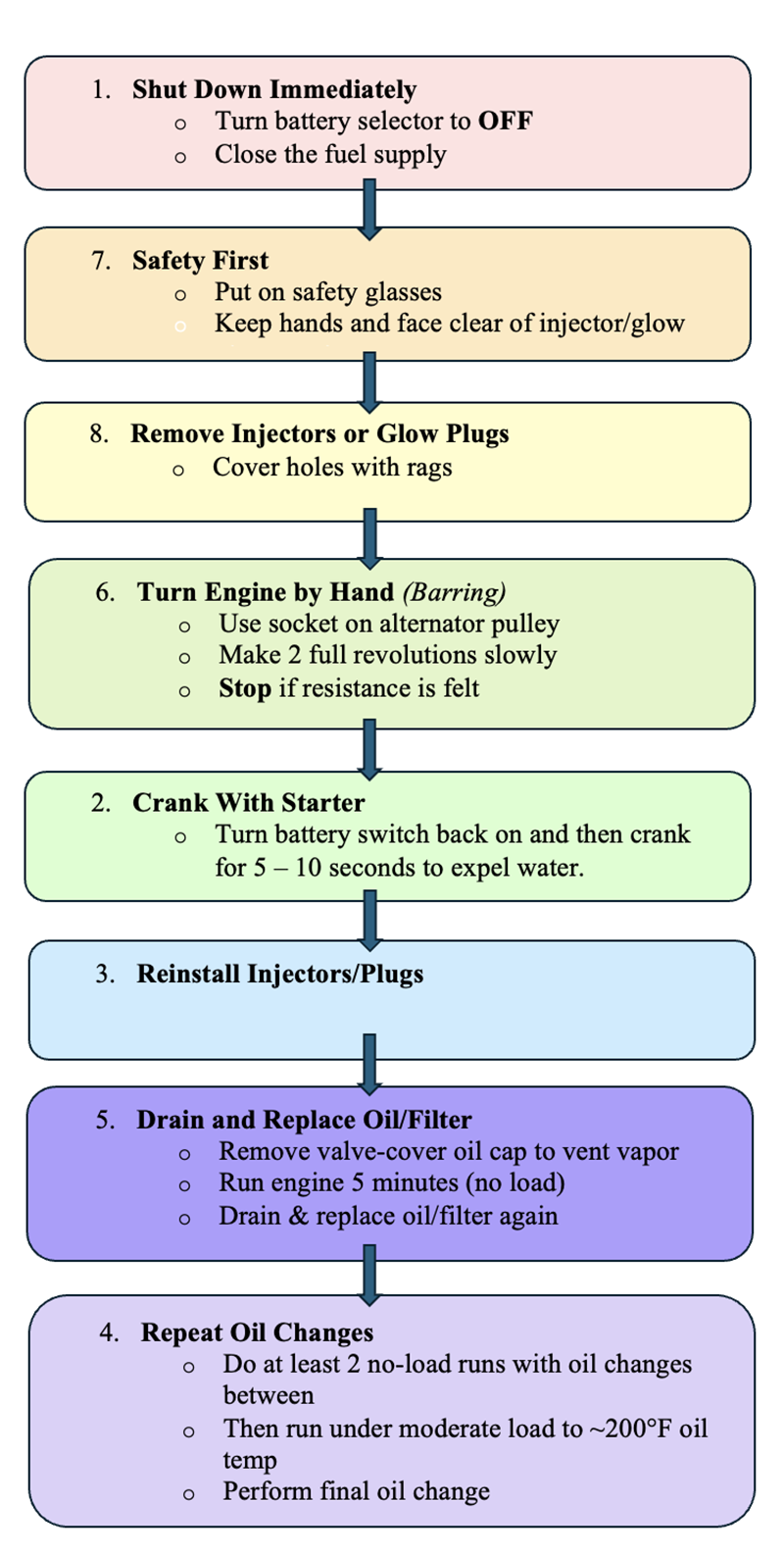
- Shut everything down – Turn the battery selector to “off” and close the fuel supply.
- Wear protective gear – Safety glasses are a must.
- Remove injectors or glow plugs – Cover the holes with rags and keep clear.
- Bar the engine over by hand – Use a socket wrench on the alternator pulley. Make two slow revolutions. If you feel resistance, stop—something may be seized.
- Crank with the starter – If it moves freely, crank for 5–10 seconds to push out water.
- Reinstall injectors or plugs.
- Drain and replace oil and filter – Remove the valve-cover oil cap to vent vapor. Run the engine for 5 minutes, then drain and replace oil and filter again.
- Repeat – Do two no-load runs with oil changes between, then run under moderate load until oil reaches about 200°F. Perform a final oil change.
If the water’s been in there for more than 24 hours:
Saltwater corrosion may have already started. Repeat steps one through four, then remove the valve cover and inspect the valve train. Pour kerosene, light motor oil, or ATF over the valves and gently tap rocker arms to ensure they move freely. If anything sticks, you may need to pull the cylinder head. If all moves freely, disable the run function, spray fogging oil into the intake while cranking, and then follow the oil-change steps above.
Prevention Is Always Cheaper
Once you’ve got the engine running again, focus on preventing a repeat. Regularly inspect exhaust risers for corrosion and replace them before they fail. Make sure your flapper valves are intact and properly installed. Test anti-siphon valves to confirm they work. And if you ever have exhaust system work done, double-check that it meets your engine manufacturer’s installation specs for height and routing.
A flooded engine is always a bad day, but catching it early and knowing what to do can mean the difference between a quick recovery and a long, costly haul-out. On the water, prevention and preparedness aren’t just smart—they’re the only way to keep your boat’s heart beating strong.
[Side Bar: On-Board Emergency Checklist: Flooded Engine
If You Suspect Seawater in the Engine
- Shut Down Immediately
- Turn battery selector to OFF
- Close the fuel supply
- Safety First
- Put on safety glasses
- Keep hands and face clear of injector/glow plug openings
- Remove Injectors or Glow Plugs
- Cover holes with rags
- Turn Engine by Hand (Barring)
- Use socket on alternator pulley
- Make 2 full revolutions slowly
- Stop if resistance is felt
- Crank With Starter
- If free, crank for 5–10 seconds to expel water
- Reinstall Injectors/Plugs
- Drain and Replace Oil/Filter
- Remove valve-cover oil cap to vent vapor
- Run engine 5 minutes (no load)
- Drain & replace oil/filter again
- Repeat Oil Changes
- Do at least 2 no-load runs with oil changes between
- Then run under moderate load to ~200°F oil temp
- Perform final oil change
If Water Has Been in Engine >24 Hours
- Repeat steps 1–4
- Remove valve cover and inspect valve train
- Pour kerosene, light motor oil, or ATF over valves
- Tap rocker arms to confirm free movement
- If all moves freely, disable run function and fog intake while cranking
- Resume oil change/run procedure
Prevention Tips
- Inspect exhaust risers regularly; replace before corrosion failure
- Check flapper valves for damage or misalignment
- Test anti-siphon valves for proper function
- Verify exhaust system meets manufacturer’s installation specs.