Originally designed for freshwater bass, the multi-arm lure system is gaining attention among saltwater anglers targeting calico bass, yellowtail and other aggressive coastal predators.
Southern California anglers have never been shy about borrowing ideas from other fisheries.
From slow-pitch jigging imported from Japan to fly fishing techniques adapted for saltwater species, many of the region’s most productive methods began somewhere else before finding a place in local waters. Now, another unconventional technique is beginning to earn a following among adventurous anglers: the Alabama Rig.
Originally developed for freshwater bass fishing, the Alabama Rig — often called an “A-rig” — is making appearances aboard private boats and sportfishing vessels as anglers experiment with its ability to imitate a tightly packed school of baitfish.
When predators are feeding aggressively on anchovies, sardines or small baitfish, the presentation can offer something individual swimbaits simply cannot: the illusion of an entire bait school.
What Is an Alabama Rig?
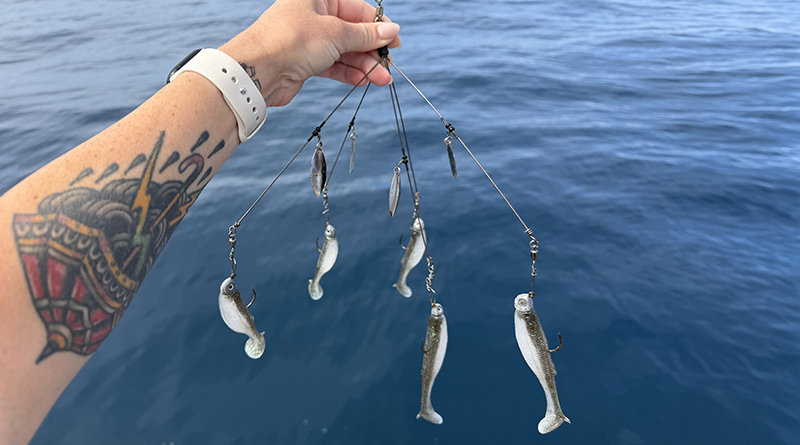
At first glance, the Alabama Rig looks more like a small umbrella than a fishing lure.
The system consists of a central wire frame with multiple flexible arms extending outward. Each arm holds a swimbait, soft plastic or teaser, creating the appearance of several baitfish swimming together.
Depending on local regulations and how the rig is configured, anglers may fish multiple hooked baits or combine hooked swimbaits with hookless teaser baits to create a larger bait ball profile.
The concept is simple.
Rather than presenting a single meal, the Alabama Rig imitates a frightened school of baitfish attempting to stay together as predators close in.
For fish conditioned to feeding on bait balls, that can be difficult to ignore.
Why It Works
Southern California’s offshore and coastal fisheries often revolve around bait.
Whether it’s anchovies packed tightly along a kelp edge, sardines balled up beneath diving birds or juvenile baitfish pushed against structure, predators frequently target schools rather than individual fish.
The Alabama Rig capitalizes on that instinct.
Instead of chasing one swimbait through the water column, predators see several baitfish swimming together.
The result can trigger competitive feeding behavior.
Fish that might hesitate to chase a single lure often react instinctively when they believe multiple prey are escaping at once.
A Tool for Calico Bass
Perhaps no local species is better suited to the Alabama Rig than the calico bass.
Calicos are aggressive ambush predators that spend much of their lives hunting kelp forests, rocky reefs and hard structure where schools of baitfish regularly gather.
Fishing the rig alongside kelp edges or over submerged rock piles allows anglers to imitate the forage bass naturally encounter every day.
Rather than crawling a single swimbait through the kelp, anglers can retrieve an entire school, creating additional flash and vibration while covering water efficiently.
During periods when baitfish are abundant, that added realism can make a difference.
Yellowtail Join the Party
The rig has also attracted attention among anglers targeting yellowtail.
When schools of yellowtail begin crashing bait near kelp paddies or breezing just below the surface, they often focus on tightly packed schools of sardines or anchovies.
An Alabama Rig allows anglers to match that scenario more closely than many traditional artificial presentations.
The technique isn’t intended to replace fly-lined sardines or surface irons, both of which remain proven Southern California staples.
Instead, it provides another option when fish are aggressively chasing bait but prove reluctant to commit to a single lure.
Other Potential Targets
Although calico bass and yellowtail have generated much of the interest, they’re unlikely to be the only species willing to eat an Alabama Rig.
Barracuda, bonito and even white seabass may respond under the right conditions.
Any predator actively feeding on concentrated bait schools could potentially be fooled by the presentation.
Like many techniques, success often depends less on the lure itself than on presenting it when fish are already feeding naturally.
When to Throw It
The Alabama Rig performs best when baitfish are abundant.
If birds are working, bait schools are visible on electronics or predators are corralling forage against kelp or structure, conditions often favor a bait-school presentation.
Water clarity can also play a role.
Because the rig relies heavily on visual appeal, cleaner water generally allows fish to better distinguish the multiple baitfish profile.
Many anglers retrieve the rig at a steady pace, allowing the swimbaits to swim naturally. Others incorporate brief pauses or occasional changes in speed to imitate injured baitfish attempting to stay with the school.
Matching Local Forage
One advantage of the Alabama Rig is its versatility.
Swimbaits can be selected to imitate nearly any baitfish currently available.
During anchovy-rich years, smaller plastics may be the best choice.
When sardines dominate the local forage base, slightly larger paddle tails can better match what predators are feeding on.
Color selection generally follows the same principles anglers already use for other swimbaits.
Natural baitfish colors often excel in clear water, while brighter patterns may help increase visibility during overcast conditions or in stained water.
Gear Considerations
Unlike a single swimbait, an Alabama Rig creates considerably more resistance in the water.
The additional drag typically calls for heavier casting rods capable of launching the larger profile and controlling the rig during the retrieve.
Medium-heavy to heavy rods paired with low-profile or conventional reels loaded with braided line are common choices.
A fluorocarbon leader provides abrasion resistance around kelp and structure while maintaining a relatively natural presentation.
Because multiple swimbaits create additional weight, anglers should also ensure their rod’s lure rating matches the rig being used.
Check the Regulations
Before tying on an Alabama Rig, anglers should familiarize themselves with California’s current fishing regulations regarding the number of hooks allowed on a single line.
Many anglers configure their rigs with only one or two hooked swimbaits while using the remaining arms as hookless teasers. This approach maintains the bait-school appearance while helping ensure compliance with applicable regulations.
Reviewing current regulations before fishing is always recommended, particularly when experimenting with new techniques.
Another Tool in the Tackle Box
The Alabama Rig isn’t replacing Southern California’s legendary surface irons, yo-yo jigs or live bait anytime soon.
Instead, it represents another example of how anglers continue adapting techniques from around the fishing world to meet local conditions.
As bait schools continue to play a central role in Southern California’s saltwater fishery, presenting multiple baitfish with a single cast offers an intriguing alternative for anglers willing to experiment.
Like every new technique, it won’t be the answer every day.
But when predators are feeding aggressively and bait fills the water, one cast that looks like an entire school may be exactly what it takes to turn curious followers into committed bites.