How upgraded bait tanks and tuna tubes can help anglers keep bait healthier and more productive from the harbor to the offshore grounds.
Anyone who’s spent time fishing Southern California knows that live bait is often the difference between a slow day and one to remember. Whether fly-lining a sardine for yellowtail at Catalina, slow-trolling a mackerel for white seabass or presenting a live bonito to trophy bluefin tuna, healthy bait consistently outperforms stressed bait.
That’s why more private boat owners are upgrading one of the most overlooked pieces of fishing equipment on board: the bait system.
While many factory-installed livewells perform adequately for occasional use, today’s offshore anglers are demanding more. Larger bait capacities, improved water circulation, better oxygenation and specialized systems like tuna tubes are becoming increasingly common as Southern California’s offshore fishery continues to improve.
The goal is simple: keep bait alive longer, healthier and more energetic.
Bigger isn’t always better
When anglers think about upgrading a bait tank, capacity is often the first thing that comes to mind. More gallons means more bait, right?
Not necessarily.
The most effective bait tanks aren’t simply larger. They’re designed to create an environment where bait can swim naturally while minimizing stress.
Rounded tanks have become the industry standard because they eliminate corners where baitfish can become trapped or repeatedly collide with tank walls. Constant impacts can quickly injure sardines and anchovies, causing the characteristic red noses many anglers have seen after a long day on the water.
Equally important is water circulation.
A properly designed livewell keeps fresh seawater moving continuously through the tank without creating excessive turbulence. Dead spots where water stagnates or overly aggressive currents that exhaust bait can both shorten bait life dramatically.
For Southern California anglers purchasing bait before making the run to Catalina or offshore banks, maintaining consistent water quality throughout the day often becomes just as important as selecting lively bait in the first place.
Water quality matters
Healthy bait depends on far more than simply pumping seawater into a tank.
As baitfish breathe, they consume oxygen and release carbon dioxide and waste products. As the number of fish increases, oxygen demand rises while water quality gradually declines.
Modern bait tank upgrades often focus on maximizing dissolved oxygen while efficiently exchanging water.
High-quality pickup systems, properly sized pumps and efficient venturi aerators all contribute to creating an environment where bait remains active rather than sluggish.
Temperature also plays a major role.
During Southern California’s warmest months, baitfish such as sardines and anchovies can become stressed when water temperatures climb beyond their preferred range. Although most recreational boats cannot actively chill bait tanks, maintaining a constant supply of fresh seawater helps prevent temperatures from rising further while flushing waste from the system.
When bigger bait requires a different approach
Traditional bait tanks excel at keeping schooling baitfish alive.
Sardines, anchovies and small mackerel are constantly swimming, circulating around rounded tanks designed specifically for their behavior.
Large offshore baits are another story.
Bonito, skipjack tuna and legal-sized yellowtail are powerful swimmers with extremely high oxygen demands. Place them inside a conventional bait tank and they often injure themselves, exhaust their energy reserves or simply fail to survive for long periods.
That’s where tuna tubes come in.
What are tuna tubes?
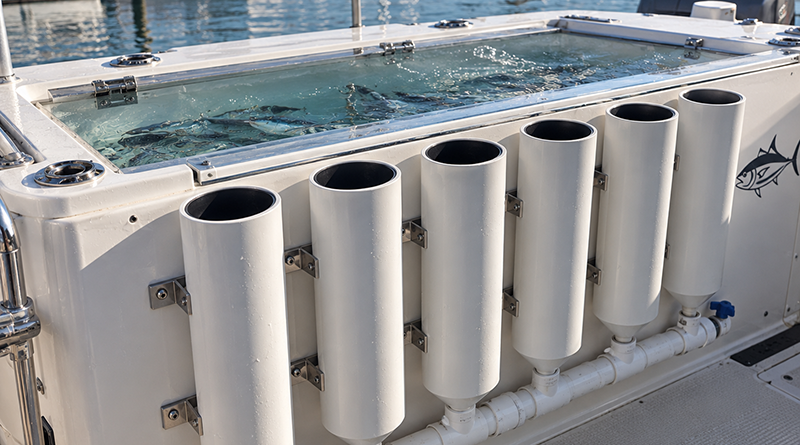
Rather than allowing bait to swim freely, tuna tubes hold each fish individually in a vertical tube.
The bait is placed headfirst into the tube while a high-volume stream of seawater flows continuously upward through its mouth and across its gills. The fish remains upright, supported by the water flow, while breathing naturally without needing to swim.
Instead of forcing the bait to constantly circle a tank, the tube allows it to conserve energy while remaining healthy and ready to fish.
Each bait occupies its own tube, preventing collisions and eliminating competition for oxygen.
Why are they becoming more popular?
Southern California’s remarkable bluefin tuna fishery has changed the way many anglers fish.
Slow-trolling a lively bonito or yellowtail has become one of the most effective techniques for targeting trophy-class bluefin. Those premium baits can be difficult—and expensive—to replace, making their survival a priority.
Tuna tubes dramatically improve the odds.
By keeping large baits calm and well oxygenated, anglers can spend more time searching for fish without worrying about replacing weakened bait every hour.
They’re also popular among marlin anglers fishing Baja California, where skipjack tuna and bonito remain some of the most productive natural baits available.
Is a tuna tube right for every boat?
Probably not.
For the average weekend angler targeting calico bass, barracuda or yellowtail with sardines purchased from a local receiver, a well-designed bait tank is often all that’s required.
Tuna tubes become most valuable for anglers who routinely fish offshore with larger live baits.
Many boats now carry both systems.
A conventional bait tank holds sardines or anchovies for fly-line fishing, while a set of tuna tubes keeps a handful of premium baits in reserve should larger game fish appear.
Choosing the right upgrade
Before investing in a new bait system, boat owners should consider how they fish most often.
Someone making overnight tuna trips may prioritize larger pumps, increased water flow and tuna tubes.
An inshore angler who spends weekends fishing kelp lines may benefit more from improving water circulation or replacing an older, square bait tank with a rounded design.
Capacity, plumbing, available deck space, electrical demands and maintenance requirements all deserve consideration before making modifications.
The bottom line
Southern California’s offshore fishery has never offered more opportunity. With bluefin tuna, yellowtail, dorado and yellowfin all within reach during the summer months, healthy bait has become one of an angler’s greatest assets.
Upgrading a bait tank — or adding tuna tubes for larger live bait — won’t guarantee more hookups. But keeping bait lively, healthy and stress-free gives anglers their best chance when the next opportunity swims by.
After all, the best bait in the receiver won’t do much good if it doesn’t survive the ride to the fishing grounds.