By: Lukas Stocker
Editor’s Note: This article is a guest contribution provided by Lukas Stocker owner of The Hull Master team. The content reflects the views and perspectives of the author. The Log did not participate in the writing or editorial development of this piece.

Winter in San Diego Bay has a reputation for giving boat owners a break from bio growth, but the period from January through mid-February 2026 showed that growth never really takes time off. Conditions early this year quietly favored early-stage fouling, and our divers consistently reported elevated growth compared to previous winters, especially on boats that sat still for extended periods.
In January, water temperatures held between 62 and 63 degrees Fahrenheit, warmer than the long-term average of 59. Salinity remained stable at 33.3 PSS. Chlorophyll briefly spiked to 0.99 micrograms per liter on January 6 before settling around 0.5, which is lower than typical bloom levels but still enough to support slime formation. Dissolved oxygen averaged about 8 milligrams per liter, well above the normal 4 to 5 range, creating favorable conditions for marine organisms to establish themselves on hull surfaces.
Our divers noted a clear uptick in growth throughout January compared to previous winters. While conditions typically slow fouling this time of year, an unusually warm winter has kept biological activity higher than expected. One diver mentioned that water temperatures have been warm enough to work comfortably in a 4/3mm wetsuit, something he has never experienced in January before. In colder winters, hulls are usually noticeably cleaner, but this year that seasonal slowdown never fully materialized. These warmer conditions are likely contributing to the elevated growth we saw across the bay in early winter.
As we moved into February, we began to see early signs of moderation. Water temperatures ranged from 61 to 64 degrees, with a temporary 1 degree drop during the heavy rains the week of February 16. Salinity held at 33.3 PSS overall but experienced a significant temporary decrease during that same rain event, which can help suppress certain forms of bio growth. Chlorophyll started the month low at 0.2 micrograms per liter and has gradually risen toward 0.6, indicating renewed biological activity after a late-January dip. Dissolved oxygen data has not yet been released for February.
The heavy rains are expected to slow overall bio growth rates in the short term. However, large freshwater runoff events often bring increased nutrients and suspended particulates into the bay. The most common result is not heavy hard growth, but a persistent slime or algae layer forming on hulls. This thin biofilm can spread quickly after rainfall and is often overlooked until performance drops become noticeable.
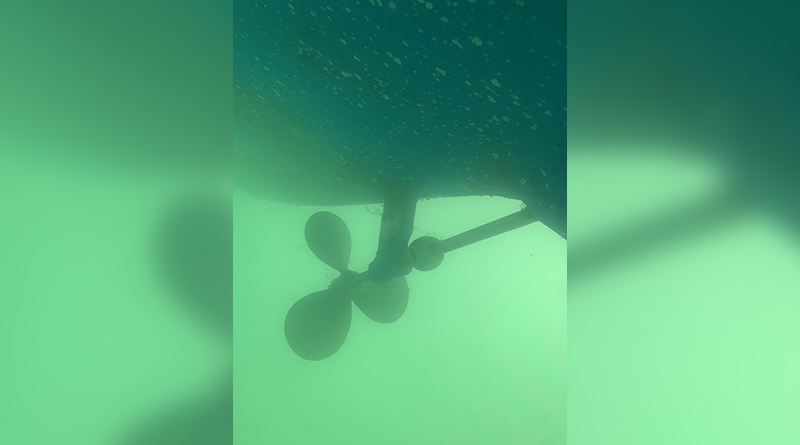
The result for boat owners is subtle but important. Slime builds first, often unnoticed, and creates drag that affects speed, fuel burn, and overall performance. Growth continues to show up earliest on the sunny side of the boat, where light and warmth accelerate biofilm development. Boats moored deeper inside San Diego Bay can also expect slightly more growth due to consistently warmer water compared to outer bay areas. After major rain events, pay particular attention to the waterline and upper hull, where algae layers tend to establish first.
There are a few simple habits that help slow the process beyond regular hull cleanings. Move your boat at least once a week if possible, even for a short run. Motion disrupts early growth before it becomes established. Be mindful of inlets and high-flow areas where nutrients concentrate and fouling can accelerate, especially after storms. Pay attention to bright slips and low-circulation marinas, and regularly check the waterline and sunny side of your hull following periods of heavy rain.
Based on January data, early February trends, and firsthand diver reports, The Hull Master continues to recommend a hull cleaning every four weeks for boaters in San Diego Bay, Mission Bay, and Oceanside. If February rain meaningfully suppresses growth, we may see a brief window of slower accumulation. We’ll report back in March with updated data and diver accounts to confirm whether growth rates are stabilizing or preparing to accelerate into spring.
In Southern California waters, winter maintenance still matters. January proved to be a warning sign rather than an off season, and February is shaping up to be transitional. Staying proactive now makes the rest of the year smoother on both your boat and your wallet. Adjusting cleaning intervals is far less expensive than reacting after growth takes hold.