What someone wears on the water can serve several purposes before a boat ever leaves the dock.
A long-sleeve performance shirt can provide protection during hours under the Southern California sun. A lightweight layer can make an early morning run offshore more comfortable. A hat can help with sun exposure and glare. Then there are the shirts, sweatshirts and hats that don’t necessarily perform a technical job but still say something about the person wearing them.
Boating apparel occupies both sides of that divide. There is clothing designed to perform on the water and clothing inspired by the culture surrounding it. For many boaters, anglers, sailors, and professional mariners, the two overlap.
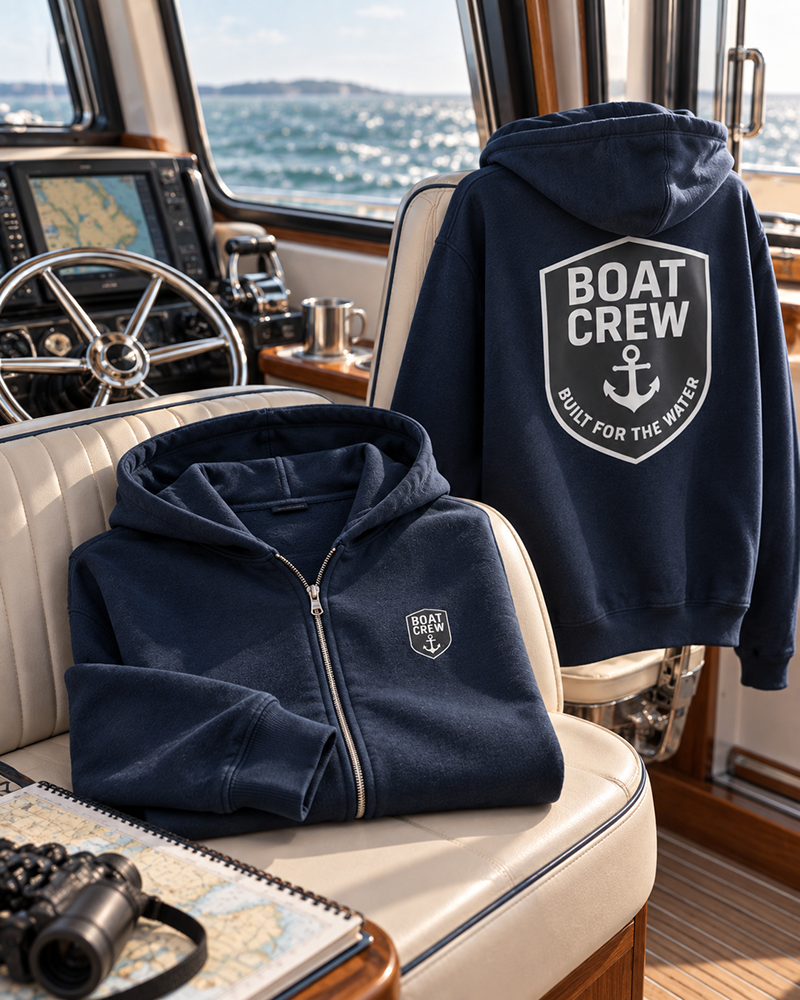
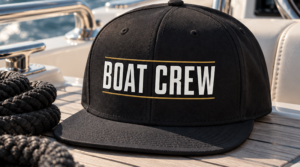
For Brian Curtiss, a Southern California ferry captain who’s spent nearly 10 years working on the water, that connection between apparel and maritime identity led him to create Boat Crew, a maritime apparel brand he’s been developing over the past year.
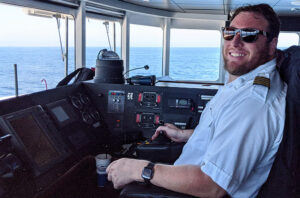
His experience as a captain has been influential on the company, but it’s also shown him how broad the boating community really is.
“There are professional mariners, anglers, sailors, divers, harbor workers, families, and recreational boaters all sharing the same water in different ways,” Curtiss said.
Rather than creating a brand that simply borrows familiar nautical imagery, Curtiss wanted artwork that was drawn from his everyday encounters, and environment, and lifestyle.
“I didn’t want it to look like a brand that discovered boats from the outside,” he said. “I wanted the designs to come from the vessels, harbors, traditions, marine life, and people I’ve spent years around.”
His professional experience has also taught him that boaters often want clothing they can live in, something comfortable around the harbor or aboard a boat that still feels appropriate when the day on the water ends.
That balance between function and identity extends throughout the marine apparel market.
Dressing for a Day on the Water
A Southern California boating day can begin before sunrise in cool harbor air before transitioning into hours of direct sun and reflected glare. Offshore, wind, spray, and changing temperatures can make the conditions considerably different from what boaters experienced at the dock.
“Southern California can be deceptive,” Curtiss said. “It may be warm and calm when you leave the harbor, but wind, spray, and temperature changes offshore can make the day feel completely different. I think people should dress for the entire trip, not just for the conditions they see at the dock.”
That becomes particularly important for anglers spending the lion’s share of the day offshore. Curtiss recommends layering your apparel so it can be added or removed as the weather changes. He suggests wearing apparel that offers considerable sun coverage with breathable, quick-drying fabrics.
One of his own essentials is a lightweight UPF hooded sun shirt, something he came to appreciate after seeing Caribbean charter operators wear lightweight protective clothing during long days in the sun. He also recommends a good hat, sunglasses, and an extra layer such as a hoodie or lightweight jacket.
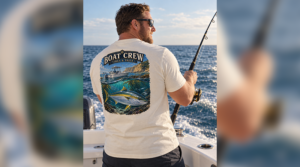
“The best setup is really about staying comfortable and protected from morning through evening, because conditions can change a lot over the course of a full day on the water,” Curtiss said.
Since boaters are exposed to both direct sunlight and light reflected from the water, fortification from the sun is particularly important. Protective clothing can supplement sunscreen while providing coverage during long days outside.
“For now, Boat Crew is still primarily lifestyle apparel, rather than technical performance gear,” Curtiss said. “But my experience on the water definitely shapes how I think about where the brand can grow.”
Technical apparel is one area he hopes to explore in the future.
For now, Boat Crew concentrates more heavily on the other role boating apparel plays: representing what the water means to the people wearing it.
A Working Coast, Not Just a Postcard
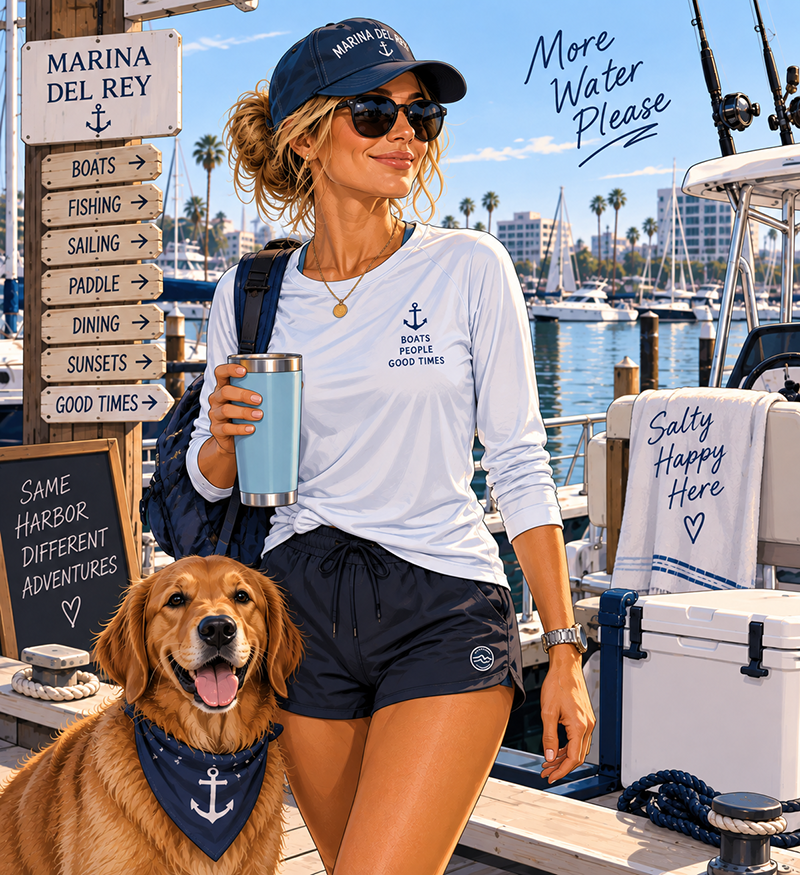
Walk through almost any Southern California harbor and that cultural side of boating apparel becomes apparent. Shirts represent fishing boats, yacht clubs, marinas, islands, harbors and destinations. Graphics depicting gamefish, nautical flags, working vessels, and familiar places can communicate an attachment to the water without saying a word.
Southern California gives Curtiss plenty of material, but his professional experience has led him to look beyond familiar vacation imagery.
“Southern California is beautiful, but it isn’t just a postcard,” he said. “It’s a working coast. People here work hard on the water and play hard on it too, and I wanted the artwork to reflect both sides of that culture.”
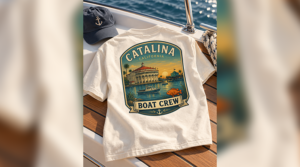
Catalina Island is one example. Beyond its scenery and recreational appeal, Curtiss sees crews crossing the channel before sunrise, fishing boats heading offshore, divers loading equipment, sailors getting underway, and commercial traffic moving through the harbors.
The challenge with location-based artwork, he said, is deciding which elements tell that larger story while keeping the place recognizable.
The region also allows boaters to experience very different bodies of water within a relatively short distance.
“We have the pleasure here of being able to work the coast in the morning and potentially be at a lake or river later that same day,” Curtiss said. “The setting may change, but the connection to boats and the water remains.”
That connection helps explain the name Boat Crew.
The concept of “crew” actually began for Curtiss before he became a professional captain. He first remembers feeling it while boating on Lake Tahoe with his family: spending a day together, looking out for one another and building memories on the water.
Years later, while professionally making crossings to Catalina, he recognized a more serious version of the same relationship.
“The setting was different and the responsibilities were much greater, but the underlying idea was familiar: trust, shared experience, and knowing everyone has a role,” he said.
Connecting those experiences convinced Curtiss that “crew” could extend beyond people professionally assigned to a vessel. It could describe families, anglers, sailors, divers, and friends whose relationships are built partly around their time on the water.
Building a Brand Around Belonging
Boat Crew began as an idea Curtiss repeatedly returned to. He liked the simplicity of the name and believed there was room for a brand that felt authentic to people who genuinely spend time around boats.
Eventually, he decided to see whether that idea could become something tangible.
“I wanted to see if I could turn it into something real — designs people would actually wear — a brand with its own identity and hopefully something that could grow into a recognizable part of boating culture,” Curtiss said.
Ultimately, he hopes the company represents belonging.
“One of the moments I look forward to most is seeing someone I’ve never met wearing the brand because it means something to them,” he said. “If Boat Crew can become something people genuinely identify with, then I think it will have accomplished what I hoped for.”
That sentiment illustrates the larger role apparel plays throughout boating culture.
A hat, shirt or hoodie can represent a vessel someone works aboard, the species an angler pursues, a harbor that feels like home, or simply the people with whom someone spends time on the water.
Not everyone wearing marine-themed clothing works aboard a vessel, just as not every boater needs technical apparel designed for extreme conditions. What someone needs depends on the trip.
An angler heading offshore for 10 hours should approach clothing differently than someone walking to dinner after docking in Avalon. A sailor preparing for a windy afternoon may prioritize layers and mobility, while someone spending a few hours cruising the harbor may be comfortable in a T-shirt and hat.
For performance clothing, boaters should consider fabric weight, breathability, sun protection, drying time, fit and durability. Apparel also should be appropriate for the conditions and should never interfere with safety equipment, including a properly fitted life jacket when one is needed.
Lifestyle apparel serves another purpose. Its value often comes from the story or community represented by the design.
For Curtiss, the best boating apparel ultimately finds room for both.
“The best apparel finds a balance between the two,” he said. “It makes sense around the water, but it also feels like something you want to keep wearing after you step off the boat.”
Southern California’s waterways are filled with professional captains and deckhands, anglers watching the weather for their next offshore trip, sailors racing around buoys, families heading to Catalina, divers loading equipment and boat owners spending an afternoon at the marina.
They may not work on the same vessel, but they often recognize something familiar in one another.
That’s where apparel and boating culture intersect. Technical clothing helps people stay comfortable and protected while they are on the water. The rest can tell a story about why they wanted to be there in the first place.
Sometimes that story is a favorite fish, island or harbor.
Other times, it is simply knowing who your crew is.