At Dana Wharf, finding whales and dolphins is only part of the job. Training, onboard naturalists and involvement in marine conservation help turn a day on the water into an opportunity to better understand the wildlife off Southern California’s coast.
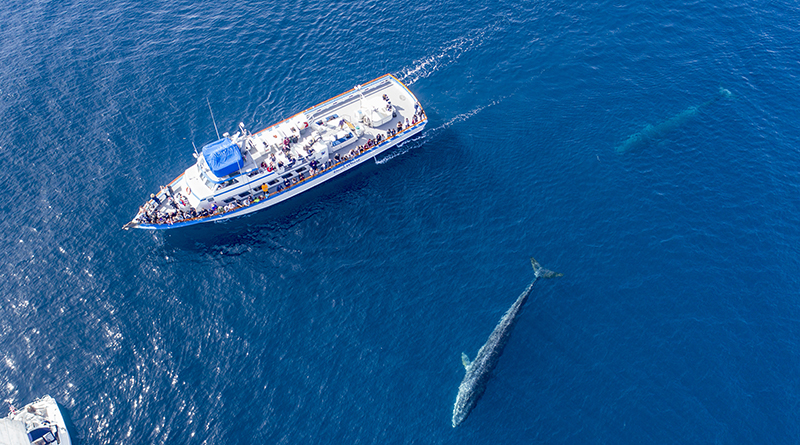
A whale breaking the surface off Dana Point can command the attention of an entire boat in seconds.
Passengers reach for cameras. Children rush toward the rail. Someone points toward the horizon, waiting for the animal to surface again.
The excitement of a sighting may draw passengers to the rail, but the experience does not end once an animal appears.
Understanding what passengers are seeing, communicating that information accurately and approaching marine wildlife responsibly require another level of knowledge. At Dana Wharf Whale Watching, education has become an important part of what happens between leaving the harbor and returning to the dock.
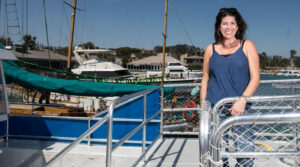
For Donna Kalez, whose family has operated Dana Wharf since her father, Don Hansen, established the business in Dana Point Harbor in 1971, the experience passengers see from the deck is supported by considerably more knowledge and preparation than may be obvious from shore.
Dana Wharf expects its captains to understand local marine life, weather, ocean conditions and the Dana Point coastline in addition to the technical requirements of operating a passenger vessel. Kalez said captains are knowledgeable about whales, dolphins and sharks and can transition between the company’s fishing and whale-watching operations when necessary.
“For our captains, technical ability is only the beginning,” Kalez said. “It takes much more than just being a captain to become a Dana Wharf captain.”
That expectation extends to how crews interact with passengers. According to Kalez, employees are expected to provide patient customer service and be especially mindful of children, families, seniors and people experiencing the ocean for the first time.
The emphasis is not simply on transporting passengers offshore, but helping them understand what they encounter once they get there.
In addition to the education that the captain’s hold, Dana Wharf also has volunteer Certified Marine Naturalists aboard many of its whale-watching trips. Following information provided by the captain, naturalists can work more directly with passengers, answering questions and providing additional context about the wildlife around the vessel.
All this collective knowledge can transform an encounter from simply seeing a whale — into a wholistic learning experience about the majestic creature.
Naturalists can help passengers identify species and understand migration, feeding patterns, social behavior and adaptations. They also discuss Dana Point’s marine ecosystem, responsible wildlife viewing and some of the threats facing whales and dolphins.
“We never want a Dana Wharf whale-watching trip to be only about taking a whale siting off a check list,” Kalez said. “We want guests to leave excited by what they saw, but also understanding the animals, their environment, and why protecting that environment matters.”
There’s plenty for them to explain.
One misconception Kalez regularly encounters is that whale watching in Dana Point is limited to a particular season. Dana Wharf operates whale-watching excursions throughout the year because the species offshore change with the seasons.
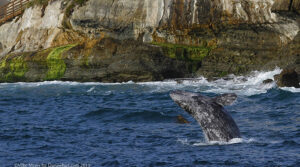
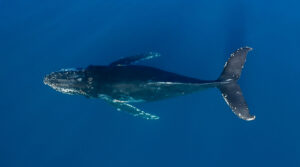
From January through April, gray whales are among the major attractions as they migrate along the Southern California coast, with humpback, minke and fin whales also possible. From May through October, passengers have their best opportunity to encounter blue whales, while November and December can again bring gray, humpback, minke and fin whales.

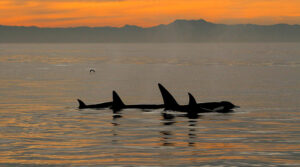
Less predictable visitors can make an appearance, too. Orcas occasionally pass through Southern California waters, and sperm whales, false killer whales, and pilot whales are among the more unusual cetaceans for which crews remain on the lookout. And in case that was confusing, despite the name, false killer whales aren’t killer whales; they’re a separate species of large oceanic dolphin, named for similarities in skull shape to orcas.
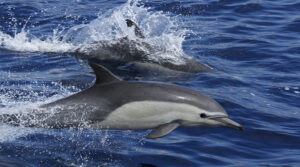
Dolphins provide another year-round attraction. Common and bottlenose dolphins are regularly encountered, while Pacific white-sided dolphins can appear during the colder months. Kalez said the waters off Dana Point support an estimated 450,000 common dolphins and are known for the large, fast-moving groups commonly described as dolphin stampedes.
Dana Point’s geography helps make those encounters possible. Deep underwater canyons occur close to shore, and the harbor is only minutes from open ocean, giving whale-watching vessels relatively quick access to productive marine habitat.
The city’s relationship with cetaceans has also earned international recognition. In 2021, Dana Point became the first Whale Heritage Area in the Americas through the World Cetacean Alliance, a designation centered on responsible whale and dolphin watching, conservation, education and community involvement.
For Dana Wharf, those ideas have roots extending much further back.
Kalez said her father’s involvement with whale watching began before Dana Point Harbor existed. Hansen started operating whale-watching excursions from San Clemente Pier in 1958 as a way to show people the gray whales traveling along the coast.
Education was part of the concept from the beginning.
Hansen worked with local educators and allowed schools to use the trips for fundraising, with the money returned to the schools. When he relocated the business to the newly developing Dana Point Harbor in 1971, San Clemente Sportfishing became Dana Wharf Sportfishing and Whale Watching.
That same year, Hansen helped start what became the Festival of Whales, an annual Dana Point tradition that continues more than five decades later.
Additionally, school field trips remain an important extension of that history.
Dana Wharf invites school groups of 20 or more aboard educational excursions and offers special group pricing during gray whale season from January through April. For students whose schools cannot fund the experience, another program helps bring the ocean within reach.
Dana Wharf works with the Gulf of Catalina Gray Whale Preservation & Education Foundation, led by Capt. Todd Mansur, to provide marine education and trips at no cost to participating students. The program combines classroom learning with time on the water, allowing children to connect lessons about marine life and conservation with the animals and habitat immediately off their coast.
More than 1,800 students participated across 18 trips from February through May 2026, according to Kalez, with the continuing goal of reaching approximately 3,000 children annually.
Capt. Brian Woolley has seen firsthand why getting those students onto the water matters. In addition to serving as captain of Dana Wharf’s Sum Fun, Woolley is a Certified Marine Naturalist with the American Cetacean Society and captains many of Dana Wharf’s educational whale-watching trips.
For some children aboard, the experience is not only their first whale watch. It is their first time on the ocean.
“A lot of the time, when they’re out on the boat, it’s their first time being on the ocean, even though they live in neighboring cities like Dana Point, San Juan Capistrano or San Clemente,” Woolley said. “It’s great seeing them view these marine mammals in their natural environment and seeing these animals swimming freely and enjoying life literally in their backyard.”
That proximity can turn something students may have previously encountered only in books, photographs or classroom lessons into something much more personal.
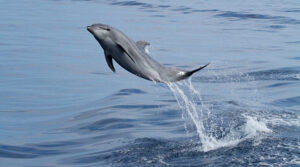
Woolley said some of the most memorable moments happen when dolphins approach the vessel and begin riding its bow wave.
“A lot of times, you can see it in the kids’ faces when they see a dolphin roll up on its side as it’s bow riding and literally look up at them,” Woolley said. “You can see that connection between the animal and the kid, and you know that’s something these kids will remember for the rest of their lives.”
Those encounters help explain why getting children onto the ocean can be such an effective extension of classroom education. Marine life is no longer something happening somewhere far away. It is swimming just offshore from the communities where many of these students live.
That educational work is part of a broader responsibility that Dana Wharf associates with operating on the ocean.
“The ocean has supported our family and our employees for more than 55 years,” Kalez said. “Supporting education and conservation is one of the ways we give back to the resource and the community that have made Dana Wharf possible.”
That responsibility is particularly relevant for employees who spend hundreds of hours each year observing the same stretch of Southern California ocean.
Captains and naturalists can see changing conditions firsthand. They may notice shifts in migration, concentrations of prey, unusual species appearances or changes in animal behavior. Their position also gives them an opportunity to introduce thousands of passengers to an ecosystem many have never experienced firsthand.
For some visitors, a Dana Point whale-watching trip may be their first close encounter with a whale or a large pod of dolphins. For a child, it may be the first time an animal discussed in a classroom suddenly appears beside the boat.
That creates an educational opportunity that extends beyond announcing a sighting.
Anyone aboard can point toward the horizon and say, “There’s a whale.”
The greater value comes from having someone explain what kind of whale it is, what it’s doing, why it may be there and why the ocean supporting it matters.
Off Dana Point, the difference between seeing wildlife and understanding it can begin with the person standing on the other side of the microphone.