A recent visit between two geographically distant ports revealed how much they have in common.
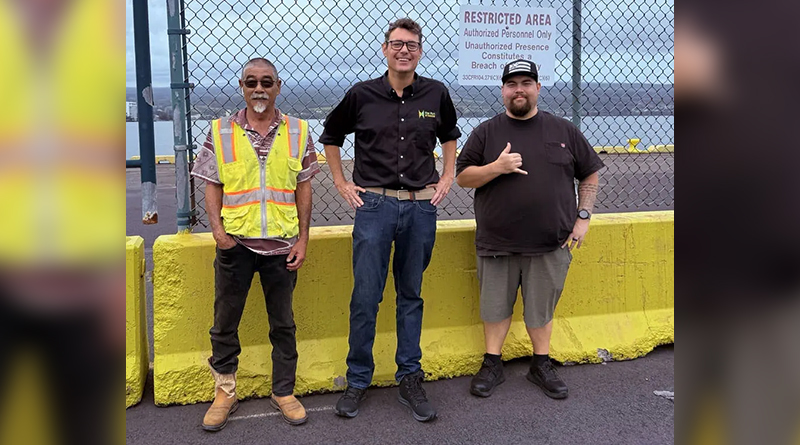
On January 26, 2026, Jason Hodge, President of the Harbor Commission for the Port of Hueneme, traveled to Hawaii as a guest of the Port of Hilo to participate in discussions centered on cargo movement, environmental initiatives and community engagement. What emerged from the visit was a recognition that both ports, despite their modest physical footprints, share similar operational challenges and priorities — and stand to benefit from closer collaboration.
“Ports like Hueneme and Hilo prove that size doesn’t limit impact,” Hodge said. “We face many of the same challenges and opportunities, and there is real value in sharing strategies that improve efficiency, protect our communities, and address climate change.”
Both ports operate in tightly constrained spaces while supporting extensive activity beyond their gates. Cargo velocity — the ability to move goods quickly and efficiently — plays a central role in their success. At the same time, both facilities are deeply integrated into their surrounding communities, making environmental responsibility and public safety key operational considerations.
During the visit, Guy Serikaku, Operations Manager for Hawaii Stevedores Incorporated, led a tour of Port of Hilo facilities and explained the unique complexities of operating a small port with limited berthing capacity. Hawaii’s inter-island shipping model requires careful coordination to keep goods moving reliably across the islands, a challenge that resonated with Hueneme’s own emphasis on operational efficiency.
“Operating a small port requires careful coordination and efficiency at every step,” Serikaku said. “Our system is designed to keep cargo moving quickly and reliably across the islands, and it was valuable to exchange perspectives with a port facing similar operational realities.”
Environmental initiatives were also a major topic of discussion. Ikaika “KK” Nacua, Marine Cargo Specialist at the Port of Hilo, outlined ongoing efforts to electrify the wharf, modernize infrastructure and pursue grant funding to support sustainability improvements. Hueneme’s nationally recognized leadership in port electrification and emissions reduction provided a practical model for what is possible at ports with similar constraints.
“We are focused on modernizing our facilities in a way that supports both operational needs and environmental responsibility,” Nacua said. “Learning from the Port of Hueneme’s experience in port electrification and sustainability helps accelerate what’s possible for ports like Hilo.”
The exchange also covered community engagement, port safety and shipboard firefighting — areas where both ports recognize the importance of preparedness and strong relationships with local stakeholders.
“Climate leadership at ports is no longer optional — it’s essential,” Hodge added. “Hueneme has shown that environmental progress and economic performance go hand in hand, and we’re excited to support other ports pursuing similar goals.”
By the end of the visit, both ports committed to continued collaboration and future engagement, particularly in sharing expertise related to electrification, sustainability and operational resilience.
The meeting underscored a broader reality within the maritime industry: ports facing similar physical and community constraints often have the most to gain from sharing practical solutions. In the case of Hueneme and Hilo, partnership and knowledge exchange are becoming important tools in building more efficient, climate-responsible and community-focused port operations.