The future of clean maritime operations in San Diego Bay may not only be happening on the water, but also on the roads that feed the waterfront.
The Port of San Diego has released the Draft Environmental Impact Report for the proposed Tidelands Avenue Electric Truck Hub near the National City Marine Terminal, and the findings are notable for both the surrounding community and the maritime industry. After months of study and public outreach, the report concluded that the project would result in no significant environmental impacts while offering measurable reductions in diesel truck emissions in neighborhoods adjacent to the Port.
For boaters, harbor tenants, and the broader maritime community, this project represents another visible step in the Port’s ongoing effort to modernize operations under its Maritime Clean Air Strategy while improving the health of the waterfront communities that live alongside maritime commerce.
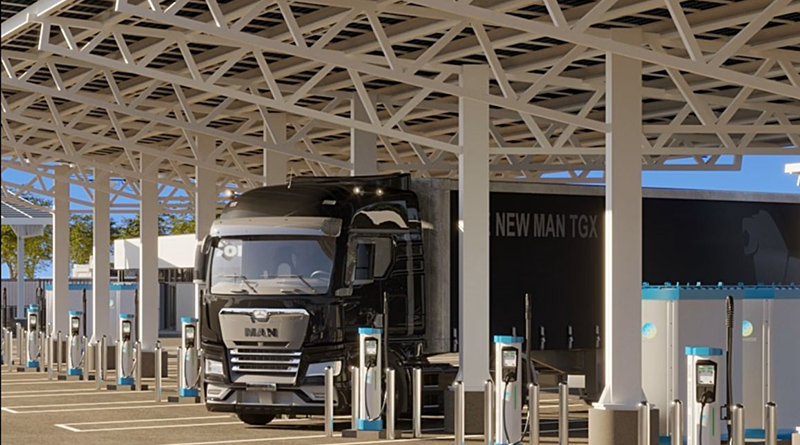
The proposed facility would occupy approximately 4.8 acres at 19th Street and Tidelands Avenue along an existing industrial truck route with no residential neighbors. If approved by the Board of Port Commissioners, Skycharger would build and operate a zero-emission truck charging hub with 70 charging ports capable of supporting both opportunity and overnight charging for electric drayage trucks serving the cargo terminals.
While that may sound like a land-side transportation project, its connection to maritime operations is direct. Every container, every pallet of cargo, and every piece of equipment that moves through the terminal depends on trucks to carry goods inland. Reducing diesel emissions from those trucks reduces the overall environmental footprint of port operations, directly benefiting air quality over San Diego Bay and the communities that border it.
To ensure operational reliability, the project includes a 1,750-kilowatt solar array paired with a 2.5 MW battery storage system, creating a resilient microgrid capable of supporting heavy charging demands without stressing the local power infrastructure. Amenities such as restrooms and a small convenience store are also planned for drivers using the facility.
Skycharger is also proposing a “Trucking as a Service” model that would allow drivers to lease electric trucks with charging and maintenance included for a monthly fee comparable to current operating costs. The program includes a 90-day trial period and a five-year path to ownership, lowering the barrier for drivers to transition away from diesel equipment.
This proposal did not emerge in isolation. In March 2024, the Port selected Skycharger to negotiate the project, and in September 2024, Commissioners directed staff to begin the environmental review process under the California Environmental Quality Act. The Draft EIR is now available for public review and comment through March 16, 2026, both online and at local libraries and the Port administration building.
The Electric Truck Hub fits squarely within the Port’s Maritime Clean Air Strategy, adopted in 2021 as one of the most ambitious clean air plans in California. The strategy’s “Health Equity for All” vision focuses on reducing emissions not just for regulatory compliance, but to improve quality of life for communities surrounding the bay.
Over the past several years, the Port has made highly visible strides toward that goal. The Tenth Avenue Marine Terminal now operates the first all-electric mobile harbor cranes in North America. The first all-electric harbor tugboat in the United States, operated by Crowley, began working San Diego Bay in 2024. Shore power connections have been expanded at cruise terminals and the National City Marine Terminal. A solar-powered microgrid is in operation, and a maritime emissions capture system, often called a “bonnet,” began operating at cargo terminals in 2025 to capture ship exhaust while vessels are at berth.
Tenant operators have also joined the transition. Terminalift has introduced electric reach stackers, forklifts, and semi-trucks. SSA Marine has added multiple pieces of electric cargo handling equipment. Pasha operates the first all-electric car haulers in the country. Dole uses battery-electric utility tractor rigs, and Marine Group Boat Works has converted a diesel tugboat to electric.
Seen in this context, the Electric Truck Hub is not a stand-alone project, but another link in a growing chain of electrification and emissions reduction that connects the dock, the water, and the roadways that serve them.
Community safety has also been a central focus of planning. Skycharger has been working with regional fire experts and the National City Fire Chief to incorporate fire safety and risk mitigation measures into the facility design.
If the project receives final approval, construction is expected to take approximately six months following EIR certification and permitting. For boaters and waterfront users, the changes may not be immediately visible from the water, but the long-term impact on air quality, emissions, and the sustainability of port operations will be felt across the bay.
The Draft EIR is open for public review through March 16, 2026, and written comments can be submitted to the Port’s Planning Department. For a maritime community that depends on both healthy waters and efficient cargo operations, this project represents another step toward a cleaner, quieter, and more modern working waterfront.