A renewed emergency declaration and a fresh round of grant funding are keeping the Port of San Diego on the front lines of an ongoing battle taking place quietly beneath the surface of San Diego Bay.
The Port has secured $200,000 from the Pacific States Marine Fisheries Commission’s Aquatic Invasive Species Rapid Response Fund to support continued diver surveys and eradication efforts targeting an invasive tropical alga known as Caulerpa prolifera. At the same time, the Board of Port Commissioners has once again extended its local emergency declaration, a status first adopted on November 14, 2023, after the alga was discovered in the Coronado Cays. The most recent action extends the emergency for an additional 60 days, through March 15, 2026, marking the 18th continuance of the declaration.
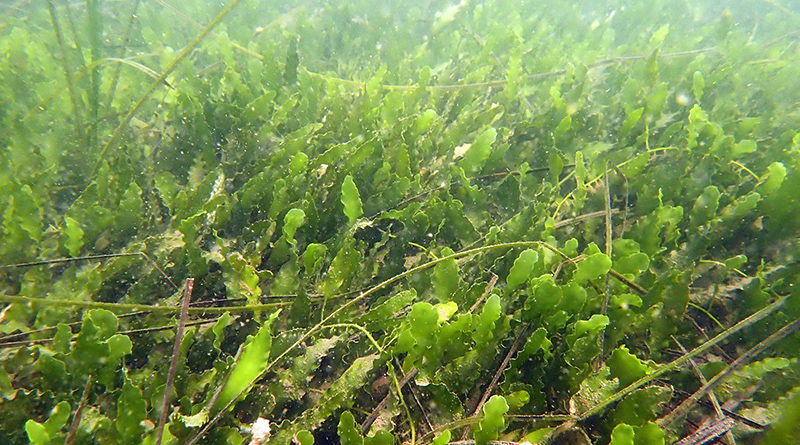
While largely unnoticed by those enjoying the bay above the waterline, the threat posed by Caulerpa is significant. The fast-growing alga spreads rapidly through fragmentation, meaning even small pieces broken off by tidal movement, boat traffic, or fishing activity can drift and take root elsewhere. Once established, it can quickly overwhelm native seaweeds and eelgrass, altering habitat and disrupting the marine food web.
Protecting eelgrass is one of the Port’s highest environmental priorities. San Diego Bay contains nearly 2,600 acres of eelgrass, including roughly 1,900 acres in the South Bay. This underwater vegetation forms the base of the food chain, providing food and shelter for dozens of marine species, including more than 70 types of fish and over 100 endangered green sea turtles. Eelgrass also improves water quality and plays a role in carbon capture, making it an essential component of the bay’s ecological health.
Caulerpa was first detected in September 2023 during a routine dive survey associated with a dock replacement project in the Coronado Cays. Follow-up surveys quickly revealed additional patches in and around the area. In April and August 2025, divers also located small patches inside the nearby San Diego Bay National Wildlife Refuge. To date, approximately 11,300 square feet of Caulerpa have been identified throughout the bay, with more than 300 square feet located within Port jurisdiction.
In response, trained divers have covered all known patches with sealed benthic barriers, a proven method of eradication that deprives the alga of light, oxygen, and water circulation. This same technique was successfully used in early 2000s eradication efforts in Huntington Harbor and Agua Hedionda Lagoon and is currently being used to address similar infestations in Newport Bay.
The Port is working in close coordination with the Southern California Caulerpa Action Team, a coalition of state and federal agencies organized to respond quickly to prevent further spread. Under established eradication protocols, two years of monitoring with no new discoveries must occur before the alga can be declared fully eradicated.
That monitoring effort is extensive. Divers, including Port Field Operations staff, continue to survey roughly 3,000 acres of South San Diego Bay, methodically inspecting the seafloor for new growth. The effort requires significant funding and coordination, which is why the emergency declaration remains important. Maintaining that status allows the Port to remain eligible for critical state and federal funding sources.
To date, more than $3.1 million has been committed to surveys and eradication efforts. This includes $1,192,000 from Port funds, $600,000 from the State of California, and more than $1 million awarded to the San Diego Bay National Wildlife Refuge Complex through the Bipartisan Infrastructure Law, the Inflation Reduction Act, and other federal sources. The newest $200,000 grant from the Pacific States Marine Fisheries Commission adds to those resources, enabling rapid deployment of divers and equipment as needed.
The September 2023 discovery marked the first time Caulerpa has been found in San Diego Bay. However, marine resource managers are familiar with the threat. Other species of Caulerpa were successfully eradicated from Southern California waterways two decades ago using the same benthic barrier approach now being deployed here.
Investigators believe the most likely source of the infestation is the release of aquarium contents into the bay. Because of the environmental risks posed by the alga, it is illegal in California to possess, sell, or transport any Caulerpa species. Violations can result in fines ranging from $500 to $10,000 per incident.
Public cooperation is a key part of preventing further spread. Aquarium owners and retailers are urged not to dispose of aquarium contents into waterways, storm drains, or sewer systems. Aquarium water should be treated with bleach before disposal into a household drain connected to a treated sewer system. Any suspected Caulerpa should be frozen for at least 48 hours before being discarded in the trash. The public is also advised not to purchase, sell, or use Caulerpa in aquariums.
Boaters, kayakers, swimmers, and divers are also asked to remain aware. When possible, they should avoid known infested areas and, if passage is necessary, move gently through at high tide to reduce the risk of fragmenting the alga and spreading it further. Anyone who believes they have spotted Caulerpa is encouraged to report it to the California Department of Fish and Wildlife.
The fight against Caulerpa is not a quick one. Even after benthic barriers are removed, years of careful monitoring must follow to ensure no fragments have survived. Yet the Port of San Diego’s continued commitment, backed by state and federal partners, reflects a recognition that early, aggressive action is far less costly than allowing an invasive species to establish itself permanently.
For now, much of the work remains invisible to the public, carried out by divers and scientists methodically working across thousands of acres of bay floor. But the outcome will be felt by everyone who depends on San Diego Bay’s health — from recreational boaters and anglers to wildlife and future generations.
By renewing the emergency declaration and securing new funding, the Port is ensuring that the response remains swift, coordinated, and well-supported until the threat of Caulerpa is fully removed from San Diego Bay.