As Southern California boaters begin preparing for long summer days on the water, there’s one question that quietly defines your entire lifestyle before you’ve even cast off a line: are you a sailboat person or a powerboat person?
This is not just a boating decision. This is a personality test with fiberglass.
At first glance, the choice seems simple. Both boats float, both get you on the water, and both will happily accept your money in slip fees and maintenance costs. But the real difference is not found in the marina ledger. It’s found in how you want your day to unfold once you leave the dock.
If your idea of a perfect day involves getting somewhere quickly, fishing efficiently, and being back at the dock in time for dinner reservations, you are likely leaning toward a powerboat. If your idea of a perfect day involves adjusting lines, watching the wind like it owes you something, and arriving several hours later than planned but spiritually fulfilled, then welcome to sailing.
Let’s start with the powerboat.
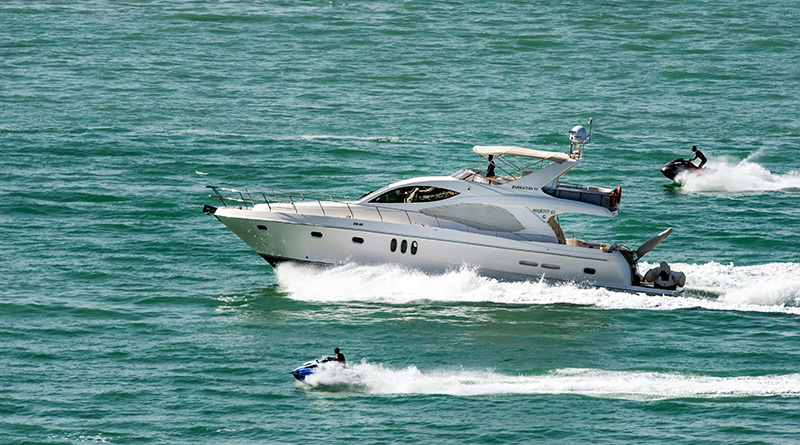
A powerboat is, in many ways, the overachiever of the harbor. You turn the key, it starts, and suddenly you have options. Want to run offshore? Done. Want to hop to Catalina for lunch? No problem. Want to leave the harbor five minutes after deciding to go boating? That is practically the entire brand.
Speed is the headline feature. While most sailboats top out around 6 to 7 knots unless the conditions are just right, powerboats comfortably cruise at 15 to 20 knots or more. In boating terms, that means you are already at your destination while your sailing friends are still discussing wind direction.
Then there’s space. Powerboats tend to offer more deck room, more seating, more interior headroom, and, quite frankly, more places to put snacks. If your boating style includes entertaining, lounging, or bringing along people who expect something resembling comfort, this matters.
Convenience is another major factor. Powerboats do not rely on wind, tide, or patience. They rely on fuel and a working engine. That means fewer canceled plans and more predictable days on the water. There’s also a lower learning curve. Once you understand navigation rules and basic handling, you are largely in control of your schedule.
Of course, that control comes at a cost. Fuel is not just a line item, it’s a lifestyle. Powerboats go where you want, when you want, for as long as your fuel tank and budget allow. Engines also require maintenance, and when they need attention, they tend to remind you in expensive ways.
There’s also the matter of noise. A powerful engine humming beneath your feet is not everyone’s idea of a peaceful escape. Add in wind chop and a shallower hull, and a breezy day can feel less like a relaxing cruise and more like a full-body experience.
Still, for many boaters, the tradeoff is worth it. Powerboats are about efficiency, flexibility, and maximizing time on the water.
Then there are sailboats.

Sailboats are not just vessels. They’re a commitment.
Where powerboats offer convenience, sailboats offer experience. Every trip is shaped by wind, tide, and your ability to work with both. There’s no turning the key and going. There is, however, planning, trimming, adjusting, and occasionally wondering if the wind is personally offended by your schedule.
That said, sailing delivers something powerboating cannot replicate: silence. Without the constant hum of an engine, the experience becomes about the water, the wind, and the movement of the boat itself. It’s a slower, more intentional way to be on the ocean.
There’s also the undeniable satisfaction factor. Successfully navigating a sailboat using wind alone taps into a sense of accomplishment that is difficult to describe and impossible to fake. You did not just arrive. You earned it.
Sailboats also shine when it comes to long-distance cruising. Without relying heavily on fuel, they can travel vast distances, even across oceans, as long as you are willing to wait for the right conditions. For those drawn to adventure, this is where sailboats truly separate themselves.
Operating costs can also be lower in certain areas. Engines are smaller and used less frequently, which can reduce fuel and maintenance expenses. But before celebrating, it’s worth noting that sails and rigging come with their own price tags and maintenance schedules.
Of course, sailing has its own set of challenges.
Space is more limited, especially on smaller vessels. Shade can be minimal, thanks to masts and rigging taking priority over sun protection. Draft is deeper, which means less access to shallow anchorages and beach landings. And perhaps most notably, sailing takes time.
A lot of time.
It takes time to learn, time to plan, and time to execute. Plans are often dictated by weather conditions rather than personal preference. It’s often said that powerboaters live for the destination, while sailors live for the journey. That is not just a saying, it’s a reality.
Sailing is also more physically engaging. Adjusting sails, managing lines, and staying aware of changing conditions requires attention and energy. It’s not a passive activity, and that’s exactly why many people love it.
So which is right for you?
If you want convenience, speed, and the ability to say, “Let’s go,” and actually mean it, a powerboat is likely your match. If you want a quieter, more hands-on experience that connects you to the elements and rewards patience, a sailboat may be calling your name.
Ultimately, both offer something valuable. Both get you on the water. Both come with their own set of costs, challenges, and rewards. And both, in their own way, define how you experience boating.
The good news is there’s no wrong answer.
The better news is that whichever one you choose, summer is coming, and the water is waiting.