Santa Barbara’s coastline has always been more than scenery. Long before pleasure boats filled the harbor and visitors lined Stearns Wharf, the Santa Barbara Channel was a working waterway—shaping livelihoods, traditions, and a deep-rooted maritime culture that still defines the region today. For boaters arriving by sea or locals spending time along the waterfront, that history isn’t tucked away in the past. It’s alive, visible, and actively being preserved.
According to Heather Behrens of the Santa Barbara Maritime Museum, the region’s maritime identity reaches back far beyond modern recreation or commerce. “Santa Barbara’s maritime identity is shaped by thousands of years of connection to the sea, beginning with the Chumash people, whose sophisticated plank canoes, or tomols, enabled trade, fishing, and cultural exchange across the Channel,” Behrens explained. “That spirit of innovation and reliance on the ocean continued through the commercial fishing era, shipbuilding traditions, abalone diving, and Santa Barbara’s emergence as a center for ocean exploration and marine science.”
She noted that the Channel itself has also been the backdrop for some of the most consequential maritime events in U.S. history. “The Santa Barbara Channel has also been the site of powerful maritime events, including the Honda Point Disaster of 1923, when seven U.S. Navy destroyers ran aground along the coast near Point Conception—the largest peacetime loss of U.S. Navy ships—highlighting both the dangers and importance of navigation along this rugged coastline,” she said. Together with the Channel Islands, historic shipwrecks, and the working waterfront, these stories reflect “a community whose livelihood, identity, and culture have always been deeply tied to the sea.”
At the center of preserving and sharing those stories is the Santa Barbara Maritime Museum, a cornerstone of the waterfront community and a natural gathering place for anyone curious about the Channel’s past and present. Located in the Waterfront Center Building—formerly the Naval Reserve Building—the museum opened its doors in July 2000 with a clear mission: to interpret and celebrate the rich and diverse maritime history of the Santa Barbara Channel.
Behrens described the museum as a literal and figurative bridge between eras. “The Santa Barbara Maritime Museum serves as a bridge between past and present by sharing the stories of the people, vessels, and industries that shaped this harbor and coastline,” she said. “Located on the waterfront, SBMM provides context for what visitors see on the water today—from recreational boaters and sport fishing vessels to commercial fishing operations and research ships working throughout the Santa Barbara Channel.”
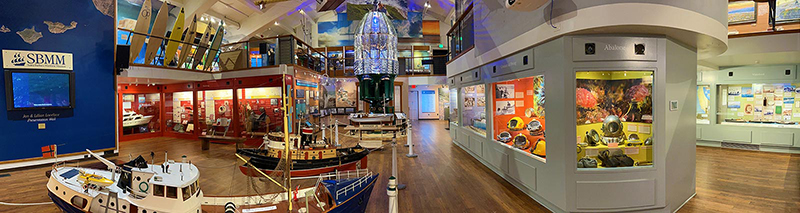
What makes the museum distinctive is its immersive approach. Rather than simply displaying artifacts, exhibits are designed to place visitors directly into the maritime experience. “Our interactive exhibits invite visitors to experience maritime life firsthand,” Behrens explained. “Guests can take the helm in the Jack Tar boat simulator, piloting a vessel across a digital Santa Barbara Channel, or test their skills in the sport fishing simulator.”
That hands-on philosophy extends throughout the museum. Behrens pointed to exhibits that highlight Santa Barbara’s role in underwater exploration, including “the Deep Sea Commercial Diving gallery and the historic JIM deep sea dive suit,” as well as cultural and human stories, such as “Daughters and Wives: Keepers of the Light,” which honors the families behind lighthouse service. Visitors can also explore ocean life through exhibits like Whales Are Superheroes!, discover regional surf culture in the Surfing History exhibit—complete with a stance test to see if they’re “goofy foot” or regular—or engage with sailor traditions through the interactive Tattoo Parlor.
Rotating exhibitions further expand the museum’s reach. “Rotating exhibitions on the museum’s Mezzanine Level, presented three to four times each year, showcase maritime art, regional history, and environmental success stories that reflect both Santa Barbara’s seafaring past and its evolving relationship with the ocean,” Behrens said.
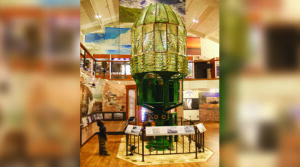
Several exhibits and programs serve as especially powerful examples of the museum’s role as a steward of maritime history. Behrens highlighted the historic Ranger, “the oldest boat in Santa Barbara Harbor,” which remains a living link to the region’s sportfishing heritage. She also pointed to the Point Conception First-Order Fresnel Lens as a reminder of the navigational technology that guided mariners safely along the coast, and to the museum’s deepwater diving and commercial fishing exhibits that document Santa Barbara’s influence on ocean industries.
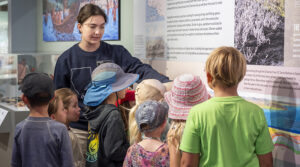
Education and outreach remain central to the museum’s mission. “Our Maritime Distinguished Speaker Series brings contemporary voices in ocean science, exploration, and conservation to the community,” Behrens said, noting that youth education programs are equally critical in building long-term connections. “Our youth education programs ensure that future generations develop a personal connection to the ocean and its history.”
That focus on continuity is intentional. For Behrens, preserving maritime history is inseparable from shaping the region’s future. “Preserving maritime history helps us understand not only where we’ve been, but how our relationship with the ocean continues to shape our future,” she explained. “For a coastal community like Santa Barbara, the harbor is both an economic engine and a cultural touchstone.”
By sharing these stories, she added, the museum fosters stewardship as much as awareness. “When people understand the legacy of those who worked, explored, and depended on these waters before them, they develop a deeper appreciation for protecting the marine environment and sustaining our maritime traditions for generations to come.”
Accredited by the American Alliance of Museums, the Santa Barbara Maritime Museum has earned widespread recognition for that work, including the 2019 Nonprofit of the Year award from the Santa Barbara Region Chamber of Commerce and the George & Vivian Obern Preservation Stewardship Award from the Santa Barbara Trust for Historic Preservation. It has also been named one of the top maritime museums in the United States by MarinaLife Magazine.
For boaters planning time ashore, the museum offers more than a casual stop. It provides context for the waters just crossed, the harbor just entered, and the generations of mariners who shaped this stretch of coast long before GPS and fiberglass hulls became standard.
In a city closely shaped by the ocean, the Santa Barbara Maritime Museum underscores that the region’s maritime heritage remains an active and evolving part of daily life.
For more information, visit sbmm.org.