In Southern California sportfishing, there are certain names anglers come to know before they ever cast a line. Boats earn reputations. Captains build loyal followings. Harbors become traditions.
And for generations of anglers launching into the Pacific, one of those trusted names has been Everingham Bros. Bait Co.
This year, the San Diego-based company marks 75 years of supplying live bait to Southern California’s fishing community, a milestone that reflects not simply longevity, but decades of adapting, investing, and quietly helping power one of the region’s most recognizable waterfront industries.
For Roy “Buck” Everingham Jr., president of Everingham Bros. Bait Co., the anniversary represents far more than a number. It reflects the dedication of multiple generations of family members and employees who have helped build the company over the decades.
“We have reached our 75th anniversary milestone with decades of dedication from my family and the families of all our crew members: boats, barges, maintenance, and office,” Everingham said. “We have a lot of long-standing employees and benefit by training and promoting from within the company. Some employees in the business are second generation. Their devotion to working long hours to supply the best quality bait we can find is how we have reached this major milestone.”
For anglers chasing tuna offshore, targeting calico bass along kelp lines, or loading tanks before a weekend run, live bait often becomes one of the most important ingredients for success. Yet behind every scoop of lively sardines or anchovies is a supply chain that most boaters never see.
For Everingham Bros., that work has been happening around the clock for three quarters of a century.
Founded in San Diego and built around the specialized business of catching, transporting, and delivering live bait, Everingham has grown alongside Southern California’s recreational and sportfishing culture. Over the decades, the company has become deeply woven into the region’s fishing infrastructure, serving commercial sportfishing fleets and private boaters across multiple ports while maintaining a reputation centered on consistency and reliability.
Keeping bait healthy and available is a far more technical process than many anglers realize. Water quality, oxygenation, transport timing, receiver design, seasonal fish movement, and ongoing maintenance all influence whether anglers receive strong, active bait ready for offshore conditions.
Through years of refinement and investment, Everingham developed systems designed specifically to maintain bait quality from collection through delivery. That operational expertise has allowed the company to remain relevant through changing fishing trends, evolving harbors, and increasingly demanding expectations from anglers.
According to Everingham, one of the primary reasons the company has remained a trusted name within the fishing community is its commitment to reinvesting in the business.
“Everingham Bros. Bait Co. has continued to invest large amounts of profit back into the equipment and to innovate our storage facilities,” he said.
The scale of those investments becomes apparent when looking at how dramatically the operation has grown over the years.
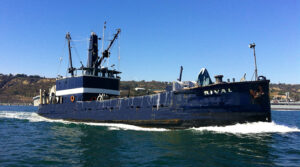
“In 1948, Everingham Bros. started out with one boat and one barge with five bait receivers only in San Diego Bay, and we officially incorporated in 1951,” Everingham said. “Today, in San Diego Bay, we have 102 bait receivers.”
The company’s growth expanded beyond San Diego Bay as Southern California’s fishing fleet continued to grow.
“In 1956, we opened the bait barge in Mission Bay, which currently has 24 receivers,” Everingham explained. “In 2005, we opened the barge in Dana Point Harbor, which currently has 12 receivers.”
Because each receiver contains two storage wells, the system now provides hundreds of individual bait-holding locations throughout Southern California.
That growth mirrors the expansion of the region’s recreational and commercial sportfishing industries over the past seven decades.
The company’s connection to San Diego extends well beyond geography.
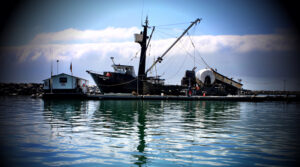
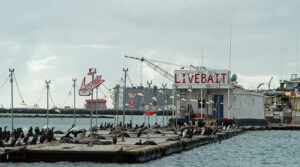
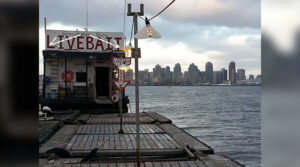
One of the more interesting chapters in Everingham Bros. Bait Co.’s history sits in a structure many anglers may never think twice about. The bait barge house currently operating in Dana Point Harbor originally began its life in San Diego, serving as the first house at the San Diego bait barge in 1950 before later relocating to Mission Bay in 1956 and eventually moving north decades later.
The structure itself has a unique origin story. Originally, it was a sunken dredge barge that had washed ashore in South Bay. Everingham Bros. founders Roy and Chuck Everingham discovered the vessel at low tide and undertook the labor-intensive task of removing the accumulated mud from its hull. Once the barge refloated on the following high tide, they towed it away and constructed a small house on top, creating what became the first bait barge house in San Diego Bay.
After serving anglers in San Diego, the house was relocated to the Mission Bay bait barge in 1956, where it remained for more than five decades. In 2011, the historic structure made its final move to Dana Point Harbor, where it continues serving Southern California anglers today.
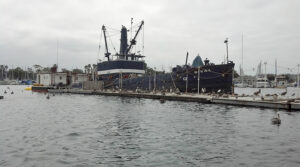
The San Diego bait barge itself also has ties to the region’s commercial fishing heritage. The barge originally served as a refrigerated vessel known as Westgate No. 1, operated by Westgate Cannery. Tuna boats would load the barge with albacore at Ballast Point, and once the catch was frozen and the vessel reached capacity, it would be transported back to the cannery near Lindbergh Field for processing. Everingham Bros. later acquired the barge from Westgate Cannery and incorporated it into its growing bait operation.
Meanwhile, the current Mission Bay bait barge house, known as Mission Star, represents another chapter in the company’s history. Designed by Roy “Buck” Everingham Jr. and built by Everingham Bros., the structure was launched in 2011 as a custom-built replica of the historic deckhouse aboard the Star of India. Buck Everingham personally built the hull and completed much of the detailed woodwork, creating a floating landmark that pays tribute to San Diego’s rich maritime heritage while continuing to serve the region’s fishing community.
It’s a small detail, but one that reflects how interconnected Southern California’s fishing communities remain and how San Diego continues influencing the broader regional sportfishing landscape.
Infrastructure investment has also remained central to Everingham’s operation.
Over the years, the company has rebuilt receiver systems, replaced aging equipment, upgraded holding capabilities, and continued maintaining facilities to improve performance and reliability. Twice-yearly maintenance schedules and ongoing replacement programs help ensure bait quality and availability remain consistent even as environmental conditions and boating demands continue changing.
The methods used to collect bait have evolved significantly as well.
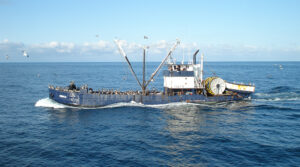
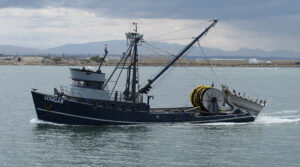
“In 1948 to 1965, we fished with lampara nets and now we use drum seines,” Everingham said. “With the hydraulic automation on the drum seines, we have the same amount of crew per boat as we did with the lampara net.”
That willingness to embrace innovation while maintaining operational efficiency has helped the company keep pace with changing demands throughout the fishing industry.
Reliable access to live bait supports more than just individual fishing trips. It supports charter operations, private boating activity, waterfront businesses, tourism, and local economies that depend on active sportfishing communities.
From long-range boats preparing for offshore expeditions to local half-day operations and private skiffs chasing afternoon bites, dependable bait continues serving as one of the foundational pieces of Southern California fishing culture.
Everingham believes the company’s longstanding commitment to growth and modernization has enabled it to keep up with the expanding sportfishing fleet throughout Southern California.
“Our dedication to growth and investing in equipment throughout the 75 years serving the sport fleet has allowed us to meet the demand for bait as the sportfishing industry has expanded,” he said.
As San Diego’s waterfront evolves through modernization, redevelopment, and changing boating trends, companies like Everingham represent another side of maritime progress, one rooted less in flashy technology and more in operational expertise developed over generations.
The company’s influence also extends beyond bait operations. Over the years, many employees have used their experience with Everingham as a stepping stone into maritime careers throughout the industry.
“Many of our fishermen and barge crew have moved on to become engineers and captains of the tuna fleet, tugs, and other commercial licensed vessels,” Everingham said. “We are proud that people who have worked with us have advanced on to contribute to the commercial fishing industry.”
The 75th anniversary has not gone unnoticed within the company. To commemorate the milestone, Everingham Bros. held an employee logo contest to create a special anniversary logo, continuing a tradition that dates back to the company’s 50th anniversary celebration.
“We did a logo contest among our employees for our 75th anniversary logo, and we displayed the logo and sold anniversary merchandise at Day at the Docks this year,” Everingham said. “We had the same logo contest tradition for our 50th anniversary T-shirt designs as well.”
While the anniversary provides an opportunity to reflect on the company’s history, Everingham remains focused on the future.
“Our family would be very pleased and happy if the next generation of our company can reach 100 or more years,” he said.
As Everingham Bros. Bait Co. celebrates 75 years in business, the company remains proof that some of the most important work in sportfishing happens quietly behind the scenes, long before the boat leaves the dock and long before the first fish finds the bait.
The milestone also serves as an opportunity to recognize the anglers, boaters, and sportfishing operators who have supported the company throughout its history.
“The Everingham family and Everingham Bros. crews and employees would like to thank all of the private sportfishing fleet and commercial sportfishing fleet for your decades of support,” Everingham said.
For more information, visit baitbarge.com.