Maintaining the health of your vessel’s battery banks is essential to the operation of every onboard electrical device, from the mast lights to the chartplotter, cabin amenities and bilge pump. We use various systems to charge our batteries, including solar panels and engine alternator, and possibly a wind or water generator, especially if we are cruising offshore. And managing all of these charge inputs properly requires a monitoring system that ensures fully charged batteries at all times while also protecting the banks from overcharging and destroying the battery cells.
Batter Selector Switches
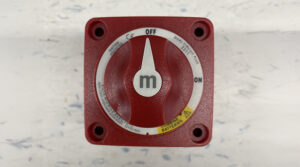
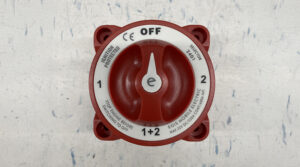
The first and most essential step in protecting our batteries is installing one or more high-quality selector switches, depending on the number and types of battery banks. The vast majority of boats up to roughly 40 feet in length use a single selector switch labeled “OFF, 1; ALL, 2” or for some applications, simply “ON” and “OFF.”
Most of these switches are constructed of a durable red plastic cover and a large, rotating switch, such as the type available from Egis Mobile Electric, Perko and Blue Sea Systems. A single switch will set you back roughly $40 to $80, which is a drop in the bucket when you consider the investment in batteries and electronics serving your vessel’s propulsion and various other onboard systems.
If you have a special apparatus requiring its own selector switch, choose an ON/OFF switch, which can lead directly to the house battery bank without interfering with the starter bank or all the other myriad wiring connected to the switch panel, which is also connected to the house bank.
On my 1966 Cal 30 sloop Saltaire, I installed an ON/OFF switch to the house bank to power a small DC-AC inverter, which I use for power tools and other small appliances requiring 120V AC power. I never know when I’ll get the urge to pull out my jig saw to fashion a small plywood box or cut a hole in the cabinetry to install some new device.
Battery Monitoring
Many small boat owners underestimate the necessity of a proper battery monitoring device for their vessels. They might measure the battery charge from time to time with a handheld multimeter, sometimes referred to as a “multi-tester,” but these occasional checks are an inadequate means of ensuring battery charge and overall health.
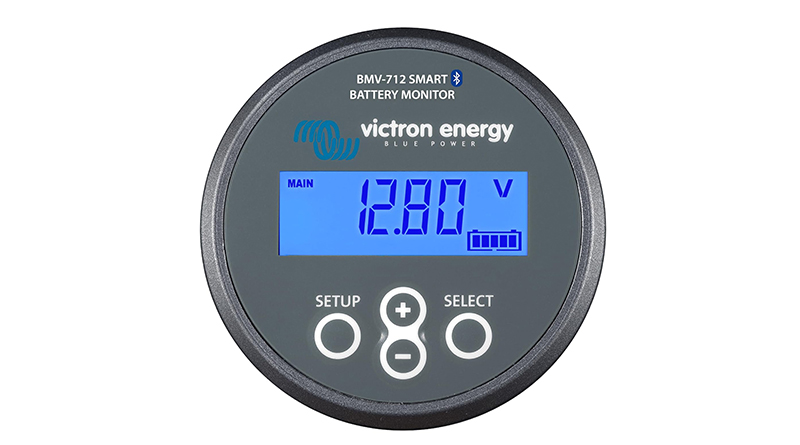
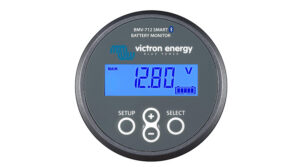
A small day-sailing vessel with an engine used only for propulsion and nav lights can be well served by a Victron BMV-712 Smart Battery Monitor, which features a small LED charge indicator. This diminutive instrument is easy to install and allows you to make customized settings, monitor battery data on a single screen and view historical data.
You can connect the round monitor to a current shunt with 10 meters of standard RJ12 telephone cable and fuse. After installing the Victron BMV-712, take advantage of its programmable relay, which turns off non-critical loads and even starts a separate generator if needed.
The Victron records battery usage patterns and critical charging events, including time left for charging, ensuring the overall health and longevity of your vessel’s battery banks. Despite its small profile, the Victron BMV-712 battery monitor and shunt can handle up to 10 amps of power, more than enough for small to mid-size vessels.
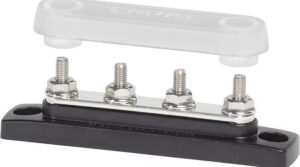
You’ll find a wide selection of control panels at Paneltronics, from their waterproof, six-position DC toggle and rocker switch panels to a 12-position panel with LED charge meter. Paneltronics also produces many custom designs fitted to the specific space allowance and onboard electrical grid requirements of your vessel.
Paneltronics can accommodate virtually any onboard system with a high-quality panel or multiple-panel array, from a basic panel with six rubber-coated toggle switches and amber LED indicator lights to a large, custom panel with over two dozen switches and two charge meters.
Blue Sea Systems, a name familiar to many coastal and offshore sailors, has a wide selection of 12V/24V panels covering a wide range of sizes, from a small-boat, six-position device selling for around $200 to their large, 36-position Blue Sea 8382 DC Panel. While the 8382 normally sells for roughly $1,700, you can occasionally find it at a bargain price of around $1,300 online.
Xantrex as well produces a broad assortment of electrical panels and controls, starting with their Freedom X/XC remote charge indicator panel, which uses a blue graphic display to indicate battery charge, load measured in watts and three battery lights. The unit is available for roughly $80 and offers peace of mind when we need a quick read on battery charge.
At the upper end of their product line, Xantrex also designs and produces large, custom AC/DC panels for luxury yacht builders. Large arrays come with one or more Xantrex Gateway touchscreen panels, which are customized to meet the demands of large luxury yachts.
Yet another familiar name is Sea Dog, which specializes in panels for small boats. Their six-gang breaker-rocker switch panels come in several styles, from an LED-illuminated panel with power socket to an unlit version with a silicone rubber splash cover.
Each of Sea Dog’s toggle and rocker panels comes with a push-button fuse holder on the front of the panel, allowing for quick and easy access. At under $40 for a product well known to many coastal and offshore sailors, it’s hard to imagine a better buy for a small boat.
If you want a genuinely custom switch array on your floating palace, take a look at the electrical panels from AC/DC Marine in Carson, Calif. The company produces a long list of customizable gauges, engine panels and charging systems, giving you a choice of either traditional analog dials and switches or touch-screen digital displays.
While a set of AC/DC Marine gauges starts at roughly $500, a NMEA 2000 touch-screen, multicolor display, including vessel speedometer, tachometer, depth sounder and compass with heading costs just over $1,000, a lot of value for a modest investment.
As a final piece of advice, you can prevent an early demise for your batteries’ lead cell partitions by making sure the cells are topped off regularly with distilled water, which is necessary in order to avoid unintended electrolysis and premature death of the battery. Also, one way to avoid battery maintenance altogether is installing a lithium-ion house bank, which requires zero maintenance and lasts for many years. The starter battery, though, should still be a standard, flooded bank to ensure a fast jolt of power to turn over the engine.
Installing a high-quality battery maintenance system is essential to keeping your vessel’s battery banks in top condition. Your voyages will be all the more enjoyable if you know the engine will always start and the lights and nav systems will always function whether you are in the middle of a storm in mid ocean or kicking back at your favorite local anchorage.