Teachers hand out homework. Sportfishing landings hand out fish counts. And lately, no matter which landing is turning in the assignment, the answer seems to be the same:
Yellowtail.
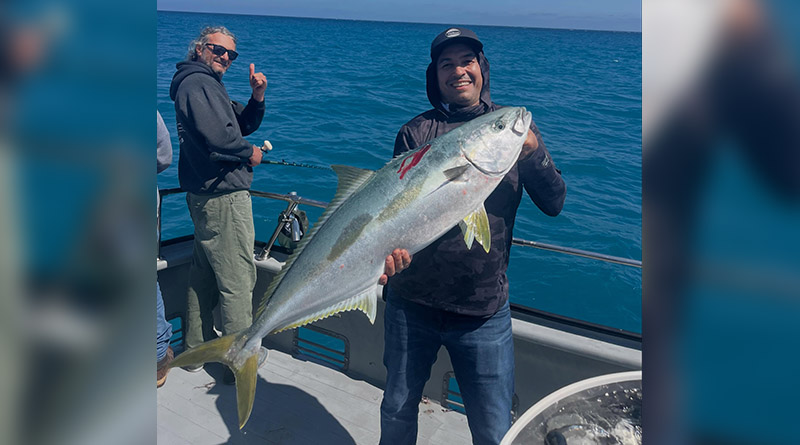
If Southern California’s summer fishing season had a mascot right now, it would be a fork-tailed yellowtail with a bad attitude and a tendency to dump anglers into the kelp.
Remember 2022, when dorado seemed to show up everywhere and every offshore report sounded like a tropical fishing postcard? This year is shaping up to be the Summer of the Yellowtail.
They’re showing up at local islands, under kelp paddies, along the beaches, on offshore banks, and, in one particularly shocking case, from a San Diego pier.
Simply put, if you’re looking for the fish of summer, it’s yellowtail.
Why Are Kelp Paddies So Good?
Most anglers already know that spotting a kelp paddy offshore is a good reason to slow down and take a closer look. What appears to be nothing more than a floating patch of kelp on the surface is actually a thriving ecosystem drifting through the ocean. Small baitfish use the kelp for protection, while crabs, squid and other forage species gather around the structure. That concentration of food attracts larger baitfish, which in turn draws predators looking for an easy meal.
For yellowtail, a kelp paddy can be the perfect hunting ground. These fish often travel and feed in packs, using their speed and numbers to trap bait against structure, current lines or the surface. A kelp paddy provides both cover and an ambush point, allowing yellowtail to move in and attack unsuspecting baitfish. As water temperatures continue to warm and more paddies begin holding life, anglers who take the time to investigate them are increasingly being rewarded with some of the best yellowtail action of the season.
Even the Pier Anglers Are Getting Involved
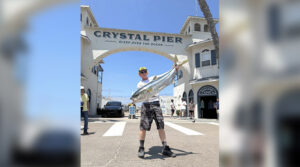
Perhaps the most surprising yellowtail story of the season came from San Diego’s Crystal Pier.
Local angler Brandon Dawson landed a 45-plus-pound homeguard yellowtail from the pier, a catch that many longtime anglers are calling a once-in-a-lifetime fish.
Landing a yellowtail of that size from a sport boat would be impressive. Landing one from shore is another story entirely.
The battle reportedly lasted about 45 minutes before Dawson and fellow anglers managed to gaff and hoist the fish onto the pier.
The catch quickly made waves throughout Southern California fishing circles and served as a reminder that yellowtail don’t always read the rulebook.
If you happen to be heading to Crystal Pier anytime soon, don’t be surprised if it suddenly seems a little more crowded than usual.
No Sardines? No Problem.
One of the more valuable yellowtail lessons this season has been the effectiveness of artificial lures when fish are keyed in on small forage. Anglers have found success throwing surface iron, Hookup Baits and A-rigs when yellowtail are feeding aggressively on anchovies and other small baitfish. In several cases, fish that showed little interest in larger live baits readily committed to artificials that more closely matched that on which they were feeding.
Surface iron continues to be one of Southern California’s most iconic yellowtail techniques, while Hookup Baits and A-rigs have proven especially effective when fish are chasing small bait near the surface. The takeaway for anglers is simple: don’t leave the dock with only one game plan. When yellowtail become selective, having a variety of artificials ready can make the difference between watching fish boil and putting them on deck.
Understanding the Yellowtail Bite
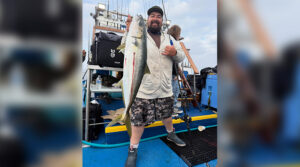
One reason yellowtail have become so popular among Southern California anglers is that they’re one of the region’s most aggressive game fish. When actively feeding, a yellowtail bite can be explosive, with a bait suddenly taking off, line screaming from the reel and the rod loading up hard—an experience many anglers describe as getting “dumped on.”
However, yellowtail can also be surprisingly finicky, especially when feeding on tiny anchovies. On those days, they may simply peck at a bait, follow a lure without committing or bite with little more than a subtle tick. That’s why presentation is so important. When fishing live bait, most sport boat crews teach anglers to “wind, don’t swing,” allowing the fish to turn with the bait before putting the reel in gear and winding until the rod loads naturally. Surface iron fishing requires a similar approach, with experienced anglers emphasizing the importance of never stopping the retrieve, as many yellowtail bites occur while the lure is swimming away from the fish.
Hooking a yellowtail is only half the battle, though. Once hooked, these powerful fish immediately look for the nearest kelp stringer, rock pile, structure or even the hull of the boat to gain an advantage. That’s why deckhands are often heard yelling, “Wind! Wind! Wind!” during the first moments of a fight. Keeping steady pressure on the fish and preventing it from reaching cover is often the key to successfully landing one of Southern California’s most sought-after game fish.
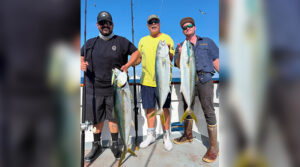
Yellow Is the Color of Summer
From Crystal Pier in San Diego to the kelp paddies off Orange County and the islands beyond, yellowtail have become the common thread tying together Southern California’s fishing reports.
Every landing seems to be turning in the same homework assignment.
Every fish count seems to include the same answer.
And if the current trend continues, yellowtail may very well be the fish that defines the summer of 2026.
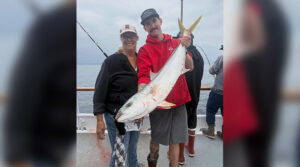
Captain Recommended Yellowtail Gear
For anglers hoping to cash in on Southern California’s yellowtail bite, the captains at Dana Wharf Sportfishing recommend keeping your tackle selection simple, versatile and ready for a variety of fishing situations.
For live bait fishing, many of the landing’s captains suggest an 8-foot medium to medium-heavy action rod rated for 20- to 40-pound line. Pairing that rod with a 400- to 500-size conventional reel provides enough line capacity and stopping power to handle most yellowtail encountered around local islands, kelp paddies and offshore structure.
When selecting hooks, the captains recommend matching the hook size to the size of the bait. Smaller anchovies often fish best on a No. 4 hook, while larger sardines may require a 3/0 or 4/0 hook to achieve a natural presentation and improve hook-up ratios.
Among the live bait setups commonly seen aboard Dana Wharf boats are Shimano Trinidad 14 and Trinidad 16 reels loaded with 20- to 30-pound line. Comparable options include the Daiwa Saltist 30 and Saltist 40, which are also popular choices among local anglers.
For surface iron fishing, the crews recommend a dedicated 9-foot jig stick paired with reels such as a Shimano Trinidad 20, Shimano Tranx 500, Daiwa Lexa 500 or Daiwa Saltist 40. These reels can be spooled with straight 40-pound monofilament or a combination of 65-pound braid backing connected to a 40-pound monofilament topshot.
When it comes to surface iron, the classic Tady 45 continues to be a favorite among many local captains and anglers. Productive colors include mint, scrambled egg and blue-and-white patterns, all of which have a long track record of producing yellowtail in Southern California waters.
For anglers targeting deeper fish, yo-yo iron remains one of the most effective techniques. Proven options include the Salas 6X and Salas 7X Heavy, both of which continue to account for plenty of yellowtail around island structure and high spots.
While every angler develops personal preferences over time, Dana Wharf captains note that successful surface iron fishermen often rely on trusted manufacturers such as Tady, Salas, Two Fish Jigs and JRI. Ultimately, confidence in a lure and time spent fishing it effectively can be just as important as the color or brand hanging from the end of the line.