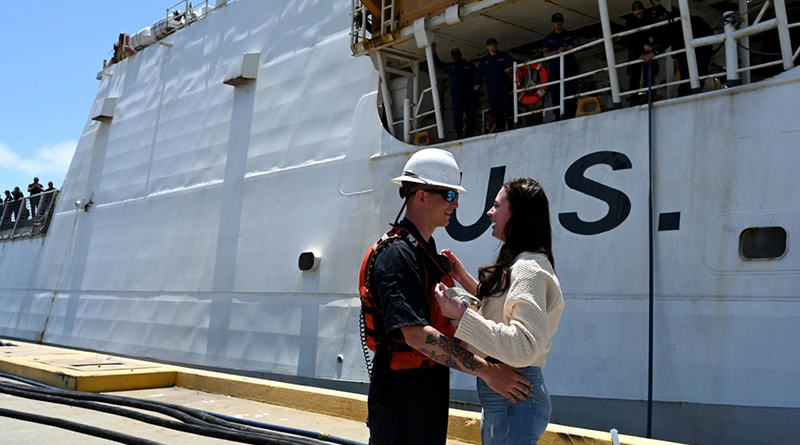
ALAMEDA — After logging more than 20,000 nautical miles during a 121-day deployment, the crew of the U.S. Coast Guard Cutter Munro (WMSL 755) returned to their Alameda homeport mid-July after a mission-packed patrol in the Bering Sea.
Departing in mid-March, Munro spent over four months supporting the Coast Guard’s Arctic District on what is commonly referred to as an “Alaska Patrol.” The deployment included a strategic presence along the maritime boundary line between the United States and Russia — an area critical to U.S. security and economic interests in the North Pacific.
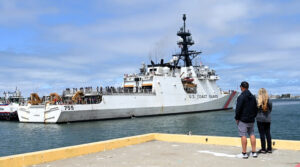
Photo by Petty Officer 3rd Class Joel Lavallee
U.S. Coast Guard Pacific Area
During the patrol, the Munro conducted 32 boardings of commercial fishing vessels to enforce domestic fisheries regulations, a mission aimed at safeguarding the multibillion-dollar Alaskan fishing industry. Working in coordination with a National Oceanic and Atmospheric Administration (NOAA) law enforcement officer embarked aboard the cutter, the crew ensured compliance with U.S. laws, helped maintain a level playing field for law-abiding fishermen, and promoted sustainable fishing practices within the U.S. Exclusive Economic Zone.
While fisheries enforcement was a key focus, the Munro also served as the region’s primary search and rescue (SAR) asset. Over the course of the patrol, the crew completed more than 100 flight evolutions involving three different aircraft, which led to the qualification of eight helicopter pilots and boosted SAR readiness in one of the nation’s most remote and challenging environments.
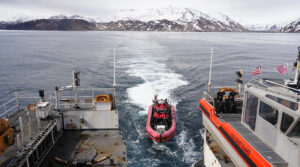
Capt. Jim O’Mara, commanding officer of the Munro, noted that weather was the most significant challenge the crew faced throughout the deployment. “Biggest challenge was weather. We have well trained crews, good equipment, excellent operational coordination with Coast Guard Arctic District and other agencies, but weather always gets a vote,” he said. “Boat operations – launching, recovering from Munro, then safely embarking, and retrieving our law enforcement teams from the wide variety of fishing vessels in the Bering Sea – anywhere from 55′ for small catchers to over 300′ for catcher processors – weather is the biggest factor. Wind direction and swell height would change rapidly, and we need Munro to be within certain pitch (up, down) and roll (left, right) parameters to safely launch and recover our 26′ and 35′ small boats. We constantly adjusted our patrol areas based on weather, position of the commercial fleet, and which fisheries were being enforced”
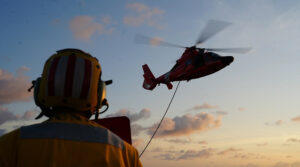
Photo by Lt.Cmdr. Helen Shaye
U.S. Coast Guard Pacific Area
In addition to small boat operations, Munro coordinated complex helicopter activities in collaboration with Air Station Kodiak. “Helicopter operations were also challenging but rewarding,” he said. “Munro coordinated with the Coast Guard H60 Jayhawk helicopter aircrew deployed from Air Station Kodiak and operating out of Cold Bay for the summer. Low cloud ceilings and thick fog often reduced visibility, which made ordinary training evolutions a real challenge; we had to reschedule often. Remaining persistent and focused, we still conducted over 100 evolutions for training, in-flight refueling, and vertical replenishment (cargo drop-off/pickup).”
Even while docked, the Munro crew was vigilant. “We reviewed weather forecasts in detail to safeguard our ship while we resupplied and refueled in Dutch Harbor,” O’Mara explained. “In April, a big storm came through. We tripled up all six of our mooring lines, and put both anchors under foot, recalled the crew, briefed a departure plan if needed, and had machinery in immediate standby ready to get underway if the situation deteriorated. The preparations paid off. Hurricane force winds came through, along with a blizzard, but Munro remained safe and secure at the pier.”
The logistical complexity of operating in such remote areas also shaped the cutter’s patrol strategies. “Weather also impacted an already challenging and remote logistics chain in the Arctic District,” said O’Mara. “The hub for logistics in the Bering Sea is Dutch Harbor, in the middle of the Aleutian Islands. Critical repair parts and replacements had to be shipped up from the lower 48 to either Anchorage, or Kodiak, then find opportunity (weather) and availability (other priorities) to get those parts or people on a final transport flight out to Dutch Harbor. Collaboration with Coast Guard Base Kodiak, and Air Station Kodiak greatly simplified operating in the remote north. Without their regional expertise and superb assistance, Munro’s support and supply lines would have been significantly hindered.”
Courtesy Photo
U.S. Coast Guard Pacific Area
One of the more complex rescue cases took place near Nunivak Island, over 300 nautical miles from Cold Bay, Alaska. Munro worked in tandem with Forward Operating Station Cold Bay, acting as a “lily pad” for a Coast Guard helicopter by providing at-sea refueling. This extended the aircraft’s time on scene during a long-range search for two individuals reportedly in the water after their skiff overturned.
O’Mara explained how such a long-range SAR case is coordinated: “The Coast Guard’s Joint Rescue Coordination Center (JRCC) in Juneau, Alaska, plans and coordinates search and rescue cases in the Bering Sea and Arctic maritime regions of Alaska. We work with our Coast Guard air stations, cutters, and small boat stations, as well as drawing on partnerships with other federal, state, and local agencies, to provide the most immediate and effective response to a call for help.”
In this case, a community member on Nunivak Island overheard a distress call, setting the rescue in motion. “A local community member in the village of Mekoryuk on Nunivak Island overheard on his personal radio that a skiff had capsized several miles away, with two people missing. Based on that report, the JRCC coordinated with CG Air Station Kodiak to send a helicopter to the scene to search for survivors,” O’Mara said. “The closest CG helicopter and crew was located at a Forward Operating Site in Cold Bay, Alaska, 370 miles (330NM) to the southeast of Mekoryuk. That helicopter flew across the eastern Bering Sea towards Nunivak Island, briefly landing on the flight deck of the Coast Guard Cutter Munro to top off their fuel before conducting a search for survivors. Coordination with the Munro also took place through the JRCC.”
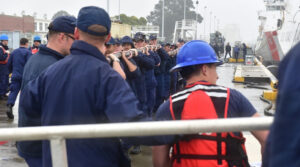
Photo by Petty Officer 3rd Class Danish Khan
U.S. Coast Guard Pacific Area
He continued, “The SAR planners at the JRCC used specialized software to create a search plan that identified the areas where the helicopter was most likely to find the missing men, and the helicopter flew search patterns over those areas. Knowing that the helicopter crew would reach their fatigue limits after a couple hours of searching, the JRCC reached out to our counterparts at the Alaska Rescue Coordination Center (AKRCC) in Anchorage. They provided an Air National Guard C-130 to transport a second Coast Guard helicopter crew from Kodiak Island to the town of Bethel, where the original helicopter crew landed following their initial search.”
Tragically, one life was lost in the incident. “The CG helicopter returned to the search area with a fresh crew. In the meantime, the Air National Guard C-130 had flown to the scene and located one of the missing men at the shoreline, sadly deceased,” said O’Mara. “The JRCC coordinated with the Alaska State Troopers for recovery of the body. The helicopter continued searching for the second missing person, but he was not found. The Coast Guard suspended the search pending further developments the following evening, roughly 23 hours after the boat capsized.”
He concluded, “In summary, this search-and-rescue case exemplified the logistical complexities, and the harsh, unforgiving cold water environmental factors associated with conducting the SAR mission in the Bering Sea and Arctic maritime regions of Alaska.”
The patrol also supported international cooperation, with Munro hosting two Royal Canadian Navy exchange officers for the duration of the mission. “This opportunity grew out of a pre-existing 1977 memorandum of agreement on the exchange of military personnel between the United States Coast Guard and the Canadian Armed Forces,” O’Mara explained. “In this instance, the Coast Guard approved Royal Canadian Officers to deploy aboard Pacific Area and District Cutters during several planned deployments in order to qualify as Deck Watch Officers and stand full watches. The Royal Canadian Navy provided exceptional officers for the exchange who fully integrated with our crew to safely execute our missions. The program benefited the US and USCG through expertise exchange from our Canadian Ally related to defense and Arctic operations, enhanced Munro’s readiness to operate anytime, for any mission we may be called upon, and we look forward to the next opportunity to embark our Canadian partners.”
Commissioned in 2017, Munro is one of four Legend-class national security cutters based in Alameda. These 418-foot cutters are equipped for multi-mission operations and designed to perform in some of the harshest maritime conditions in the world. With a range of 12,000 nautical miles, a top speed of 28 knots, and the capacity to support a crew of up to 170, Munro is well-suited for extended deployments and critical missions across the Pacific.
The cutter is named in honor of Signalman First Class Douglas A. Munro, the only Coast Guardsman to receive the Medal of Honor. He gave his life in 1942 during the evacuation of U.S. Marines under fire at Guadalcanal in the Solomon Islands.
As the Coast Guard continues to focus on Arctic readiness and fisheries enforcement, Munro’s latest patrol reinforces the service’s commitment to maritime governance, national security, and life-saving missions in some of the nation’s most remote waters.