Yes, tuna are mackerel. No, yellowtail are not tuna. Dorado are dolphinfish — but if you mention it to your neighbors, don’t tell them you caught a “dolphin”; they’ll think you hooked Flipper! So, as a service to Southern California anglers who’ve been using fish names erroneously with confidence — and asking questions never, here’s a brief intervention to edify.
By Me, Katherine Clements, F.E.B.H. (Fish Expert by Humiliation)
SoCal PACIFIC OCEAN — There are certain things Southern California anglers simply accept without investigation. It’s similar to them telling you that the four-pound fish they caught was 12 pounds — they’re simply making that stuff up!
There are certain things Southern California anglers rarely stop to question. We hear “bluefin,” “yellowtail,” “bonito” and “dorado,” then grab the right rod and get to fishing. Nobody is standing at the rail wondering where these fish sit on the family tree. But maybe we should, because it turns out some of the fish we talk about all summer aren’t exactly what their names would have you believe. Just because we are stoked on the yellowtail and tuna doesn’t mean they’re in the same family.
This system has worked beautifully for generations.
Unfortunately, we started looking things up.
And now we think you should know some things.
First, we need to discuss tuna.
Yes, tuna are members of the mackerel family.
Please remain calm.
That beautiful bluefin tuna you spent thousands of dollars in fuel, tackle, boat payments and emotional stability pursuing belongs to the family Scombridae, alongside mackerel and bonito.
That doesn’t mean the 180-pound bluefin you caught after a three-hour battle should be introduced at the dock as “my mackerel.” You have earned the right to call it a bluefin. In fact, calling it a mackerel after that much effort feels disrespectful to everyone involved.
But taxonomically speaking, tuna and mackerel are relatives.
This also means that when someone catches a mackerel at the bait receiver and reacts as though a raccoon has somehow entered the bait tank, perhaps show the little guy some respect. His family is doing very well.
Which brings us to yellowtail.
Southern California anglers have a particularly complicated relationship with yellowtail because they look like they could be a tuna.
They swim fast. They fight hard. They travel offshore. They make reels scream. They taste fantastic. They appear in grip-and-grin photos next to tuna. They have basically done everything possible to get invited into the tuna family.
But they’ve been denied.
California yellowtail are not tuna.
They’re amberjacks.
Specifically, the California yellowtail, Seriola dorsalis, belongs to the jack family, Carangidae.
We understand if you need a moment.
That 30-pound yellowtail you proudly held up while yelling something about “tuna season” was standing next to the tuna, but he was not one of them.
He was essentially a plus-one.
This doesn’t make yellowtail any less impressive. If anything, knowing they’re amberjacks makes their reputation even more interesting. These fish have managed to infiltrate Southern California tuna culture so successfully that most people have never questioned their credentials.
Yellowtail are the guy at the party nobody remembers inviting, but everyone is thrilled showed up. We are happy they’re here, we want them to stay, but we’re just acknowledging that they’re different so we can sound smart when we school our friends on fishing facts.
Then there is dorado.
This is where terminology becomes dangerous.
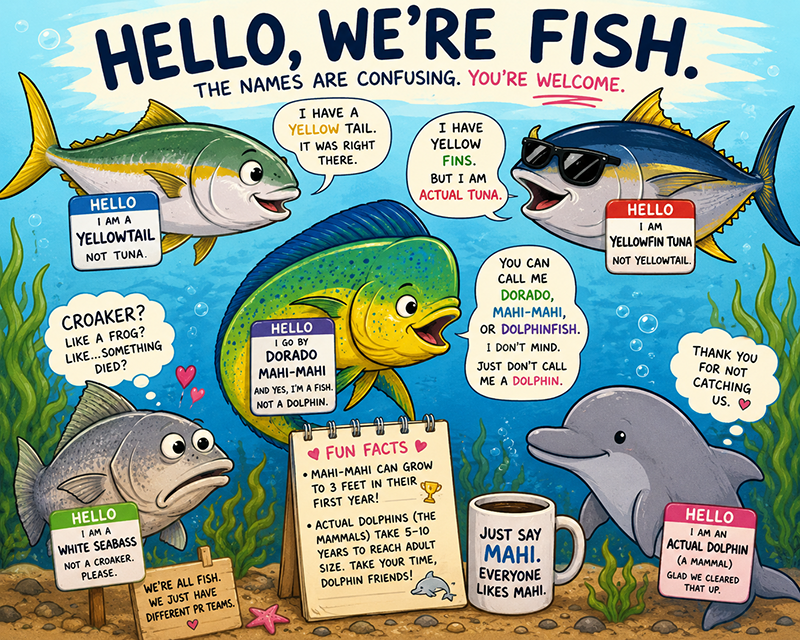
Dorado are also called mahi-mahi. Same fish, different name. “Dorado” comes from the Spanish word for “golden,” a fitting name for a fish famous for flashing brilliant yellows, greens and blues. “Mahi-mahi” comes from Hawaiian and means “strong-strong,” an equally fitting description once you have one on the end of your line.
But there is a third name.
Dolphinfish.
They aren’t dolphins.
I cannot emphasize this enough.
If you return from an offshore trip and tell a group of non-anglers that you “caught six dolphins today,” you have created a public relations emergency for yourself.
Do not blame me. The point of this sassy article is to help you avoid that mistake.
Dorado, mahi-mahi and dolphinfish are all names for the same spectacularly colorful pelagic fish in the family Coryphaenidae. They’re known for their remarkable speed, brilliant coloration and habit of gathering around floating kelp paddies and other offshore debris.
They are fish.
Oh! And here’s a fun fact: despite the wildly confusing name “dolphinfish,” mahi-mahi grow like they’re late for something. A mahi can reach about three feet long in its first year, while an actual bottlenose dolphin, you know, the mammal, can take 5 to 10 years or more to fully mature. So, one grows at warp speed and belongs on a fish count; the other takes its sweet time growing up and absolutely does not belong in your fish hold. Please continue using the word “mahi.” It’s safer for everyone.
But back to the point: Actual dolphins are marine mammals.
This distinction is especially important when discussing your weekend in mixed company.
“We found some dorado under a kelp paddy” is a perfectly normal Southern California fishing statement.
“We killed it on the dolphins Saturday” requires significantly more explanation.
So remember: it’s “dorado” if you’re fishing, “mahi-mahi” if you’re ordering lunch, and “dolphinfish” if you’re trying to alarm everyone at the dinner table.
While we’re clearing things up, that bonito I mentioned earlier deserves a seat at this increasingly confusing family meeting.
Pacific bonito are also members of the mackerel family, as I stated at the beginning of the article, but stopped short of elaboration.
Yes, really.
They’re relatives of tuna and mackerel and have spent decades being treated by some Southern California anglers as the fish they caught while trying to catch something else.
This feels unfair.
Bonito are fast, aggressive and capable of putting up a fantastic fight on light tackle. Yet there is always somebody aboard who reacts to one like the fish personally wasted his time.
“Bonito.”
He says it with the same disappointment normally reserved for finding a parking ticket under the windshield wiper. Respect your elders. Or cousins. Taxonomy gets complicated.
Meanwhile, the bonito is a legitimate member of the same family as your beloved bluefin. Bleed that bonito, filet him, throw him on the grill with some pepper, and dip his meat in soy sauce. I’ve had someone onboard do this before and it was a hit!
Then we arrive at another Southern California favorite: white seabass.
We have bad news.
White seabass are not seabass.
At this point, we understand if you no longer trust fish names.
The white seabass belongs to the croaker family, Sciaenidae. That puts Southern California’s prized “seabass” alongside croakers and drums.
This fish has been operating under an assumed identity for years.
Nobody seems particularly concerned.
Perhaps that’s because “I caught a 50-pound croaker” doesn’t have quite the same level of gravitas at the yacht club. It sounds…weird. A croaker? Like a frog? Like somebody croaked? Is everyone OK?
The fishing world apparently decided “white seabass” sounded better, and everyone agreed not to ask follow-up questions.
California halibut provide another opportunity for confusion because they’re not the same species as Pacific halibut — despite both being flatfish and both having the word halibut in their names.
California halibut are the local inshore favorites anglers target along sandy bottoms, bays and coastal structure. Pacific halibut are their much larger northern relatives encountered farther up the West Coast.
Calling them both halibut is technically acceptable. Assuming they’re the same fish is wholly unacceptable. They’re a large, saltwater flatfish belonging to the right-eye flounder family, Pleuronectidae.
Think of it like Newport Beach, California, and Newport, Rhode Island. Same first name. Entirely different wardrobe.
And then there are rockfish.
“Rockfish” sounds wonderfully specific until you discover that California has an enormous collection of species casually gathered beneath that name.
Vermilion rockfish. Bocaccio. Copper rockfish. Canary rockfish. Chilipepper. Starry rockfish.
If you’ve ever looked into a fish hold after a rockfish trip and thought, “There appear to be 14 different things happening down there,” you were correct.
This is why identification matters beyond winning trivia at the dock.
Different species can be subject to different regulations, size restrictions, seasons, and possession rules. Being able to identify what you caught is part of responsible fishing, particularly in a region with such a diverse mix of coastal and offshore species.
Of course, none of this means anglers need to begin correcting each other with Latin names on the stern.
Quaeso noli. (Please don’t.)
Nobody wants to hear, “Actually, that’s Seriola dorsalis,” while trying to gaff a yellowtail.
We’re simply suggesting that it might be worth knowing what’s on the other end of your line.
Southern California fishing is particularly entertaining because our waters bring together an assortment of species whose common names range from reasonably descriptive to actively misleading.
Yellowtail have yellow tails, so somebody deserves credit there.
Yellowfin tuna also have yellow fins, but before anyone gets confused, they are actual tuna, not yellowtail. Apparently, a yellow appendage was enough inspiration to name two completely different fish and leave the rest of us to sort it out.
White seabass are silver.
Dolphinfish aren’t dolphins.
Tuna are mackerel.
Yellowtail aren’t tuna.
And bonito are closer relatives of tuna than yellowtail are, despite yellowtail spending considerably more time hanging around the tuna crowd and looking like they belong there.
And somewhere offshore, a dorado is changing from electric blue to brilliant green while an angler explains to his mother over the phone that, no, he did not catch Flipper.
Fishing names are strange.
Maybe that’s part of the fun.
You don’t need a degree in marine biology to go fishing. You don’t need to memorize scientific classifications before leaving the dock.
And nobody is suggesting the next time your buddy hooks a yellowtail you yell, “Congratulations on your amberjack!”
Actually, please do that once.
Just stop telling people your yellowtail is a tuna.
Knowing a little more about the species Southern California anglers pursue adds another layer to being on the water. It makes us better observers, better storytellers and, occasionally, slightly less ridiculous when explaining our catch to people who don’t fish.
So here is your cheat sheet.
Tuna? Mackerel family.
Bonito? Also mackerel family.
Yellowtail? Amberjack.
Dorado? Dolphinfish.
Dolphinfish? Definitely not dolphins.
White seabass? Croaker.
Rockfish? You’re going to need more information.
And, for the record, Flipper was/is a bottlenose dolphin (Tursiops truncatus). It’s a mammal, a TV icon, and safeguarded by The Marine Mammal Protection Act (MMPA).
What about that enormous fish that broke you off after a Hemingwayesque 40 minute “life and death struggle,” you ask?
According to every angler who’s ever lost a fish, that was unquestionably the biggest one anyone has ever seen.
No scientific classification necessary.