For Southern California boaters who plan their days around the tide charts and their evenings around what is biting, a new cookbook release from Bluewater Grill may be the next addition to keep on board.
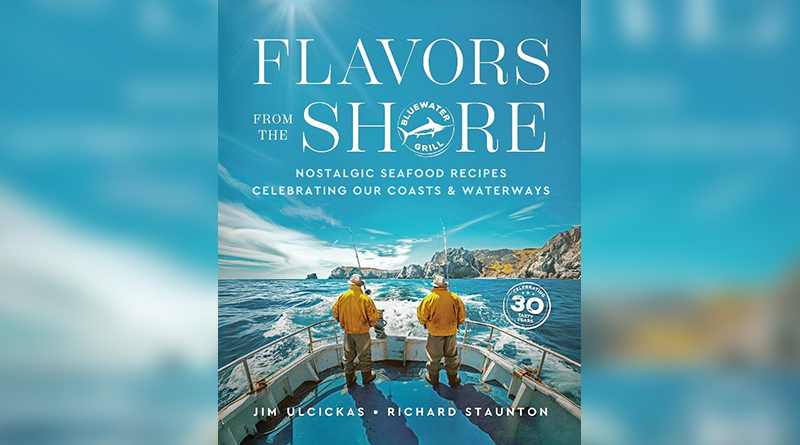
Marking 30 years of the well-known restaurant group, Bluewater Grill owners Jim Ulcickas and Rick Staunton have released “Flavors from the Shore,” a seafood-focused cookbook that brings together decades of coastal-inspired recipes into one collection. Set to release April 28, 2026, the book highlights the same fresh, approachable dishes that have defined the brand, while offering a format that lends itself just as easily to a home kitchen as it does to a boat galley.
For boaters anchoring off Catalina Island, drifting in the Channel Islands, or tying up for a quiet evening in the harbor, the concept feels particularly fitting. Few experiences match the simplicity of cooking your own catch after a day on the water, and “Flavors from the Shore” leans directly into that tradition.
In fact, the inspiration behind the cookbook is deeply rooted in that exact lifestyle. “The inspiration for the book was from personal use of our own boats fishing the Channel Islands, as well as Baja and the Sea of Cortez,” said Ulcickas. “My partner Rick operates the very well-known Kaley, a swordfish boat, and I have a 62-foot Northstar called Solitaire. When you are offshore, you are limited to what you have in your galley, so we always make sure that we have the right ingredients to properly cook whatever we catch.”
That mindset translates directly into the recipes featured throughout the book. As Ulcickas explained, preparation starts with having the right staples on board. “Of course, this includes lemon or lime juice for making ceviche, soy, wasabi, and ginger for tuna or yellowtail sashimi, and fresh vegetables like green onion, tomato, garlic, and cilantro. In addition, it’s best to have some really good sea salt, fresh ground pepper, and a mixture of dried herbs. You are only limited by your own imagination.”
The book features 100 recipes built around seafood and shellfish, with an emphasis on flavor without unnecessary complexity. That balance makes it especially appealing for boaters working within the constraints of limited space, minimal equipment, and a desire to keep things straightforward after a full day offshore.
At its core, the cookbook is a reflection of the Bluewater Grill story, one shaped by a long-standing connection to the ocean and a focus on sharing that experience through food. Ulcickas and Staunton draw from three decades of restaurant experience, offering a collection that spans coastal regions across the United States and beyond.
The journey begins close to home with California-inspired dishes, including Blackened Pacific Swordfish and California Spiny Lobster prepared “Puerto Nuevo Style,” both of which translate naturally to a Southern California setting where local seafood often defines the menu. For anglers targeting species like yellowtail, halibut, or rockfish, the techniques and flavor profiles offer adaptable ideas that can be applied to a wide range of fresh catches.
Ulcickas noted that versatility in preparation is key, especially when cooking on the water. “Some days we like to do things on the barbecue with a simple seasoning. Other days we can pan sauté, blacken, or roast in the oven. If we get lucky and catch numerous species, we use the species’ best prep use to determine how we’re going to cook it.”
That philosophy extends to specific species common to Southern California waters. “For example, tuna is best served raw in the middle and seared on the outside, or diced into cubes and made into poke. Yellowtail is great as sashimi, as well as cut into steaks and barbecued on the grill with salt, pepper, and lemon. White seabass is best lightly sautéed with a little garlic herb butter, and ground fish like lingcod and calico go great lightly battered and pan-fried for fish tacos.”
From there, the book moves north to the Pacific Northwest and the Aleutian region, introducing recipes such as roasted oysters prepared in multiple styles and Orange and Walnut-Crusted Halibut. These dishes reflect a slightly heartier approach, well-suited for cooler evenings on the water or post-fishing meals when something warm and satisfying is in order.
The collection continues inland with freshwater-inspired recipes from the Midwest, including Trout Amandine and Lake Superior Whitefish, before shifting east to the Atlantic and Mid-Atlantic coasts. Classic dishes such as Maryland-style crab cakes and lobster rolls rooted in Maine and Connecticut traditions offer a familiar, crowd-pleasing option for group meals, whether at anchor or back at the dock.
Further south, the flavors turn bolder with dishes influenced by the Gulf region, where shrimp, oysters, and blackened fish take center stage. For boaters who enjoy adding a bit of spice to their cooking, these recipes provide a change of pace while still maintaining a focus on accessible ingredients and preparation.
The book also ventures beyond U.S. waters, incorporating global influences that reflect the broader appeal of seafood cuisine. Recipes such as Garlic Butter Australian Tiger Prawns, Ponzu Ahi Tuna Poke, Grilled Hawaiian Ono, Spanish octopus, and Zuppa di Pesce bring an international dimension to the collection, offering boaters the opportunity to experiment with flavors that go beyond the local catch.
In addition to the food itself, “Flavors from the Shore” includes a selection of signature cocktails designed to complement the dishes. For those spending extended time on the water, these additions provide a way to round out the experience, turning a simple meal into a more complete gathering.
What sets the cookbook apart, particularly for the boating community, is its adaptability. While rooted in restaurant-quality dishes, the recipes are designed with practicality in mind. Many can be scaled down, simplified, or adjusted based on what is available, making them well-suited for cooking in a compact galley or on a small grill.
Ulcickas also emphasized that great meals start long before the cooking begins, with proper fish handling playing a critical role. “My best advice for boaters is to properly handle the fish after it’s caught. This includes bleeding it properly and humanely killing it with a knife point to the brain. Then quickly pack it in a slurry of ice water to chill the fish so it can set. Fish should chill for a minimum of two hours before filleting and cooking.”
From there, the focus shifts to execution. “Once you have your pristine fillets prepared, don’t overcook them. Use a thermometer and test the temperature at the thickest part, where it should read 130 degrees. Once you remove fish from the grill, it will continue to cook for another five or ten degrees, which in some cases makes it overdone. Depending on how you like your fish, you may adjust five or ten degrees.”
For certain species, simplicity remains key. “Tuna and yellowtail, on the other hand, if you want a rare center, should just be seared on the outside,” he added.
That flexibility aligns closely with the rhythm of boating life in Southern California, where plans often shift based on conditions, catch, and company. A successful day on the water may end with a quick meal or evolve into an impromptu dinner shared with friends at anchor. In either case, having a reliable set of recipes on hand can elevate the experience without adding unnecessary complexity.
As Bluewater Grill celebrates its 30th anniversary, “Flavors from the Shore” offers more than a retrospective of the restaurant’s history. It presents a practical extension of that legacy, one that fits naturally into the routines of those who spend their time on the water.
For Southern California boaters, it may quickly become more than just a cookbook. It’s the kind of resource that finds a permanent place in the galley, ready to be pulled out after a long day of fishing, when the anchor is set, the sun is dropping, and dinner is about to begin.