Editor’s Note: This story is a follow-up to The Log’s June 5, 2026, coverage of the Santa Rosa Island wildfire and the Catalina Island Conservancy’s restoration efforts. To provide readers with a broader understanding of the ongoing discussion surrounding Catalina’s mule deer management, The Log sought comment from the Coalition to Save Catalina Island Deer, the Catalina Island Conservancy, the California Department of Fish and Wildlife. This article reflects those interviews and statements.
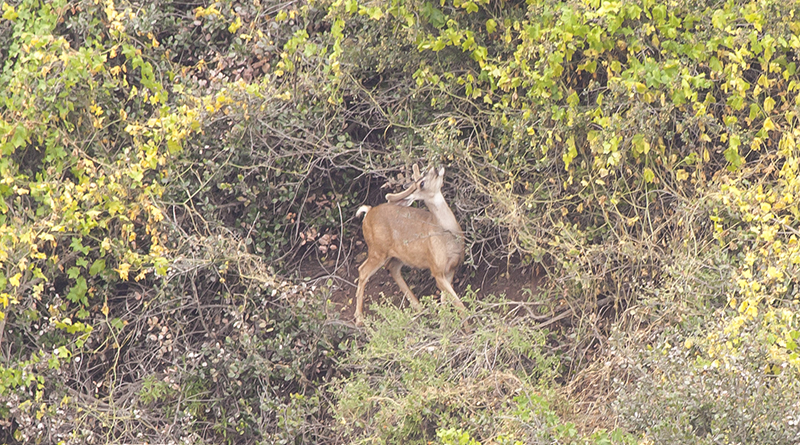
The debate over Catalina Island’s mule deer continues following The Log‘s recent coverage of the Santa Rosa Island wildfire and the Catalina Island Conservancy’s view that the fire underscores the importance of removing invasive mule deer from Catalina.
After the article was published, Wendy Hernandez, a founding member of the Coalition to Save Catalina Island Deer, contacted The Log to offer a different perspective on the issue.
Hernandez said she believes the discussion surrounding the Santa Rosa fire should include additional viewpoints beyond the Conservancy’s interpretation of the event.
“This article leaves out one very important fact,” Hernandez wrote. “Santa Rosa Island’s deer, elk, sheep, cattle and other large grazing animals were removed years ago — some decades ago. Yet here we are in 2026 discussing a record wildfire that burned over 18,000 acres. If removing all the herbivores was supposed to be the solution, why are invasive grasses still widespread enough to fuel a fire of this magnitude?”
Hernandez said the Coalition’s primary concern is not opposition to habitat restoration, but what it views as a lack of scientific justification and public transparency surrounding the proposed eradication of Catalina’s mule deer.
“The Coalition’s primary concern is not opposition to habitat restoration,” Hernandez said. “We want a healthy, biodiverse, resilient Catalina Island. Our concern is that the Conservancy and CDFW have moved forward with the most extreme option — eliminating every mule deer on the island—without the level of independent science, public review, and accountability that an irreversible decision like that requires.”
According to Hernandez, the Coalition does not dispute that deer affect native vegetation. Instead, she said members question whether complete eradication has been demonstrated to be the only scientifically supported solution.
“The deer are being blamed for a wide range of complex problems on Catalina, including habitat decline, invasive grasses, erosion, water impacts and wildfire risk,” Hernandez said. “We do not dispute that deer can affect vegetation. But the question is whether killing every deer is scientifically justified, legally sound, and actually likely to solve the problems being claimed.”
She argued that Catalina faces numerous environmental pressures beyond deer browsing, including invasive plants, historic grazing, drought, wildfire history, roads, development and decades of land management decisions.
“The public has not been shown a credible, current baseline deer count, a meaningful alternatives analysis, or clear plant-by-plant evidence showing that total eradication is necessary,” Hernandez said.
Hernandez also believes the recent Santa Rosa Island wildfire demonstrates that restoring island ecosystems involves more than removing large herbivores.
“Santa Rosa Island is relevant because it shows the danger of oversimplifying island ecology,” Hernandez said. “Large herbivores were removed from Santa Rosa, and there has been native plant recovery in some areas. But that did not eliminate wildfire risk, invasive grasses, or the need for ongoing active management.”
She said the Coalition believes the fire illustrates that multiple factors, including wind, drought, ignition sources, invasive grasses and long-term restoration efforts, continue to influence wildfire behavior.
“The lesson for Catalina isn’t to do nothing,'” Hernandez said. “The lesson is that eradication should not be sold to the public as a cure-all.”
Instead of complete eradication, Hernandez said the Coalition supports what it describes as a science-based, adaptive management approach.
“The Coalition supports lawful, transparent, science-based management,” she said. “That should start with an independent current deer population survey, clear habitat objectives, protection of the most sensitive plant communities through fencing and targeted restoration, aggressive invasive plant and fire-fuel management, and an adaptive deer-management plan with measurable population targets.”
According to Hernandez, those measures could include expanded hunting opportunities, professional population management where necessary, fertility control or sterilization where feasible, and continued monitoring rather than complete removal of the herd.
Pepe Barton, director of communications for the Catalina Island Conservancy, said the Conservancy agrees that deer removal alone will not restore Catalina’s ecosystems, but maintains that it’s a necessary first step in a broader restoration effort.
“We agree that simply removing invasive mule deer is not enough,” Barton said. “It’s the step that makes the rest of the restoration work possible.”
According to Barton, Operation Protect Catalina Island also includes habitat restoration, landscape monitoring, native wildlife and pollinator surveys, replanting and seeding.
“The goal is not simply to remove deer,” Barton said. “The goal is to give the Island the chance to recover and heal.”
“Catalina is not an uninhabited laboratory,” Hernandez said. “It’s a living island community with residents, visitors, wildlife, public-trust resources, cultural values, and real fire-safety concerns. Before the state allows a private landowner to eliminate every mule deer on the island, the public deserves full environmental review, independent science, and a serious consideration of less extreme alternatives.”
The Catalina Island Conservancy has taken a different position, maintaining that mule deer continue to suppress the recovery of native vegetation by browsing young plants and shrubs that are essential to healthy chaparral ecosystems. Conservancy officials have said reducing browsing pressure is a necessary step toward restoring native habitat and improving the island’s long-term ecological resilience.
Barton continued one to state that the organization believes Santa Rosa Island reinforces—not weakens—the case for restoring Catalina’s native ecosystems.
“Everyone who loves Catalina Island wants the same thing: an Island that is healthier, safer and better able to protect itself,” Barton said. “That is exactly why the lessons from Santa Rosa matter to us.”
Barton said the Conservancy believes the effects of invasive grazing animals on the Channel Islands have been extensively documented over the past century.
“The devastating impact of invasive animals on the Channel Islands is well established, along with their ability to convert the land from native chaparral into fire-prone invasive annual grasses,” Barton said.
Barton said the Conservancy views today’s conditions on Santa Rosa as evidence of long-term ecological damage rather than proof that removing invasive animals is ineffective.
“The invasive grasses and fire risk on Santa Rosa today are the legacy of a century of invasive animals that stripped more than 75 percent of the island’s native vegetation and its cloud forest of tall oak and pine groves,” Barton said. “Even after all non-native animals were removed, the cloud forest has not recovered.”
He said the Conservancy believes Santa Rosa should be viewed as a cautionary example.
“Santa Rosa is not a reason to wait,” Barton said. “It’s a warning about what happens when damage goes too far and shows us the future, we still have time to prevent on Catalina.”
Barton also referenced information published by the National Park Service regarding Santa Rosa Island’s cloud forest and said wildfire experts have similarly discussed the relationship between invasive herbivores and wildfire risk on Catalina.
Responding to the Coalition’s suggestion that long-term population management would be preferable to eradication, Barton said the Conservancy believes ongoing herd reduction would not solve the underlying ecological problem.
According to Barton, approximately 22 invasive mule deer were introduced to Catalina during the late 1920s and 1930s for sport hunting. With no natural predators and no opportunity to migrate, the population expanded rapidly, with historical reports estimating roughly 2,000 deer by the 1940s.
“Managing a small population across 48,000 acres is not a lasting solution because deer reproduce quickly and rebound even after their numbers are reduced,” Barton said.
He added that long-term population control may sound more moderate, but in practice would require repeated lethal removal indefinitely.
“It does not solve the problem, and it does not allow the Island to recover,” Barton said.
Barton said the Conservancy’s position is based on research conducted both on Catalina and throughout the Channel Islands.
“Wildfire scientists, plant ecologists and peer-reviewed research conducted here on Catalina are clear that non-native mule deer increase our wildfire risk and prevent native plants from recovering,” Barton said.
He said Catalina is now the last Channel Island that still supports an invasive deer population.
“Catalina has a chance to do what the other Channel Islands have already shown is necessary: remove the pressure from invasive animals so native habitats can recover,” Barton said.
Barton said the California Department of Fish and Wildlife approved the Conservancy’s restoration management permit after reviewing research from Catalina and other Channel Islands supporting the project.
The Log also submitted a series of questions to the California Department of Fish and Wildlife seeking the agency’s perspective on Catalina’s mule deer management and the concerns raised by the Coalition to Save Catalina Island Deer. CDFW declined to address the questions, stating that it does not comment on matters that are the subject of pending litigation.
“CDFW does not comment on matters that are the subject of pending litigation,” the department said. “Any questions about the Catalina Island Conservancy (CIC) plans would need to be addressed to the CIC.”
Barton emphasized that the Conservancy views Operation Protect Catalina Island as a long-term restoration effort rather than solely a deer removal project.
“Operation Protect Catalina Island is a long-term effort to protect the Island and everyone who depends on it, including the boaters and visitors who cross the Channel to enjoy it,” Barton said.
He said Catalina’s importance extends beyond conservation because it serves as a destination for generations of Southern California boaters and visitors.
“Catalina is more than a destination,” Barton said. “It’s the place families return to season after season. It’s where kids take their first swim off the boat, where the crossing itself becomes part of the tradition.”
Barton noted that Catalina differs from the other Channel Islands because it supports both a permanent community and millions of annual visitors.
“This is about protecting native plants and native wildlife, but it’s also about protecting people, homes, livelihoods, visitors, boaters and the future of the Island itself,” Barton said.
Barton acknowledged the controversy surrounding the project and said the Conservancy has modified its plans in response to public concerns.
“We know this is hard, and we’ve listened by removing aerial shooting from the plan and reducing operations near Avalon,” Barton said. “Our goal is to leave Catalina healthier and more resilient than we found it, for the people and boaters who love it and the native wildlife who call it home.”
Barton said the Conservancy ultimately believes delaying action would place Catalina’s native species at greater risk.
“We should not allow native and endemic species to move closer to extinction when we still have a chance to protect them and restore the Island they depend on,” Barton said.
The differing viewpoints highlight an ongoing debate over how best to balance habitat restoration, wildfire resilience and wildlife management on Catalina Island. While the Coalition to Save Catalina Island Deer argues that less intensive management strategies deserve further consideration, the Catalina Island Conservancy maintains that complete removal of invasive mule deer, combined with long-term habitat restoration, offers the best opportunity for ecological recovery. As discussion surrounding Operation Protect Catalina Island continues, questions remain over the role deer play in the island’s ecosystem and whether complete eradication is the only path toward long-term restoration.