The California Department of Fish and Wildlife (CDFW) announced last week that five individuals in Siskiyou County have been cited for illegal suction dredge mining, underscoring the agency’s continued effort to protect rivers and streams from practices harmful to native fish and wildlife. Although the incidents occurred in 2024, the cases remain active, with arraignments scheduled this fall and additional investigations underway across the state.
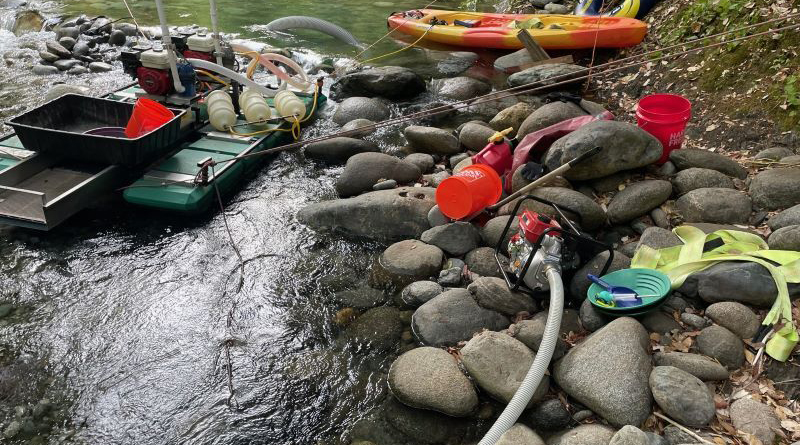
On August 20, 2024, wildlife officers cited one individual after discovering he was actively operating a suction dredge on the Salmon River near Cecilville. The person admitted to using the dredge to recover gold and other minerals and presented paperwork showing a partnership tied to the activity. Officers seized the mechanized portion of the dredge and cited the individual under Fish and Game Code section 5653(e), which prohibited possession and use of suction dredge equipment in state waterways. Although the case was initially dismissed due to a clerical error, the Siskiyou County District Attorney’s office refiled charges, and arraignment was scheduled for October 7, 2025.
Since that initial citation, four other individuals have been cited and had their dredging equipment seized on the Klamath River and Elk Creek. Arraignment dates for those cases are pending. In its Sept. 26, 2025, news release, CDFW emphasized that suction dredging remains illegal in California and that enforcement actions are ongoing.
Suction dredging involves using mechanized or motorized systems to vacuum material from riverbeds to recover minerals such as gold. The practice has been banned in California since 2016 because of its damaging effects on aquatic ecosystems. Scientific studies show that dredging increases water turbidity, destabilizes streambeds, causes erosion, and can release contaminants into waterways. It also creates conditions favorable to invasive species, putting further pressure on native fish like salmon and steelhead already struggling with habitat loss and climate change.
“Illegal suction dredging is not a victimless activity — it harms rivers, fish, and the wildlife that depend on healthy watersheds,” CDFW noted in its release. The agency confirmed that it is actively pursuing multiple cases statewide and reminded the public that possession of suction dredge equipment within 100 yards of closed waters remains prohibited, regardless of partnerships, memberships, or business agreements.
Jen Benedet, Acting Deputy Director of the Office of Communication, Education and Outreach for the California Department of Fish and Wildlife, reinforced this point in a statement, noting: “any motorized vacuum/suction dredge is illegal anywhere in California’s rivers, streams, and lakes—and even possessing a dredge in or within 100 yards of such can be a violation. CDFW cannot issue dredge permits under the current moratorium, so there’s no lawful way to motor-dredge in 2025–26. While suction dredging is prohibited, non-motorized recreational mining methods such as gold panning remain legal. CDFW recognizes the longstanding interest in recreational mineral recovery and encourages miners to pursue these activities through lawful practices.”
While suction dredging is banned, recreational miners still have legal options. Traditional gold panning and other non-motorized methods are permitted, and CDFW has encouraged miners to pursue these practices as a lawful alternative.
The renewed enforcement in Siskiyou County highlights the state’s ongoing commitment to balancing California’s long history of recreational mineral recovery with the need to safeguard fragile aquatic habitats. With several arraignments approaching, the outcome of these cases will likely serve as a reminder that California’s ban on suction dredging is not just policy — it’s actively enforced.
Why Suction Dredging is Banned in California
Since 2016, California law has prohibited the use of motorized or mechanized suction dredges to mine rivers, streams, and lakes. The practice, once popular among recreational miners, has been shown to cause significant environmental harm.
Scientific studies found that suction dredging:
- Increases turbidity (clouding the water and reducing oxygen needed by fish).
- Destabilizes streambeds and causes erosion, altering habitat for salmon, steelhead, and other species.
- Releases contaminants such as mercury trapped in sediments, which can enter the food chain.
- Encourages invasive species like signal crayfish by disrupting native ecosystems.
While suction dredging is banned, non-motorized methods like gold panning remain legal, allowing Californians to continue the tradition of recreational mineral recovery without the ecological risks.