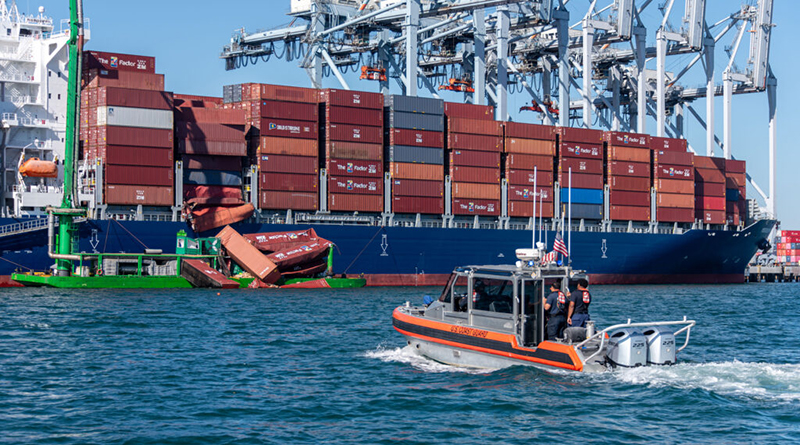
LONG BEACH — About 67 shipping containers toppled from the cargo ship Mississippi around 9:00 a.m. on Tuesday, Sept. 9, 2025, while the vessel was berthed at Pier G in the Port of Long Beach. No injuries were reported. A Unified Command led by the U.S. Coast Guard established a 500-yard safety zone and temporarily halted cargo operations at the pier while recovery crews secured the area. Port officials said other terminals and broader port operations were not impacted.
Early accounts indicate a “domino effect” began after crews started releasing the straps (lashings) that secure the stacks, with additional rows collapsing hours later as responders worked the scene. Video and eyewitness report also showed the ship listing as boxes slid, though the precise cause remains under investigation. Several containers struck an emissions-capture “clean air” barge alongside the vessel. Authorities said roughly 67 containers ended up in the water, with merchandise such as apparel and shoes visible among the debris. The Coast Guard and partner agencies continue to stabilize remaining stacks and survey the site.
Latest Port Update (as of Sept. 18): In a news release dated Sept. 18, the Port of Long Beach reported continued progress in salvage operations. The Container Recovery Group, working with salvage crews and ILWU members, has recovered 54 containers from the pier and water (up from 32 as of Sept. 14). Unaffected containers aboard the Mississippi are being offloaded to provide safe access to the damaged emissions-control barge; once that barge is cleared, crews will shift focus to removing damaged containers from the ship. Coast Guard safety officers remain on scene to oversee all movements. The Captain of the Port has approved 55 commercial vessels (as of Wednesday, Sept. 17) to safely transit through the 500-yard safety zone around the Mississippi. The safety zone remains in effect and is enforced by Coast Guard small boat crews, Port of Long Beach Harbor Patrol, and the Long Beach Police Department. The U.S. Coast Guard and National Transportation Safety Board continue to lead the investigation. For non-cargo claims related to the incident, call 877-430-6361 (9 a.m.–5 p.m. PDT, Mon–Fri) or email [email protected]; cargo-related claims should be filed with the parties listed on shipping documents. More information is available at www.piergincidentclaims.com.
Where the ship came from
The Mississippi, a Portugal-flagged containership, had arrived from Yantian (Shenzhen), China, shortly before the incident.
Immediate impacts
- Cargo delays: Expect localized delays for freight moving through Pier G/ITS while boxes are recovered and damaged stacks restowed. Truck gates at the terminal remained open for drayage, but vessel operations paused for safety. Wider port activity continued.
- Retail ripple: Officials noted the ship carried general consumer goods bound for major retailers; some shipments will be delayed or lost, though system-wide effects should be modest given that the rest of the complex is operating.
- Public safety & environment: The incident occurred inside the harbor; responders established a safety zone and are containing debris. Authorities are monitoring for hazards as salvage proceeds.
Context
The Port of Long Beach moved a record 9.6 million containers in 2024, underscoring why even a localized stoppage can draw outsized attention.
What likely caused it (and what investigators will look at)
Investigators typically examine lashing integrity and sequence, stack weight distribution, twistlock and corner-casting condition, and ballast/trim when a ship is alongside. The initial reports about lashings being released and a visible list will be key focus areas for the Coast Guard’s probe, which is now underway.
How it got fixed
Recovery teams secured and restowed leaning stacks on deck; used floating cranes and barges to lift waterborne boxes; surveyed the hull, barge damage, and terminal deck; then reopened berth operations in phases once the Unified Command clears hazards. The Coast Guard is coordinating salvage and issuing hourly marine safety broadcasts until the area is fully safe.
How shippers and consumers can adjust
- Shippers/forwarders: Check with carriers for revised ETAs and potential re-routes; expect ad-hoc drayage appointments as Pier G clears.
- Retail/consumers: Some SKUs tied to this vessel could see short delays; alternatives will likely be fulfilled via other sailings given normal operations elsewhere in the harbor.
What’s next
The Unified Command will release findings once the cause is determined and salvage progresses. Port officials say the priority remains safety, rapid recovery, and minimizing disruption to the supply chain.