

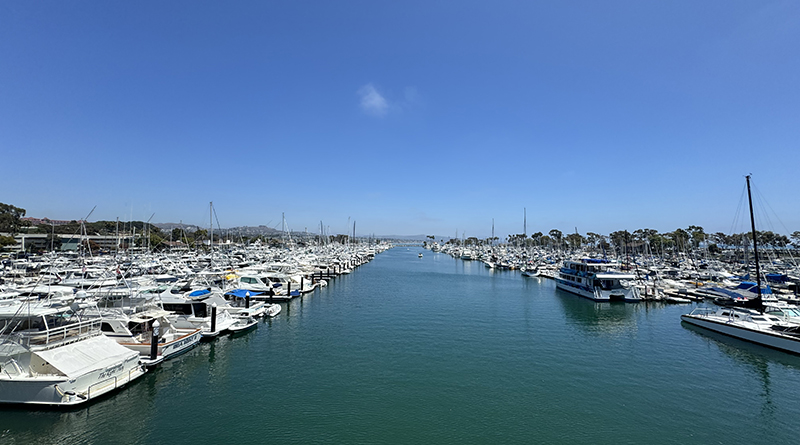
A recent town hall meeting at Dana Point Harbor brought together boaters, county officials, and project stakeholders for an update on the harbor’s ongoing revitalization. While the evening began with progress reports on construction, the conversation quickly shifted to a more contentious topic: rising slip fees and how they are determined.
Held March 30 outside Coffee Importers, the meeting drew a crowd of engaged harbor users, many of whom expressed frustration over planned rate increases tied to the redevelopment project. At the center of the discussion was a question that has become increasingly important to Dana Point boaters: what exactly defines “market rate” under the county’s lease agreement with Dana Point Harbor Partners?
Orange County Fifth District Supervisor Katrina Foley opened the meeting by outlining recent developments in the harbor revitalization effort, including progress on new docks, hotel construction, and expanded public spaces. The project, which represents a major transformation of the harbor, has been positioned as a long-term investment in both infrastructure and visitor experience. However, as the discussion moved toward marina operations, attention shifted to how those improvements are impacting the boating community.
Under the terms of a 2018 lease agreement, Dana Point Harbor Partners is responsible for setting slip fees based on market rate appraisals. Two separate appraisals have since emerged, each offering a different interpretation of what that market looks like.
One study, commissioned by the county, concluded that Dana Point slip rates have historically been below market value. That assessment was based in part on comparisons to nearby marinas, including Newport Beach and other Orange County locations. A second appraisal, funded by a group of boaters, took a different approach by excluding Newport Beach from its comparisons, resulting in lower market benchmarks.
The differing conclusions have fueled ongoing debate, particularly among local boaters who question whether Newport Beach is an appropriate comparison for Dana Point.
During the meeting, attendees voiced concerns about how the definition of “market rate” is being applied in practice. Darcie Harris, co-chair of the Democratic Women of South Orange County, addressed Foley directly, framing the issue as one rooted in how the market itself is defined.
“I hear what you’re saying, that this is a contract and you don’t have a magic wand to start it over,” Harris said. “I’m also hearing that what defines what you can do is the term ‘market rate.’ And there’s a very simple question that can be asked without making this too complicated. How many boat owners have left this harbor and gone to Newport? None.”
Her comment underscored a broader concern among attendees that the comparisons used in the appraisal may not reflect real-world boater behavior or regional dynamics.
Foley acknowledged the frustration but emphasized the limits of her authority under the existing agreement. According to other sources, she explained that the county does not have the ability to dictate how independent appraisers define the market, nor can it directly control slip pricing under the lease.
“The contract does not allow us to dictate slip fees,” Foley said, according to other sources.
The current rate structure includes planned annual increases of 9 percent over a five-year period, a figure officials said was set between the findings of the two appraisals.
Following the meeting, Foley reiterated that the framework governing slip rates was established prior to her time in office. According to other sources, she said that authority over pricing was intentionally transferred as part of the lease agreement, limiting the county’s ability to intervene.
“They intentionally gave up the power to set the rates because they didn’t want to be in this kind of situation with boaters,” Foley said, according to other sources. “There’s not any legal way for me to reduce the rates.”
Foley also noted that while it may be possible to pursue an additional appraisal, doing so would require approval from the Orange County Board of Supervisors and may not produce a different outcome. Market conditions could have shifted since the previous studies, potentially resulting in even higher benchmarks.
“My goal has always been to be transparent, fully disclosing, even when the information isn’t something people like,” Foley said, according to other sources. “I’m doing my best to try to negotiate, to keep the rates low, but that’s all I have.”
For many boaters, however, the issue extends beyond the percentage increases themselves. Bob Langen of the Dana Point Boaters Association said the core of the debate lies in how the market is defined within the lease.
“The whole debate boils down to a couple of sentences in a 270-page contract,” Langen said. “It says Dana Point Harbor Partners has to use a market appraisal, but it doesn’t define what that market is.”
Langen pointed out that the appraisals may not fully account for how boaters actually make decisions about where to keep their vessels.
“It’s not just about prices,” he said. “It’s about where people actually go. When people leave Dana Point Marina, where do they go? Who are you competing against?”
He also criticized the reliance on Newport Beach as a primary comparison in the county-commissioned study.
“The first guy just said he knew what the market was, that the only competition is Newport Beach,” Langen said.
In addition, Langen noted that the lease agreement does not specify what criteria should be used to evaluate the quality or reliability of an appraisal, leaving room for differing interpretations.
On the other side of the discussion, representatives from Dana Point Harbor Partners emphasized that pricing decisions are reviewed regularly and adjusted based on demand. Joe Ueberroth, founder and president of Bellwether Financial Group and a partner in the development group, said occupancy levels remain a key factor in determining rates.
“Honestly, we look at it every year,” Ueberroth said. “We want to have a full harbor, and if we’re not full, that’s going to have an impact. The market will speak to that.”
He added that the group is prepared to respond if higher rates begin to affect occupancy.
“If you run a business and you raise your prices and no one comes in, what are you going to do?” Ueberroth said. “You’re going to look at yourself and go, ‘We’ve got a problem.’ And if that’s what the market tells us, we’re going to have to react.”
Ueberroth also addressed the financial realities behind the redevelopment project, noting that the effort is supported by significant financing.
“I’m committed to having a full marina,” he said. “If that doesn’t happen, we’re going to readjust our thinking. We have a $320 million loan, and there are a lot of stipulations that come with that. We can’t go bankrupt.”
Despite concerns from some boaters, Ueberroth said the intention is not to match the higher rates seen in neighboring harbors.
“If we raised rates to Newport levels, we would not have a full marina,” he said. “That’s not what we’re trying to do.”
Meanwhile, construction on the marina portion of the revitalization project is nearing completion. Ueberroth said new slips have received positive feedback, and additional boater-focused amenities are in development.
“We’re trying to meet the commitment in our lease to build the harbor,” he said. “We’ve gotten positive feedback on the new slips, and we’re close to finishing the marina side. We’re designing boater facilities, working with the yacht club, and we do have funding for that. It’s coming.”
The marina is expected to be completed by the end of next year, aligning with broader regional timelines leading up to the 2028 Summer Olympics.
As the town hall concluded, it was clear that while progress on the physical transformation of Dana Point Harbor continues, questions about affordability and access remain unresolved. For many in attendance, the issue is not simply about numbers, but about preserving a harbor that has long served as a home for a diverse community of boaters.
Additional information, including both appraisals, comparisons between them, and lease amendments, is available on Foley’s Dana Point Harbor revitalization webpage.


One Response
“Market rate” is the rate that someone will pay. As Dana Point Harbor Partners correctly stated, if they charge rates above “market rate”, their slip occupancy will drop, and they’ll have to lower their rates until their slips are fully subscribed. It’s very simple supply and demand.