




Editor’s Note: This story originated from a submission to The Log by John Griffith, a longtime Southern California sailor, marine ecologist, ornithologist, conservation biologist, and creator of FlopStopper. Griffith contacted the newspaper to share the personal story behind his involvement in the Gratiot River Watershed Project, a conservation effort underway in Michigan’s Upper Peninsula. Because his path to that work began with childhood sailing trips from Long Beach to Catalina Island and a lifelong connection to Southern California’s marine environment, The Log chose to focus this article on the boating experiences and Catalina influences that shaped his career and eventually carried those lessons far beyond California.
For John Griffith, Catalina Island was never simply a destination 26 miles across the sea. It was a classroom, a playground and, ultimately, the place that helped determine what he would do with his life.
Griffith, a marine ecologist, ornithologist, and conservation biologist, grew up in Long Beach during the 1960s and 1970s. His first trip to Catalina came in 1966 aboard the Great White Steamer, beginning a relationship with the island that would influence everything from his career in biology to his approach to land conservation and even the creation of a boating product.
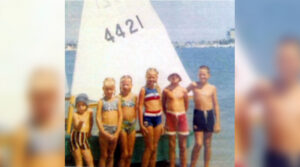
The youngest of six children, Griffith learned to swim and sail at Long Beach Recreation’s Leeway Sailing and Aquatic Center when he was five. His family owned a Cal 24, and summers often meant loading eight Griffiths aboard the sailboat and making the crossing from Long Beach to Catalina.
Emerald Bay became a particularly important part of his childhood. The family would camp there for weeks during the summer, giving Griffith an opportunity to explore an environment dramatically different from the growing city across the channel.
Back home, he spent hours observing Southern California wildlife. He collected marine invertebrates from Alamitos Bay, including nudibranchs, sand stars, bubble snails, crabs and octopuses, temporarily displaying them in what he called his “marine aquarium” before returning them to the water. Through scouting, he also spent time in Southern California’s mountains and the High Sierra.
As Long Beach developed, however, Griffith watched some of the natural areas he knew as a child disappear beneath housing and commercial development.
That made him wonder what might eventually happen to Catalina.
An answer arrived in 1972.
That year, members of the Wrigley family transferred a substantial portion of Catalina Island for conservation, leading to the establishment of the Catalina Island Conservancy. Griffith was 10 years old.
For a child already fascinated by wildlife and worried about disappearing habitat, the decision made an impression that lasted.
Griffith said seeing so much of Catalina protected gave him a sense of relief and helped solidify his decision to pursue conservation biology. Decades later, he would attempt to apply the lesson he took from Catalina to conservation projects of his own.
His education continued at Woodrow Wilson High School in Long Beach, where Griffith credits marine biology teacher C.J. Mertz with providing the scientific foundation for much of what followed.
Sailing remained part of his life as well. Griffith became an early windsurfer and competed as a triangle racer while still in school.
In 1981, he met his future wife, Jane, while she was teaching sailing and he was teaching windsurfing. The couple married in 1984 and graduated from San Diego State University in 1986 — John, with a degree in biology and marine ecology, and Jane with a degree in zoology.
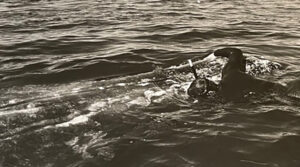
His work also took him farther down the coast. Griffith participated in gray whale research in Baja California and eventually established Griffith Wildlife Biology with Jane.
The couple became involved in endangered bird recovery in Southern California, including work involving the Least Bell’s Vireo, California Gnatcatcher and Southwestern Willow Flycatcher. Among their areas of specialization was controlling Brown-headed Cowbird parasitism, which can threaten native songbird reproduction.
Yet the influence of Catalina continued to follow Griffith even when his work moved beyond the island.
It also led, in a much more practical way, to an invention familiar to some boaters.
Griffith is the creator of FlopStopper, an anti-roll device designed to reduce uncomfortable rolling while a boat is anchored. According to Griffith, the inspiration came from numerous sleepless nights aboard the family sailboat at Emerald Bay.
In other words, even one of his business ventures can be traced back to nights spent aboard a boat at Catalina.
But his largest attempt to carry the island’s influence forward would eventually take place more than 2,000 miles away.
In 1987, John and Jane moved to Michigan’s Upper Peninsula, where they began acquiring land while continuing their biological consulting work. Their goal wasn’t simply to establish a home, Griffith said, but to pursue conservation on a much larger scale.
He viewed it as a way of paying forward the example he had witnessed on Catalina as a child.
In 1992, exactly 20 years after the Catalina Island Conservancy was established, the Griffiths founded Keweenaw Natural Areas, an all-volunteer nonprofit organization focused on protecting land in the Gratiot River watershed and along the Lake Superior shoreline.
They began by donating 80 acres.
Over the following decades, the organization assembled what became the Gratiot River Conservation Area. By 2025, the protected area had grown to more than 4,100 acres stretching inland from Lake Superior.
Griffith and his family also pursued conservation independently. A separate property known as the Keweenaw Lakeshore Forest eventually grew to 1,915 acres, including more than a mile of Lake Superior shoreline and the Turtle Lake wetland complex. In 2022, the Griffiths placed a permanent conservation easement on the property intended to prevent future subdivision and development.
For Griffith, protecting those properties represents the same principle that captured his attention on Catalina decades earlier: land can be worth preserving precisely because of what doesn’t get built on it.
That philosophy has now grown into his most ambitious conservation effort.
Griffith is involved with American Songbird Management & Recovery and the Gratiot River Watershed Project, an effort to acquire 17,315 acres in Michigan’s Upper Peninsula.
The property includes much of the Gratiot River watershed, miles of river and tributaries, forest habitat and recreational trails. According to project organizers, the area supports hundreds of bird species as well as North Woods wildlife including black bears, wolves, bobcats, foxes and other mammals.
The proposed acquisition also would connect with existing protected property, creating a considerably larger contiguous natural area.
The price tag is $30 million.
According to Griffith, approximately $21 million has been raised, leaving $9 million needed by December 2026 to complete the acquisition.
For The Log readers, however, the significance of Griffith’s story isn’t simply a conservation campaign taking place in Michigan.
It’s where the campaign began.
Long before there were thousands of acres, conservation easements and multimillion-dollar fundraising goals, there was a kid from Long Beach aboard a Cal 24 headed for Catalina.
There were tide pools and kelp forests. There were marine animals collected from Alamitos Bay and returned after a morning of observation. There were sailing lessons, windsurfing races, and weeks spent at Emerald Bay. Later, there were gray whales in Baja, and a career studying the wildlife of Southern California.
And there was an island that Griffith saw protected while he was still young enough for that decision to help shape what he believed was possible.
More than 50 years later, he’s attempting to apply that lesson on a very different shoreline.
The distance between Catalina Island and Lake Superior may be measured in thousands of miles, but for Griffith, the connection between the two is considerably shorter.
It began with a sail across the channel.

One Response
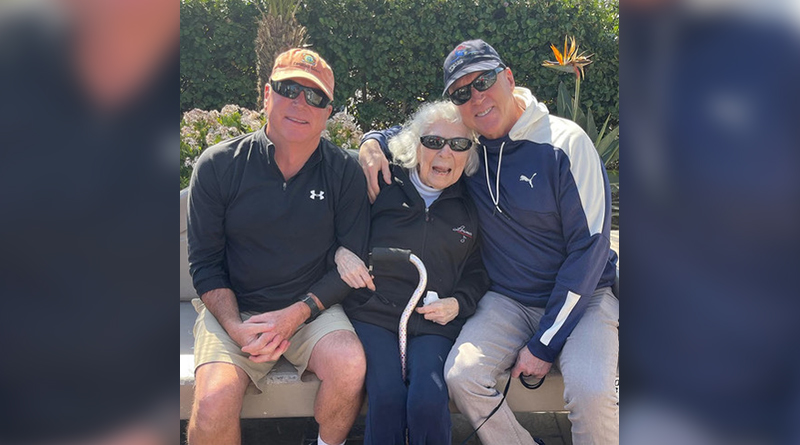
Thank you for a wonderful article! My hope is that others who appreciate Catalina and the Wrigleys will help me “pay it forward” by contributing at http://www.AmericanSongbird.org btw the pics are my brother William and me with our beloved Mrs. Williams (we both had her for 2nd grade, 6 years apart) on the occasion of her 100th birthday; us 6 Griffith kids at Leeway with our Naples Sabot “Shoe Fly”; and me swimming with the second ever friendly Gray Whale in Laguna Guerrero Negro, BCS.